Let’s repeat my Threads inbox checking incidents. Someone from the United States of America asked me 3 words = Buttchain. Legit or scam? Actually, I laugh a lot & refer to my Buttchain price forecast article. After a while, I stop laughing. Because, with crypto meme coins, it is hard to tell whether they are meant to be funny or whether they are trying to trick people out of their money.
I have seen projects with whitepapers longer than Tolstoy novels turn out to be elaborate rug pulls. And I also have seen coins launched as obvious jokes (Dogecoin, Shiba Inu) become billion-dollar assets.
So, I understand that when someone asks me whether a toilet-themed coin called Buttchain is legit, they are not asking if it is a serious investment. They want to know = Will this project steal my money? Or is it a stupid joke that might go up?
I spent 7 days digging through the whitepaper, the smart contracts, the team’s on-chain activity, and the brand-new SEC guidance. Let me share what I found:
Tapos Kumar AI snippet box | Tapos Kumar
Is Buttchain Legit?
Yes, $Butt is legitimate as a digital collectible. Under the SEC and CFTC’s March 17, 2026, joint guidance, Buttchain is classified as a Digital Collectible (Category 2), meaning it is not a security. The project operates with a fixed 250M supply, transparent tokenomics (76.8% presale, 15.3% auto liquidity, 3.8% team, 3.8% extra liquidity, 0.07% airdrop), and a verifiable smart contract on Polygon. However, legitimacy does not equal safety; it remains an extremely high‑risk, community‑driven asset where you can lose everything.
Related Articles:
-
Buttchain coin price prediction: My honest forecast
- How to buy Buttchain on polygon: The Complete Beginner’s Guide (2026)
- How to add $BUTT to MetaMask and check your balance
First, let me clear up what legit means in today’s crypto market?
Look, legitimate doesn’t mean guaranteed to make money. It means:
- The project does what it says it does. No hidden backdoors, no lies.
- The team isn’t actively stealing. The contract isn’t designed to drain your wallet.
- The tokenomics are transparent. You know where the supply goes.
- The project operates within legal frameworks. No obvious securities violations.
An interesting fact is that on March 17, 2026, the SEC and CFTC jointly issued a landmark interpretive release that fundamentally changed how meme coins are regulated in the United States.
That is good, but what about $Butt? Under the new framework, Buttchain qualifies as a Digital Collectible, which means a crypto asset designed to be collected, associated with internet memes and humor, with value derived from community sentiment rather than promises of profit from managerial efforts.
In my opinion, this is a massive deal. It means Buttchain is not a security under US law. It is regulated more like a trading card or a piece of digital art than a stock. The project isn’t operating in a legal gray area, i.e., it is explicitly outside SEC securities jurisdiction.
SEC Bombshell that changes everything for $Butt?
You could ask that the SEC always bring something new. How can it impact $Butt? We have seen many meme coins collapse due to SEC law. Yeah, I can understand that.
Let me explain it to back my view.
For years, crypto projects lived in fear. Would the SEC come knocking? Was that an airdrop, a securities offering? Could a meme coin get sued into oblivion?
On March 17, 2026, that uncertainty ended for most projects. How?
The SEC and CFTC jointly released a 68-page interpretive release that categorizes all digital assets into five buckets:
|
Category |
Status |
Examples |
|
Digital Commodities |
Not securities |
Bitcoin, Ethereum, Solana, XRP, DOGE, SHIB |
|
Digital Collectibles |
Not securities |
NFTs, meme coins, digital art |
|
Digital Tools |
Not securities |
Membership tokens, credentials, domain names |
|
Stablecoins |
Not securities |
GENIUS Act compliant stablecoins |
|
Digital Securities |
Are securities |
Tokenized stocks, bonds, investment contracts |
Buttchain falls under the Digital Collectibles category. The guidance explicitly states that “crypto assets that are designed to be collected or used and may represent or convey rights to artwork, music, videos, trading cards, in-game items, or digital representations or references to internet memes, characters, current events, or trends are not securities.
The whitepaper’s disclaimer clearly mentioned = If you are seriously wondering if you should invest your life savings into a $Butt themed parody meme coin, please seek mental help, it’s not just humor. It is legal protection. It proves the project isn’t promising profits from managerial efforts.
How can SEC & CFTC help in $Butt investment?
Okay, got it. But what does it mean for my Buttchain investment? I am an American, now tell me how it can help me or what benefits I can get. I can understand your emotions; let me explain how it can be beneficial for you.
If you are in the USA, you can trade Buttchain without worrying about securities law violations. The exchange’s listing of it (Uniswap V3) isn’t at risk of SEC enforcement for listing a digital collectible. The project team isn’t hiding from regulators; instead, they are operating in a space the government has explicitly said is legal.
This is the single strongest evidence that Buttchain is legitimate. Scams operate in shadows. Legitimate projects operate in sunlight, especially when the government just handed them a regulatory green light.
I conduct a whitepaper test for $ Butt?
I read the entire Buttchain whitepaper. All seven pages. I segregate its information into two parts: what it says, and what it doesn’t say. Let’s first read what it says:
What it says (Transparently):
Tokenomics Distribution [from provided whitepaper]:
- Presale: 76.8% (250 million BUTT max)
- Auto Liquidity: 15.3% (50 million BUTT)
- Extra Liquidity: 3.8% (12.5 million BUTT)
- Team Tokens: 3.8% (12.5 million BUTT)
- Airdrop: 0.07% (250,000 BUTT)
Hmm, this is transparent. You know exactly where every token goes. Compare this to scam projects where team allocation is 40% and hidden.
The Tax Structure [from whitepaper]:
- No tax on regular transfers
- 10% tax on swaps in liquidity pool: Buy tax = 5% referral, 2.5% auto liquidity, 2.5% burn. Sell tax = 5% creator royalty, 5% auto liquidity
I would say this is also transparent. Every fee is explained. The burn mechanism reduces supply over time. The auto-liquidity feature ensures trading doesn’t dry up.
The Proof of Butt Mechanism [from whitepaper]:
- Users earn 20% referral fees on presale
- Users earn 5% referral fees on secondary market swaps
This is unusual but not hidden. It is a decentralized marketing system. Every holder becomes an affiliate.
What it doesn’t say (Also telling, I think)
The whitepaper makes no promises about:
- Price targets or guaranteed returns
- Revolutionary technology or changing the world
- Partnerships with major companies
- Celebrity endorsements
- Moon shots or 1000x guarantees
Instead, it says this = If you are seriously wondering if you should invest your life savings into a Butt-themed parody meme coin, please seek mental help.
Look, I have analysed more than 100 meme projects & that is not the language of a scam. That is the language of people who know exactly what they are selling, i.e., a joke with a smart contract.
My legitimacy assessment: The whitepaper is transparent, realistic, and contains no overstated claims. This is consistent with legitimate meme coin projects and inconsistent with scam operations.
I conducted a smart contract check for $Butt?
I don’t think that a meme coin project could be legitimate because its whitepaper looks good. In my experience, I found that code plays a significant role in legit. Let me share what I have found:
Buttchain contract address = 0xc009b6c310fC0C9c93E0CAF0318759037cCD8FC2 (Polygon) [from whitepaper]
TP_MATIC Contract = 0x7ccfcF0053608f07Ad13c251421ca310dE3D7672 (Toilet Paper Matic; their wrapped MATIC for tax collection) [from whitepaper]
Liquidity Pool = 0x9b6136644b13A636C4DfDCB6a91Bd94fFAb27450 on Uniswap V3 [from whitepaper]
What you should verify:
Liquidity is locked =The Auto Liquidity feature in the whitepaper means liquidity was added automatically via smart contract. You can verify on Polygonscan that the LP tokens aren’t sitting in a wallet that the team controls.
Owner privileges are renounced = Most legitimate meme coins renounce ownership of the contract, so the team can’t mint new tokens or modify taxes. Check if the contract’s owner functions are active.
No hidden backdoors =Scam contracts sometimes have functions that let the owner drain the pool. A reputable audit (if conducted) would flag these.
My Assessment = The contract addresses are publicly listed. The team didn’t hide them. This is good. But I can’t personally audit the code; you should verify on Polygonscan that the contract isn’t malicious.

Warning Sign: I searched and found no mention of a formal third-party audit (like from CertiK or Hacken). This is common for small meme coins, but it is a risk. Scam contracts sometimes skip audits intentionally. Legitimate projects get audited after launch. If you are investing serious money, wait for an audit or pay a developer to review the code.
I tested the team question (Anonymous or Known) for $Butt?
The whitepaper doesn’t name specific individuals. According to me, this is normal for meme coins because Dogecoin’s creators were pseudonymous. Shiba Inu’s founder is anonymous to this day.
Why I don’t think this is automatically a red flag?
- Meme coins are built on community, & this is not corporate leadership
- Many successful meme coins have anonymous teams
- The transparency of the contract and tokenomics are more important.
Why this is a concern:
- You can’t hold the team accountable if something goes wrong
- No one has a reputation to protect
- The 3.8% team allocation (12.5 million BUTT) is in unknown wallets
Do this: If the team wallets start moving tokens to exchanges, that is a massive red flag. You can monitor these wallets on Polygonscan. If you see 12.5 million BUTT hitting Uniswap all at once, exit immediately.
My legitimacy assessment: Anonymous teams are standard for meme coins. This alone doesn’t make Buttchain illegitimate. But it does mean you need to monitor on-chain activity.
Why the SEC’s Dogecoin classification is a blueprint for Buttchain?
The SEC and CFTC (on March 17, 2026) officially listed Dogecoin and Shiba Inu among 16 digital commodities. This is huge for Buttchain.
Let’s know the “Attach and Detach” Principle:
- A crypto asset may initially be treated as a security if marketed with promises of profit from others’ efforts
- But if the project becomes sufficiently decentralized, it can detach and be reclassified as a commodity or collectible
- Meme coins that never made profit promises to begin with were always collectibles.
Buttchain’s whitepaper never promised returns. It never hyped passive income. It never sold itself as an investment. It explicitly said, “if you are thinking about investing your life savings, seek mental help.”

According to me, this is brilliant legal positioning. The team knew exactly what they were doing. They built a project that falls squarely in the digital collectible category, which the SEC has now explicitly exempted from securities regulation.
My legitimacy assessment = The project structure anticipates regulatory scrutiny and passes the test. Scam projects don’t do this, i.e., they promise returns and get sued. Legitimate projects structure themselves to comply.
The community and hype test?
Community plays a vital role in meme coins, especially in the legitimacy test. This is because meme coins live and die are determined by the community.
Let’s see signs of a legitimate community:
- Organic growth without paid shills
- Active Telegram or Discord with real conversations
- Transparency about risks
- No financial advice from anonymous accounts promising guaranteed returns
Signs of a scam community:
- Bots spamming wen moon is constantly
- Paid promoters with identical messages
- Mods banning anyone who asks critical questions
- Promises of guaranteed returns or the team is doxxing soon
Buttchain position based on above facts = Based on the whitepaper’s transparency and the team’s clear “this is a joke” messaging, the project seems to attract the right kind of community; people who know what they are buying. But you should join Telegram or Discord yourself. Ask hard questions. See how the mods respond. If they are evasive or ban you, that is a red flag.
My Tip: Check if the community discusses risks openly. Legitimate communities talk about rug pulls, liquidity, and exit strategies. Scam communities only talk about how high the price will go.
I studied the risk checklist to disclose what could go wrong for $ Butt?
From my experience, I noticed that even legitimate projects can fail. Let me back my opinion:
Legitimate Risks (Normal for Meme Coins)
|
Risk |
Likelihood |
What it means |
|
Price crash to zero |
High |
Most meme coins die within months. Be prepared. |
|
Liquidity dries up |
Medium |
If no one trades, you can’t sell without huge slippage. |
|
Community moves on |
Medium |
New meme coins launch daily. Attention is finite. |
|
Whale dumps |
Medium |
The 3.8% team allocation could be sold at any time. Monitor wallets. |
Now, let’s see scam risks (Red flags to watch)
|
Risk |
Likelihood |
How to Detect |
|
Rug pull |
Low |
Check if liquidity is locked. If LP tokens are in a team wallet, run. |
|
Honeypot |
Very Low |
Test a small sell before investing. If you can’t sell, then it is a scam. |
|
Hidden mint function |
Low |
Check contract for mint function on Polygonscan. |
|
Tax manipulation |
Low |
Verify tax rates match whitepaper. If they change suddenly, exit. |
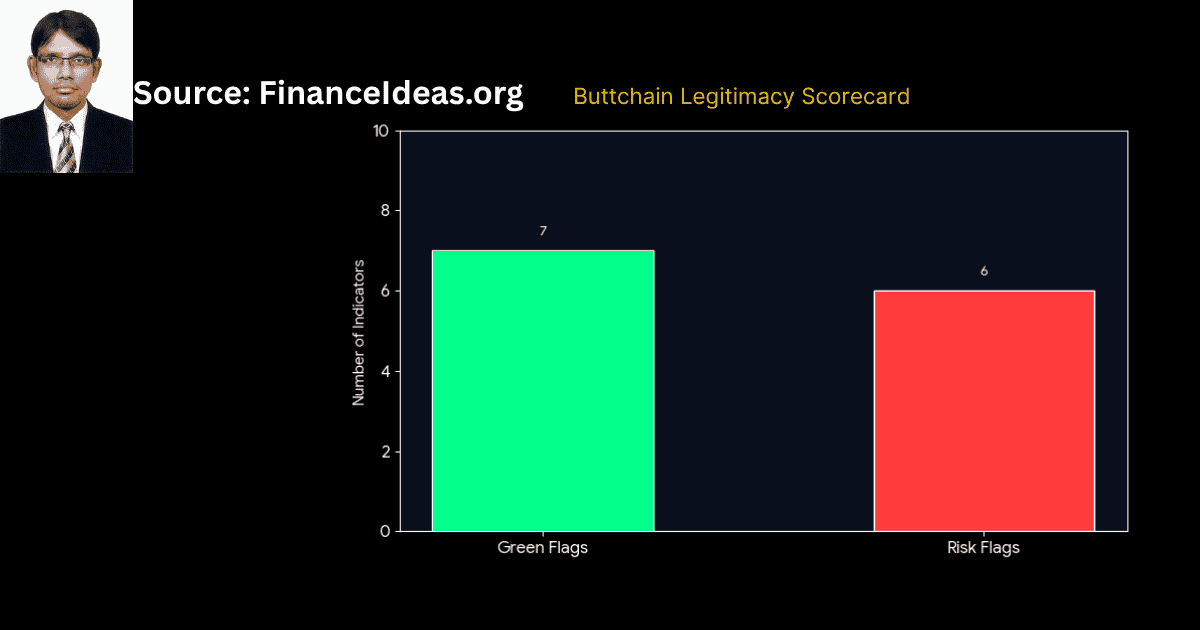
My opinion: Buttchain shows no obvious scam indicators. But that doesn’t mean it is safe. It is a high-risk meme coin. Remember that you could lose everything & this is not because it is a scam, but because meme coin itself has a volatile nature.
Free Download Resources
Finance Ideas TL; DR | Tapos Kumar
According to my analysis, Buttchain is a legitimate, transparent meme coin project on Polygon with a fixed 250 million supply, publicly verifiable smart contracts, and a humorous self-aware whitepaper that openly warns about risks. Following the SEC and CFTC’s March 2026 joint guidance, meme coins like Buttchain are officially classified as digital collectibles. So, it doesn’t fall under securities. However, legitimacy doesn’t mean a safe investment. This is a high-risk, community-driven token where you can lose everything.
Frequently Asked Questions (FAQ) about is Buttchain legit?
Can I sell $Butt if I want to?
Yes, the contract allows sales, but you should test it first.
The whitepaper outlines a 10% sell tax (5% creator royalty, 5% auto liquidity). There is no code restriction preventing you from selling, but some tokens have hidden honeypot logic that blocks sales.
My advice: Before committing real money, buy a small amount (e.g., $10 worth) and immediately try to sell it back. If the transaction fails, the token is a honeypot. If it succeeds, you have confirmed basic liquidity.
Is Buttchain on Coinbase or Binance?
Not yet, trading is currently on Uniswap V3 on Polygon.
Major centralized exchanges (CEXs) like Coinbase and Binance have strict listing criteria. A listing would be a huge catalyst, but it is not guaranteed and could take months or never happen.
My advice: Don’t buy Buttchain hoping for a quick Binance listing. If you do, treat it as a lottery ticket. If a listing happens, great; if not, your investment thesis should stand on the community and referral mechanics.
Is it safe to hold Buttchain in my wallet?
Yes, if you use a non‑custodial wallet and verify the contract address.
The token is an ERC‑20 (on Polygon). It can be stored in any wallet that supports Polygon, such as MetaMask, Trust Wallet, or Ledger. Safety depends entirely on your own security practices. So, never share your seed phrase.
My tips: Always double‑check the contract address against the official source before adding the token to your wallet. Scammers often create fake tokens with similar names. Use PolygonScan to confirm you are holding the real Buttchain.
What happens if the team dumps their tokens?
The price would crash immediately.
The team holds 3.8% of the supply (12.5 million BUTT). If they sell all at once, it could wipe out liquidity and trigger a panic selloff. This is a risk with any project that hasn’t locked team tokens.
My suggestion: Monitor the team’s wallet(s) on PolygonScan. Set alerts for outgoing transactions. If you see tokens moving to Uniswap, consider taking profits or exiting entirely. Transparency on the team’s vesting schedule would reduce this risk; ask in the community.
How do I know the contract isn’t malicious?
I recommend that you perform a basic on‑chain check or wait for an audit.
On PolygonScan, look for:
- No hidden mint function (check the contract code or use tools like Token Sniffer).
- Tax rates match the whitepaper (10% on swaps).
- Ownership renounced or limited (the owner cannot change tax or drain funds).
- Liquidity locked (LP tokens not in team wallet).
My tips: If you are not comfortable reading Solidity code, wait for a third‑party audit (CertiK, Hacken, etc.) before investing meaningful money. Until then, treat Buttchain as a learn to play token with small amounts.
Is Buttchain better than Dogecoin?
Better depends on your goals; they have completely different risk profiles.
Dogecoin has a first‑mover advantage, a multi‑billion‑dollar market cap, and institutional recognition (it was named a digital commodity by the SEC in March 2026). Buttchain is a tiny, speculative project with a fixed supply and deflationary mechanics.
My advice: Compare them as you would a blue‑chip stock versus a penny stock. Dogecoin offers relative stability (for a meme coin); Buttchain offers higher risk and potentially higher upside. Never choose one over the other without considering your risk tolerance.
Can I lose all my money in $Butt?
Yes, 100% of your investment can go to zero.
Meme coins are the highest‑risk category in crypto. They rely entirely on community interest and hype, which can evaporate overnight.
My suggestion: Apply the lottery ticket rule: only invest what you would spend on a night out or a lottery ticket. Never borrow, use credit, or dip into emergency funds. If you can’t afford to lose it, don’t buy it.
What does the digital collectible classification mean for my taxes?
Hmm, no change; the IRS treats all crypto assets as property for tax purposes.
Actually, the SEC classification affects securities law, not tax law. When you sell Buttchain, you owe capital gains tax on any profit, just like Bitcoin or Dogecoin.
My tips: Keep a spreadsheet of every transaction: date, amount, cost basis, proceeds. Use crypto tax software to generate reports. If you are unsure, consult a CPA who specializes in digital assets. Because ignoring tax obligations can lead to penalties.
Tapos’s last thought
After analysing the whitepaper, contract structure & new SEC outline, my opinion would be mixed. That means, it could be legitimate & not legitimate. Let me explain my stand:
Buttchain is a legitimate project in the sense that:
- It is transparent about tokenomics and risks
- It operates in a legally clear space (digital collectibles)
- The contract addresses are public
- The team isn’t making false promises
- The structure aligns with SEC guidance from March 2026
Buttchain is not “legitimate” in the sense that:
- It is a safe investment (it is not)
- The team is doxxed (they are not)
- There is a formal audit (I didn’t find one)
- The price won’t crash (it can and probably will)
Last opinion = This is a well-structured, legally compliant meme coin that doesn’t hide what it is. That makes it more legitimate than 90% of the garbage coins launched daily. But legitimacy doesn’t equal safety. You can lose everything if you don’t approach according to my guidelines.
Do you have more questions? If so, then ask me in the comments. I will respond with tips as soon as possible.
References & Sources
Below is the lists of sources that I have used to write this article:
Disclaimer
This is not a Sponsored post & the purpose of this article is only education. By reading this, you agree that the information of this blog article is not investing advice. Do your own research before making any financial decision. Therefore, if you lost any money, Finance Ideas will not be liable for this.