“I can remember the night I realized I was saving out of fear.”
It was past midnight. I was scrolling through my banking app, heart pounding as I saw my growing savings balance, and yet, I felt nothing but exhaustion.
I wasn’t spending. I wasn’t enjoying life. I was hoarding money like armour against the next layoff or emergency.
Then I understood that saving alone doesn’t fix your life.
What we need isn’t a budget or investment plan. We need a sequence of healing.
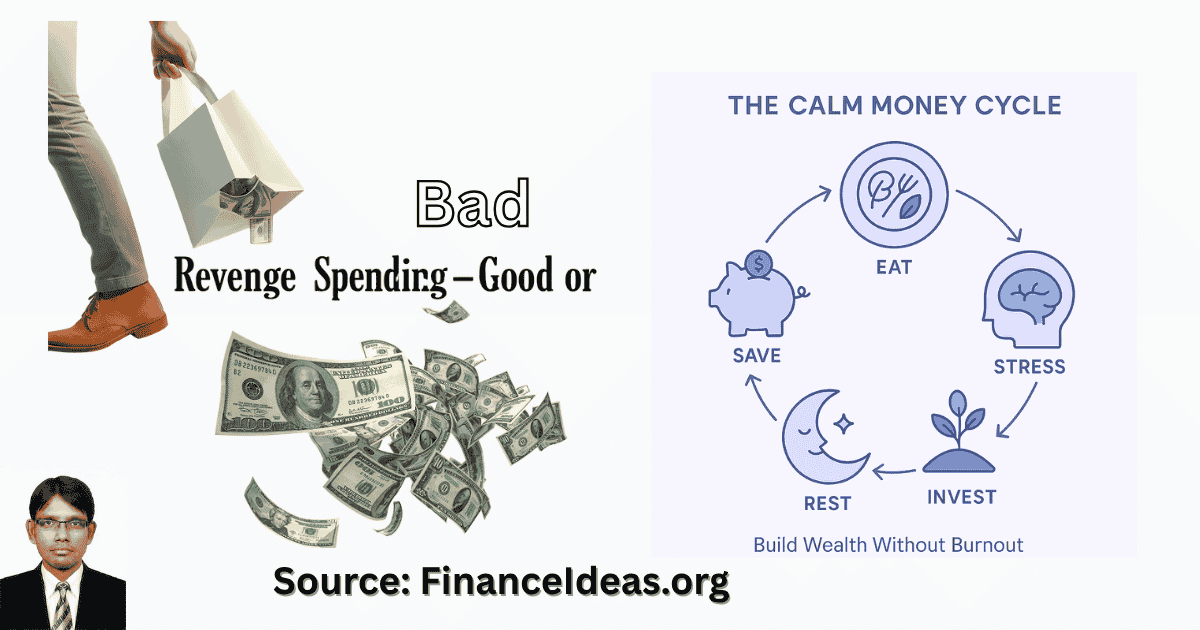
Over the next two years, I went through five phases that rebuilt my relationship with money, food, stress, and rest:
Save → Eat → Stress → Invest → Rest & this is my story.
Today, I am just going to share my personal experience with revenge saving: how I manage it & how I overcome it. My roadmap could be yours too; so, sit & read patiently.
Finance Ideas AI Snippet Box | Tapos Kumar
What happens when you balance saving, eating, stress, investing, and rest?
When each habit supports the next, life stops feeling like a chase.
Saving gives stability, eating fuels clarity, less stress brings patience, investing builds trust, and rest restores focus.
Together, they create a silent, repeating rhythm where money, health, and peace compound naturally without hacks & luck, only better habits looping forward.
My Tip: Bookmark this as your Life Alignment Blueprint; the only five-step cycle that turns survival mode into sustainable calm.
Related Articles
- Rest Smarter, Save Better | Weekly Free Rest Rituals That Improve Your Wallet
-
3 Micro-Breathers That Save $50 a Week: How I Stopped Overspending with a 90-Second Pause Trick
-
Micro-Break Math: Small Pauses, Big Profits
-
Impulse detox 60 second rule: The One-Minute Pause That Works
-
Sleep deprived spending: The Habit Draining Americans’ Wallets
What is Revenge-Saving?
After the pandemic layoffs, many Americans started what I call ‘revenge saving’. It is like revenge spending’s serious older cousin; instead of splurging to feel alive, we save to feel safe.
But I took it too far. I cut subscriptions, quit social outings, and started tracking every dollar like a detective. I was saving not out of purpose but out of fear.
When Saving Becomes Stress?
I would check my account balance five times a day. If I bought a latte, I felt guilty for hours.
Sound familiar? Many of us save so hard that we create the same anxiety we were trying to escape.
The Turning Point
One evening, my mom said:
“You can’t out-save fear, kiddo. You have got to outgrow it.”
That hit me. Saving should build confidence, not control.
How I Fixed It
Automated my savings: 15% of my income went to a “Future Fund” before I could touch it.
Named my goals: “Freedom Fund,” “Travel Jar,” “Calm Cushion.” Each goal had a purpose.
Allowed guilt-free spending: I budgeted $100 per month for “joy purchases.”
These tiny changes transformed revenge-saving into purposeful saving. Within 6 months, I wasn’t scared anymore; instead, I was empowered.
I found the Weird Link Between Food and Finances?
During my revenge-saving phase, I ate like a college kid on finals week: ramen, chips, and caffeine.
Saving money, yes. Saving health, no. Then I noticed something: the worse I ate, the worse I managed stress, sleep, and even spending. A foggy brain makes foggy financial choices.
Small Fixes That Changed Everything for me
- Breakfast became non-negotiable. I started my mornings with eggs and oats instead of coffee alone. My focus and productivity doubled.
- Sunday preparation ritual. I spent 1 hour cooking simple meals: chilli, grilled chicken, and veggie stir-fry. Cheap, healthy, fast.
- Hydration hack. I replaced soda with water & lemon. Sounds minor, but the mental clarity was night-and-day.
My neighbour was a freelancer living on energy drinks. When he started batch-cooking, he saved $200 per month and said, “My anxiety dropped faster than my grocery bill.”
Then, I realized: financial health and physical health are twins. If your body is crashing, your budget will follow.
When Stress Becomes the Silent Debt?
Even after getting my savings and meals under control, stress was still wrecking me.
I would wake up at 3 a.m. thinking about bills, future goals, or worst-case scenarios that didn’t even exist.
Stress was the invisible tax on my life because it stole energy, focus, and joy.
My Breaking Point
One morning, I forgot a friend’s birthday because I was too busy obsessing over my retirement spreadsheet.
Then I realized: I was managing numbers better than I was managing myself.
How I Learned to Unwind Without Guilt
- The 10-Minute Money Worry Rule. I gave myself 10 minutes each evening to think about money, then shut it down.
- Micro-breaks. Every 90 minutes of work, I took 3 minutes to breathe, stretch, or look out the window.
- Digital curfew. No phone or financial apps after 9 p.m.
In a month, my sleep improved. My decisions became sharper. I even spent less because I wasn’t chasing stress relief through impulse buys.
How Stressed Are You About Money? (Take this short quiz now)
- Do you check your bank account more than twice a day?
- Do you feel guilty spending on small joys?
- Do you wake up thinking about bills?
- Do you avoid checking statements because it makes you anxious?
If you answered “yes” to more than 2 questions, your stress is spending your energy before your money ever does.
From Saver to Investor: The Scariest Leap?
I used to think investing was for people with fancy degrees or big paychecks. I was wrong.
The truth: you don’t invest when you have a lot, instead you invest to get a lot.
When I first transferred $500 into an index fund, my hands literally shook.
But something magical happened; I realized that money wasn’t leaving me; it was working for me.
My Simple 3-Step Investing System
- Start small, but start now. $50 or $100 a month is enough to build momentum.
- Automate everything. I set up automatic contributions to my Roth IRA and ETF portfolio every payday.
- Forget it (mostly). I stopped checking the market daily; once a month was plenty.
Within 2 years, I had built a 5-figure portfolio without stressing over day trading.
One of my friends invested $500 per month starting at 29.
After 5 years, his portfolio grew to over $100K, not through risky plays, but through consistency.
He told me, “The toughest part wasn’t investing; it was trusting the process.”
What I Learned
- Investing isn’t about beating the market. It is about beating your own fear.
- The goal isn’t wealth for luxury; it is wealth for peace.
- Smart investing is emotional stability in spreadsheet form.
Resting Is Productive
For years, I treated rest like a reward; something I had to earn.
But burnout taught me the opposite: rest is part of the work.
Without rest, you spend your energy faster than your paycheck.
How I Relearned Rest
- Scheduled rest like meetings. Saturday mornings = phone-off time.
- Micro-naps over endless coffee. 15 minutes recharges more than another espresso.
- Nature therapy. Walking by the river taught me that peace doesn’t cost money, but attention does.
The Rest-Invest Connection
Once I started resting intentionally, I noticed my investing decisions improved.
Rest made me patient, and patience made me profitable.
The Moment Everything Clicked
One evening, I looked at my financial dashboard and felt calm.
That was not pride or fear, only calm.
Then I knew I wasn’t only saving or investing, I was living.
How does Everything in my Life Connect?
If there is one thing I have learned, it is that nothing in life stands alone.
Your money, your food, your stress, your rest, they are all threads in the same fabric.
Back when I was chasing financial control, I thought fixing my bank balance would fix my peace.
But later realized: every part of life whispers to the other. When you heal one, you heal them all.
When you save with intention, you stop panicking over the future, and that calm spills into your daily choices; you eat better because you finally believe you deserve nourishment.
That energy shift helps you handle stress like a person in charge, & not in survival mode. You make decisions with simplicity instead of fear.
From there, you invest not only money but also trust in yourself, your goals, and your future.
And for the first time, you can rest without guilt. Real rest. The kind where your shoulders drop and you actually breathe again.
Then something subtle but beautiful happens: rest refills the tank that was once drained. You start saving again, but this time, it is not revenge. It is readiness.
This is how I found balance grows: not in big things, but in small, connected circles that keep me becoming someone steadier, freer, and finally at peace.
Finance Ideas TL; DR | Tapos Kumar
Financial peace isn’t about becoming rich; it’s about becoming ready.
When you save with intention, eat to stay strong, manage stress with awareness, invest calmly, and rest without guilt — your entire life begins to breathe easier.
It’s not one big decision; it’s a rhythm of small, honest choices that keep looping back to support you.
Start where you are. Your goal should not be perfection; instead, it is progress that feels peaceful.
Remember: Freedom isn’t a number in your bank account — it is the moment you stop negotiating with your anxiety.
Frequently Asked Questions (FAQ) about revenge saving eat stress invest rest?
What if I can’t save much every month?”
Start anyway, even $10 is enough.
Remember that saving is not about the amount; it is about identity. When you save, you are voting for your future self, not your current paycheck.
I started with $12 a week. It felt small until I realized it wasn’t money I was growing; it was trust.
My Tip: Create an auto-transfer for a number so small it feels almost silly. Once you forget it is leaving, you have won the first battle, consistency.
Should I pay off debt before I start saving?
Do both, just not equally.
Debt is like a leak in your roof; savings is like the umbrella you carry till you fix it.
I kept $800 in an emergency fund while paying off my credit cards. That small cushion kept me from taking on new debt every time life got messy.
My Tip: Hit pause on perfection. Build a mini safety fund first, then throw every extra dollar at debt.
Isn’t eating healthy expensive?
It is expensive to stay tired and sick.
Healthy eating doesn’t mean organic everything; it means consistent nourishment.
When I swapped fast food for meal prepping, I saved $60 a week, and my focus came back.
My Tip: Pick 5 repeatable meals that are cheap, balanced, and take under 20 minutes. Keep ingredients simple & your goal should be energy, not Instagram aesthetics.
What is worse, stress or burnout?
Stress whispers; burnout screams.
Stress can be useful when it motivates you to act. Burnout happens when you ignore it for too long.
I used to think I could “push through”, until I started forgetting why I was pushing.
My Tip: Watch your warning signs: caffeine dependence, short fuse, constant fatigue. Don’t wait for collapse to take a break; schedule rest like a meeting.
When should I start investing?
Before you feel ready.
If you can save, you can invest. Waiting for the “perfect moment” is how most people lose five years.
I began with $100 a month in a simple index fund. I didn’t understand everything, but I understood time.
My Tip: Automate small, regular contributions. It is better to invest imperfectly for 10 years than to invest perfectly for 2.
How much rest is actually enough?
Enough is when you stop waking up angry at the alarm.
Rest isn’t about hours; it is about recovery. I used to sleep eight hours, yet I still feel drained because my brain never logs off.
My Tip: Take one “tech-free hour” before bed. There would be no phone, no screens, no scrolling. Actual rest starts when your mind stops rehearsing problems.
Is revenge-saving unhealthy?
Only if you stay stuck in it.
Revenge-saving is powerful fuel, at first. It comes from fear, but it can evolve into focus if you let it.
The problem is when it turns into hoarding safety instead of building freedom.
My Tip: Once you have hit your first financial goal (say, $5K), redirect that energy toward living, i.e., travel, learning, investing. Remember, safety is a foundation, not a fortress.
How do I stop feeling guilty when I spend money?
Spend on purpose, not impulse.
Guilt comes from confusion about whether your spending aligns with your values.
When I created a “joy budget,” I stopped second-guessing my choices. A latte wasn’t wasteful anymore; it was intentional comfort.
My Tip: Rename one budget category “What Makes Me Feel Alive.” If you plan your pleasures, you will stop punishing yourself for them.
What if I have already started investing but feel stuck?
Check your emotions, not only your portfolio.
Sometimes “stuck” isn’t about money; it is about mindset. I once paused all investments, thinking I would hit a ceiling, but what I really needed was sleep.
My Tip: Before changing strategy, take a week off market-watching. Walk, read, breathe. Simplicity costs less than panic.
Can this framework work for couples?”
Yes, if you play as a team, not opponents.
Money fights happen when one person saves for safety while the other spends for relief.
My partner and I started doing “Sunday money dates.” We laughed, argued, compromised and got on the same page.
My Tip: Combine transparency with autonomy. One shared account for goals, one personal account for sanity. Focus on balance, not control, to keep love alive.
What if I am deep in debt and can’t see the end?
Start with the smallest victory, not the biggest battle.
When you pay off even one small debt, your brain releases motivation like oxygen.
I paid off a $200 store card first; it changed nothing financially, but everything emotionally.
My Tip: Stack small wins. Momentum is the antidote to despair.
How do I keep the motivation once the excitement fades?
By tracking progress, not perfection.
There is a calm joy in seeing how far you have come, even when you are not “there” yet.
When I started noting each mini-win; $100 saved, one rest day taken, one meal cooked, my motivation became self-sustaining.
My Tip: Write your wins somewhere visible. Success grows quicker when it is seen daily, not only felt occasionally.
Tapos’s last thought
Imagine one morning, you wake up and your first thought isn’t panic.
There is coffee brewing, sunlight slipping through the blinds, and your phone isn’t buzzing with overdue reminders.
You are not rich; you are ready.
Your bills are handled because you learned to save without fear.
Your energy feels steady because you chose to eat with intention.
Your mind isn’t racing because you have learned to breathe through stress instead of breaking under it.
Your money is silently working for you because you invested in calm without chaos.
And your weekends finally feel like weekends, because you let yourself rest.
This is not actually luck, and it is not fantasy.
It is the result of small; kind choices repeated until peace becomes your new default.
If you remember one thing from this journey, let it be this:
The goal was never to escape life’s noise; instead, it was to learn your rhythm within it.
Because when you are financially grounded, emotionally fed, and finally rested, that is not only success. That is freedom you can feel.
References & Sources
Below is the lists of sources that I have used to write this article:
- Securities and Exchange Commission (SEC)
- Federal Reserve – Consumer Resources
- Investor Education Foundation – Building Financial Wellness
Disclaimer
This is not a Sponsored post & the purpose of this article is only education. By reading this, you agree that the information of this blog article is not investing advice. Do your own research before making any financial decision. Therefore, if you lost any money, localhost/bloghub/ will not be liable for this.