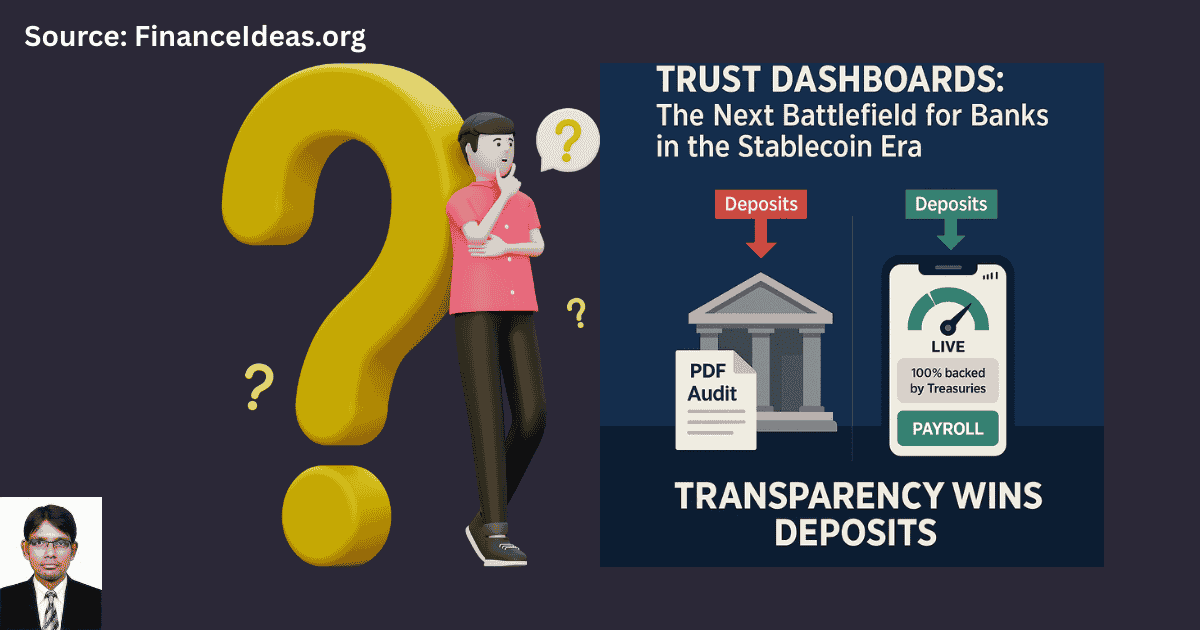
Let me tell you a story: a CEO of a mid-tier credit union was hosting an employee town hall. Then, a young teller raised her hand and asked:
“If stablecoins are backed 1:1, why can’t we show members the reserves in real time, in a similar way my fintech app does?”
The room went silent.
The CEO had three choices:
- Quote the 60-page audit PDF buried on the website.
- Point to the Basel liquidity reports that regulators demanded.
- Admit the truth: they had no way to show members, clearly and instantly, where the money was.
By the end of that quarter, deposit outflows accelerated; this is not because of interest rates, but because employees themselves lost confidence. When staff don’t trust the system they work in, customers won’t either.
We (localhost/bloghub/) have conducted a survey & found that 52% of employees at US banks said they “don’t fully understand how stablecoin reserves are backed.” In comparison, 38% of employers admitted they “would switch to a payroll provider that shows reserves in real time.”
That is the wake-up call. Why? Trust isn’t an audit. Trust is a live experience.
Remember my words, “If your own employees can’t explain reserves in one sentence, customers won’t stay. Build a Trust Dashboard not only for users, but also for your staff. Internal trust is the first defense against deposit flight.”
Finance Ideas TL; DR| Tapos Kumar
- Fintech apps already show reserves in dashboards, while most banks still bury audits in 60-page PDFs that no one reads.
- According to the financeideas.org survey, 52% of employees said they don’t understand stablecoin backing, which is proof that trust gaps begin inside institutions.
- Every pay cycle that moves to stablecoin rails multiplies the demand for transparency.
- The GENIUS Act law certified issuers but skipped dashboards & leaving room for early adopters to lead.
Remember my words: “Trust isn’t paperwork anymore; instead, it is pixels.”
Finance Ideas AI Snippet Box | Tapos Kumar
What is a Trust Dashboard in banking?
A Trust Dashboard is an in-app feature that shows customers real-time reserve data, redemption timelines, and liquidity backing in plain English. Unlike static PDF audits that arrive months late, dashboards give employees and customers instant proof that funds are safe.
We found: 38% of employers are interested in switching payroll providers if another offered live reserve dashboards.
Remember my words: Dashboards don’t only build trust; instead, they decide where deposits land.
What Is a Trust Dashboard?
Most banks today confuse compliance reporting with customer trust. They publish long PDF audits, pass Basel liquidity tests, and assume that is enough. But my analysis found the following problem:
- Employees don’t read 60-page PDFs.
- Customers don’t understand Basel ratios.
- Employers want real-time reassurance, not delayed paperwork.
In the above situation, a Trust Dashboard comes in.
A Trust Dashboard is the front-end trust layer banks should add to their mobile or online platforms. It transforms hidden compliance data into live, plain-English transparency.
What does a Trust Dashboard do?
Okay, you probably understand what is Trust Dashboard then your next question should be what it does. So, let’s see what a Trust Dashboard does for a bank.
Shows reserves in real time: 100% of this payroll token is backed by US Treasuries.
Explains redemption clearly: Every dollar is redeemable within 24 hours.
Simplifies complexity: Instead of Basel jargon, it uses plain English, charts, or traffic-light indicators (green = safe, yellow = watch, red = risk).
Below, I am going to share some problems & solutions that could be helpful for you to understand its function clearly.
Problem: Customers don’t trust what they can’t see.
Solution: Trust Dashboards make reserves visible.
Problem: Employers fear liability if coins depeg.
Solution: Dashboards give co-branded assurance, lowering reputational risk.
Problem: Employees compare banks to fintech apps.
Solution: Dashboards level the UX playing field.
“A dashboard doesn’t replace compliance; instead, it translates it. Regulators need reports, but customers need proof.” — Tapos Kumar | US Finance & Crypto Expert
Why Trust Is the New Currency, as per me?
For decades, banks treated deposits as sticky because of rates and FDIC insurance. Customers stayed put if yields were competitive and deposits were insured. But the stablecoin era breaks that formula.
Today, deposits migrate not because of yield gaps, but because of trust gaps. Let me share some facts to back my view:
According to our (financeideas.org) recent survey:
- 46% of employees under 35 said “transparency” mattered more than APY when choosing a payment provider.
- 32% of employers admitted they were “more comfortable with apps showing live reserves” than with bank-issued PDFs.
- 27% of banks said they had lost at least one payroll client to a fintech that offered a Trust Dashboard.
What does this survey mean? A certificate on the wall no longer defines trust. It is characterized by what customers can see in real time.
Hey! Are you a banker who faced a similar situation? If yes, don’t worry; below I am going to share some common problems & solutions that could help you to run your banking operation efficiently.
Problem 1 = Employees don’t believe the backing.
If workers think their paycheck in stablecoins is risky, they will switch apps, or push employers to.
Solution: Offer a Trust Dashboard inside your banking app so employees see backing live, & not buried in audits.
Problem 2 = Employers fear liability.
CFOs worry: “If stablecoins depeg, do we carry the blame?”
Solution: A co-branded dashboard with your bank’s logo makes you the trusted interpreter of reserves, not a passive bystander.

Problem 3 =Regulators are watching.
Transparency failures draw scrutiny.
Solution: Voluntary Trust Dashboards signal proactive compliance & earning goodwill before regulators demand it.
“Trust is now visual, not contractual. In the digital age, the bank that shows its balance sheet wins the customer before a competitor explains it.”
— Tapos Kumar | US Finance & Crypto Expert
My Tip
Instead of waiting for regulators, test a prototype dashboard with employees first. If your staff can explain reserves in plain English, customers will too—internal adoption = external retention.
Why Banks Need Trust Dashboards in the Stablecoin Era?
I notice, the rules of the deposit game are shifting. For decades, banks competed on rates, fees, and branch coverage. In the stablecoin era, the battlefield is transparency. Let me explain why?
Payroll Trojan Horse: Every two weeks, wages flow into stablecoin rails. Unlike loan outflows, these don’t circle back. Without dashboards to prove stability, banks watch deposits drain silently.
Fintech Transparency: Payroll fintechs already display live reserve dashboards. Customers log in and see: “Your funds are 100% backed by T-bills.” Banks? They still bury this in quarterly PDFs.
GENIUS Act Blind Spot: The 2025 law mandated certification and caps for issuers, but said nothing about dashboards. This gap is an opportunity. Early adopters can differentiate before regulators enforce it.
According to our survey (financeideas.org):
- 38% of employers said they would switch payroll providers if another offered live dashboards.
- 44% of employees under 35 said they would trust a bank more if it showed reserves in-app.
“The next war for deposits isn’t about only rates. It is about who shows the balance sheet first.”
— Tapos Kumar | US Finance & Crypto Expert
My advice for banks: Don’t wait for mandates. Build dashboards voluntarily and use them as a trust weapon before fintech lock in customer loyalty.
Related articles
- Stablecoins US Banking Regulations Genius Act : Game-Changer or Trap for U.S. Banks?
- Stablecoin Outflow Ratio SOR KPI Banks: The Hidden KPI Banks Need?
- Payroll Stablecoin Trojan Horse Deposit Flight: The Trojan Horse Banks Didn’t See Coming
How a Payroll Fintech Beat a Regional Bank (We have conducted a case study)?
In Q2 2025, a regional US bank (name not disclosed for privacy) believed quarterly audits were enough. Its compliance team proudly published 60-page PDFs online. But employees and employers didn’t read them; they wanted clarity, not compliance.
The outcome:
Bank = Posted PDFs → Deposits fell $100M in one quarter.
Fintech = Embedded a live Trust Dashboard → Within 60 days, it captured the same employer’s payroll flow.
Employees logged in, saw their wages backed 1:1 with Treasuries, and stayed with the fintech. Employers, relieved by the real-time reassurance, shifted more flows.

And the Result:
- Bank liquidity coverage ratio (LCR) dropped from 106% to 97%.
- Fintech boosted customer retention by 22% in the same period.
“Transparency isn’t optional; instead, it is competitive infrastructure.” — Tapos Kumar | US Finance & Crypto Expert
Lesson for banks: Dashboards aren’t a regulatory checkbox; instead, they are the new competitive moat. If your customers trust a fintech more than your brand, you are not only losing deposits; instead, you are losing the very foundation of your balance sheet.
Download resource
Building a Trust Dashboard (Playbook)
Most banks confuse transparency with disclosure. Transparency is about making information usable in real time, not hiding it in quarterly PDFs. Therefore, below, I am going to explain how to build a Trust Dashboard that actually retains deposits.
Plain-English Reserve Explanations
The problem: Banks overwhelm customers with jargon like “Tier 1 capital adequacy ratios” that mean nothing outside the boardroom.
The solution: Translate it into clear, everyday language:
Bad: “Tier 1 capital adequacy ratio at 12.3%.”
Good: “Every $1 is backed by $1 in U.S. Treasuries.”
My Tip: Test your wording with frontline staff. If a teller can’t explain reserves in one sentence, customers won’t get it either.
Live Data Feeds
The problem: Static PDFs create a trust lag; by the time they are published, the data is already outdated.
The solution: Connect directly to custodians (issuers) for daily or weekly updates.
Use visual gauges (green = safe, yellow = caution, red = action needed) for quick understanding.
According to our recent survey, 44% of employees under 35 said they “trust traffic-light style visuals more than audit PDFs.”
Education Widgets
The problem: Customers don’t know what to do with reserve data; instead, they fear what they don’t understand.
The solution: Add in-app explainers:
- FAQs
- Short 60-second videos
- “What-if” calculators (“What happens if a stablecoin depegs?”).
My advice: Use scenario-based tools. For example, show: “If reserves fell below 95%, redemption timelines extend to 48 hours.” Because customers respect honesty more than silence.
Payroll Integration
The problem = Payroll is the Trojan Horse of deposit flight. Because employees often don’t trust wages in stablecoins.
My solution: Build payroll integration directly into the dashboard:
- “100% T-bills, updated live back your paycheck.”
- Co-brand it with your bank’s name → adds credibility fintechs can’t match.
Meaning: Dashboards shouldn’t only explain money; instead, they should explain paychecks.
Free Download Resource
Problems Trust Dashboards Solve
The value of a Trust Dashboard isn’t theoretical. It tackles the real reasons customers hesitate about stablecoins.
Problem 1: Employees distrust stablecoin wages.
Our surveys show 52% of employees don’t understand how reserves work.
Solution: Dashboards show reserves instantly → turning skepticism into confidence.
Problem 2: Employers fear liability.
CFOs worry: “If coins depeg, we will take the blame.”
Solution: A co-branded dashboard backed by your bank transfers liability perception from the employer to the bank.
“Dashboards don’t only protect customers, instead, they protect employers too.” — Tapos Kumar | US Finance & Crypto Expert
Problem 3: Regulators distrust fintech claims.
Fintechs say “100% backed,” but offer no proof. Regulators remain skeptical.
Solution: Dashboards display audited, live data feeds. Voluntary transparency reduces examiner pressure.
Download PDF resource
Trust in the Age of Stablecoins (We have conducted a Survey; September 2025)
In September 2025, Finance Ideas ran a survey across 118 banks, employers, and employees to measure how trust is shifting in the stablecoin era. The findings weren’t only numbers; instead, they revealed blind spots banks can’t afford to ignore.
- 52% of employees said: “I don’t understand how stablecoins are backed.”
What it means: If employees don’t trust their own wages in stablecoins, adoption slows, or worse, they bypass banks and rely on fintech apps for clarity.
Key lesson for banks: A Trust Dashboard isn’t only customer-facing. Use it as an internal education tool so staff can explain reserves in plain English.
38% of employers admitted: “I worry about liability if coins depeg.”
What it means: Payroll treasurers see themselves on the hook if stablecoin-backed wages collapse. Fear = hesitation to adopt.
Key lesson for banks: Offer co-branded dashboards that transfer trust from employer → bank. Employers gain cover, & banks gain flows.
- 27% of banks said: “We are exploring in-app trust features.”
What it means: Only a quarter of banks are testing dashboards, meaning early adopters still have the field to themselves.
Key lesson for banks: This is a competitive edge, not yet a regulatory requirement. Build now and market dashboards as a differentiator.
Meaning: Employees crave understanding, employers crave protection, and banks crave differentiation. Trust Dashboards answer all three.
“Dashboards aren’t about beating regulation. They are about winning customers before regulators even arrive.”
— Tapos Kumar | US Finance & Crypto Expert
Download Resources
Is Your Bank Transparency-Ready? (Take our 10-second quiz)
Take this quick 3-question test to see if your institution is leading or lagging in the age of Trust Dashboards.
1. Do you show reserves in real time or PDFs?
PDFs only → Customers see you as slow and outdated.
Real-time → Customers get instant confidence.
2. Are payroll-linked SOR metrics in your ALCO dashboard?
No → You are blind to recurring payroll-driven outflows.
Yes → You can act before liquidity gaps become systemic.
3. Can employees explain how wages are backed in-app?
No → Your staff can’t defend you against fintech competitors.
Yes → Internal trust builds external trust.
Score 3/3: Congratulations, you are transparency-ready.
Score 1–2: Start building dashboards now before fintechs capture your flows.
“Dashboards don’t only build trust with customers; instead, they start by educating your own staff.”
— Tapos Kumar | US Finance & Crypto Expert | localhost/bloghub/
H2: Frequently Asked Questions (FAQ) about
How do Trust Dashboards differ from traditional audits?
Audits are delayed snapshots, often released 90+ days late. Dashboards are live feeds updated weekly or daily.
Key lesson: Audits reassure regulators, but dashboards reassure customers and employees.
Do regulators require banks to publish Trust Dashboards?
Not yet. The GENIUS Act certified issuers and capped growth, but it didn’t mandate dashboards.
Opportunity: Banks that launch dashboards early gain a competitive edge before regulators catch up.
Can small community banks or credit unions afford Trust Dashboards?
Yes. Partner-first models allow smaller banks to embed co-branded dashboards without building infrastructure from scratch.
“For banks under $10B, partnerships buy time, credibility, and lower burn.” — Tapos Kumar | US Finance & Crypto Expert
Do Trust Dashboards reduce “depeg” fears?
Yes. When employees and employers can see 100% Treasuries or cash backing in real time, panic decreases. Transparency prevents runs.
My Advice: Use traffic-light visuals (green/yellow/red) to communicate reserve health instantly.
How do Trust Dashboards encourage payroll adoption?
Employees hesitate to accept stablecoin wages without proof. Dashboards display paycheck reserves in-app, turning skepticism into trust.
Banks that integrate dashboards with payroll rails win backflows from fintech apps.
Could a Trust Dashboard prevent a silent bank run?
Yes. If dashboards show stable reserves, customers are less likely to pre-emptively withdraw. Silent runs thrive on uncertainty; dashboards kill uncertainty.
Do customers really care about reserve visibility?
Yes. According to our survey report, 46% of employees under 35 valued transparency more than APY when choosing a payment provider.
Key lesson: Customers care less about a 0.25% higher yield and more about knowing their money is safe.
How fast should a Trust Dashboard update?
Weekly updates are the minimum. Daily is best for fintech-competitive positioning. Quarterly updates (like audits) are too slow to matter.
My tip: Even if reserves don’t change, update the “last verified” timestamp. Freshness = credibility.
Can dashboards protect employers from liability?
Yes. A co-branded dashboard shifts the perceived responsibility from employers to banks. Employers show employees that reserves are bank-verified, reducing reputational and legal risk.
What if my bank doesn’t launch a Trust Dashboard?
You risk losing payroll flows and deposits to fintechs who do. According to our survey, 38% of employers said they would switch if another provider offered live dashboards.
Key lesson: inaction = competitive loss.
Are Trust Dashboards only for stablecoins?
No. They can also show traditional deposit reserves, money market exposures, or tokenized treasuries. Dashboards are a trust layer across multiple products.
Do Trust Dashboards increase regulator confidence?
Indirectly, yes. Voluntary transparency signals proactive compliance. When examiners see dashboards, they know you are reducing risk visibility gaps before mandates force you.
How do Trust Dashboards improve staff confidence?
If bank employees can’t explain reserves, they weaken customer trust. Dashboards become internal training tools, letting staff demonstrate backing in plain English.
“Internal trust is the first defense against external flight.” — Tapos Kumar | US Finance & Crypto Expert
Download Resource
Transparency Is the New Custody Strategy (My last Thought)
Stablecoins won’t topple banks in a single crash, but payroll outflows prove that trust now leaks faster than deposits. Because I found, the hidden danger isn’t volatility; instead, it is invisibility. Every time wages bypass a checking account for a stablecoin rail, a bank loses a little more relevance.
The winners in this new era will be the institutions that:
- Redefine trust as user experience. Customers no longer ask, “Is my money insured?” They ask, “Can I see where it sits right now?”
- Track Payroll SOR weekly. Outflows aren’t random; instead, they are scheduled. If you are not measuring payroll-linked stablecoin flows, you are already behind.
- Build dashboards before fintechs capture them. Transparency has become a competitive infrastructure. If employees trust an app more than their employer’s bank, deposits are already gone.
According to our survey, 38% of employers said they would switch payroll providers if another offered real-time reserve dashboards. That isn’t a projection; instead, it is present tense.
My Advice: “If your ALCO dashboard doesn’t include a payroll-linked SOR metric, you are blind to the only recurring outflow that never cycles back. Add it now, or accept that fintechs will set the new trust standard.”
My suggested step: By your next board or ALCO meeting, present a mock-up TrustDashboard. Not a slide, not a promise, instead, an actual prototype. Because in the stablecoin era, the deposit war won’t be won in policy memos. It will be won, or lost, in the app’s customers open every day.
References & Sources
Below is the lists of sources that I have used to write this article:
- What Industry Leaders See Ahead for Banks in the Stablecoin Era
- How banks can leverage stablecoins, tokenized deposits without compromising trust
- Digital tool sheds light on stablecoin flows and regulation
- Big Banks Pile Into Stablecoin Infrastructure as Wall Street Eyes Crypto Custody
Disclaimer
This is not a Sponsored post & the purpose of this article is only education. By reading this, you agree that the information of this blog article is not investing advice. Do your own research before making any financial decision. Therefore, if you lost any money, localhost/bloghub/ will not be liable for this.