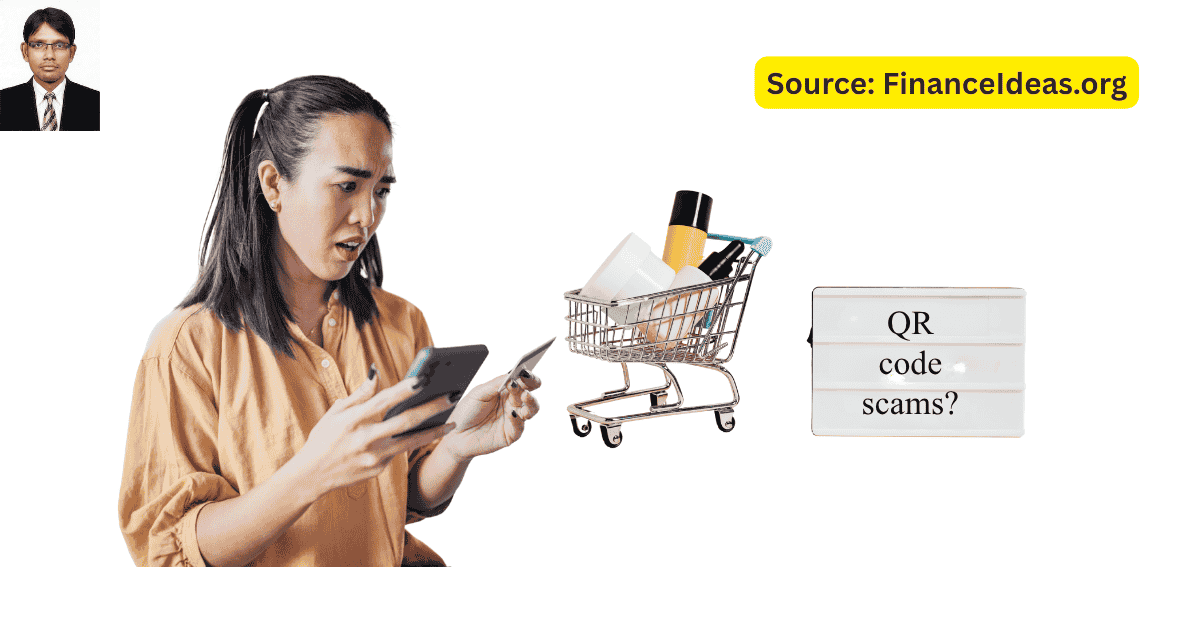
A small box arrives at your door. Your name is on it. You didn’t order anything. A printed note inside says: “Thank you for your order. Scan this QR code to confirm your delivery address.”
You scan it because the page looks exactly like Amazon. Then it asks you to log in.
You enter your email and password. The page spins. Then it asks for your card number “to verify the delivery.”
Hmm, you think for a few seconds, but type it in out of emotional excitement. Within an hour, your Amazon account is compromised, your card is being used for unauthorized purchases, and the box, the one that started it all, was not a real order. It was a trap.
I wrote this hypothetical story after reading fake Black Friday deal reports on US federal sites. In my previous article, I discussed how to detect them, and today, I will discuss how to avoid Black Friday scams.
Anyway, let me tell you what this scam is called. This is quishing, i.e., QR code phishing. As per our study, it is one of the fastest-growing Black Friday scams in America, and it doesn’t require you to click a link, open an email, or visit a suspicious website. All it requires is a moment of curiosity.
Okay, it is time to learn them. Let’s start with the following:
Finance Ideas AI snippet box | Tapos Kumar
Why are QR code scams so dangerous?
Because they bypass the skepticism we have built for links. People have learned not to click suspicious links. But QR codes appear physical, tangible, official. Scammers overlay them on shelf tags, parking meters, and delivery notices. You didn’t click a link; you scanned a code. The psychological barrier is lower. That is what makes quishing so effective.
Related Articles
-
Black Friday Shopping [How to Survive the Crowds and Save Money in 2026]
-
Spot fake Black Friday deals verification guide: I Tracked 25 Retailers’ Black Friday Prices. Most Were Fake
Why is Black Friday a scammer’s Super Bowl?
In my view, Black Friday is not only the biggest shopping day of the year for Americans. It is the peak deadline for shopping scams globally.
Let me back up my views. Now it is the middle of the night. I open federal sites on my laptop & analysis them based on my financial knowledge. Yeah, quiet environment & I am thinking well with multiple cups of coffee.
Below, in the table, I have shared my analysis based on federal data. Let’s read them:
| Scam metric | Latest verified insights | Source |
| Phishing surge Black Friday | 620% increase in phishing emails leading up to Black Friday; Darktrace noted a further 20–30% spike during Black Friday week itself. | Darktrace |
| Fake delivery phishing | Shipping-related phishing emails surged 427% in late 2025; Check Point continues to track delivery-themed scams into 2026, now evolving with malware distribution via fake sites. | Check Point Research |
| Amazon impersonation | Amazon remains the number 1 impersonated brand; about 80% of consumer brand phishing attempts target Amazon. In 2026, AI voice-cloned “Amazon support” calls emerged as a new frontier. | Darktrace, Forbes, Axis Intelligence |
| Fake postal service sites | NordVPN reported an 86% increase in malicious postal service websites during December 2025 holiday season; in 2026, networks of 800+ fake e-commerce/postal sites were revealed. | NordVPN |
| Gift card fraud | Americans lost nearly $200 million to gift card scams in the first nine months of 2025, according to the FTC. Updated reports confirm losses were already over $210 million in 2024, with totals climbing toward $250 million in 2025–2026. Gift cards remain one of the most common payment methods demanded by scammers. | FTC, Virtwave |
| Social media scam losses | The FTC reports that scams originating on social media drained over $2 billion from Americans in the most recent year of data, with nearly 30% of all fraud beginning on these platforms. | FTC Consumer Sentinel |
My study found that scammers follow the money. When 202.9 million Americans shop over Thanksgiving weekend, criminals see 202.9 million opportunities. And they are getting better at it: more than a quarter of phishing emails now contain over 1,000 characters, hmm, a hallmark of AI‑generated scams designed to look legitimate. The truth is: the days of obvious typos are fading. Today’s scams are polished, professional, and personalized.
Below, I have explained 5 safety tips under each question. I found these are recurring threats that have become more common recently. So, read them patiently. Each question guides you effectively so that you can detect threats and avoid scams on Black Friday.
How to handle phishing emails (The inbox shield)?
The threat: Phishing attacks impersonating major retailers like Amazon, Walmart, Target, and Macy’s surged more than 600% ahead of Black Friday. These emails look like legitimate exclusive deal alerts, order confirmations, and delivery notifications.
The Solution: I wrote these solutions based on real cases & federal study. So, you can trust them.
| Rule | Reasons |
| Never click links in unsolicited emails | Yes, even if the email looks legitimate, go directly to the retailer’s app or type the URL manually |
| Check the sender’s full email address | Scammers use addresses like amazon-deals@mail-secure.com instead of @amazon.com |
| Hover over links before clicking | On desktop, hover to see the real URL. On mobile, long-press the link |
| Report, don’t engage | Forward phishing emails to spam@uce.gov (FTC) and delete them |
Look, I am not hallucinating you. My analysis is based on US federal data. If you have doubts, you can check official sites. I am saying this because, in this AI & spammer era, trusting anyone in finance is costly.
So, let me tell you what the FTC said. FTC mentioned that scammers use familiar company names or pretend to be someone you know. They pressure you to act now before you miss a ‘great deal’ or a ‘limited time offer.’
My advice: Treat every unsolicited email as suspicious until proven otherwise. Legitimate retailers do not send exclusive deals that require you to click a link and enter payment details on a page that isn’t their main website.
How to spot Quishing (The QR Code Guard)?
The threat: QR code scams, also called quishing, are exploding. Attackers place fraudulent QR codes on posters, emails, social media posts, and even overlay legitimate codes on retail shelf tags and parking meters.
The solution: Follow these rules:
| Rule | Reasons |
| Never scan QR codes on shelf tags | If a retailer wants you to access a deal, it will be in their app or at checkout |
| Never scan QR codes in unsolicited mail | Fake delivery notifications with QR codes are a common trap |
| Use your phone’s built-in QR scanner | It shows the URL before you visit. If the URL looks wrong, don’t proceed |
| Verify the destination URL | A QR code that leads to amazon-verify.net is not Amazon |
Follow this extra rule: If you didn’t ask for the QR code, don’t scan it.
Why is the payment method important (The payment fortress)?
The threat: Scammers overwhelmingly demand payment methods that are impossible to reverse: gift cards, wire transfers, and cryptocurrency. The FTC reports that Americans lost more than $200 million to gift card scams in a single year, with over 40,000 complaints filed. Recent 2026 reports confirm losses are climbing toward $250M+, with more than 100,000 complaints logged. Gift cards remain one of the most common payment methods scammers demands, especially Apple, Target, and Amazon cards.
The solution:
Read the table patiently & act accordingly:
| Payment method | Protection level | Why? |
| Credit Card | Strongest | Fair Credit Billing Act allows you to dispute charges |
| Debit Card | Moderate | Your money is gone first; you fight to get it back |
| PayPal / Digital Wallet | Good | Purchase protection on eligible transactions |
| Gift Card | None | Once the number is shared, the money is gone |
| Wire Transfer | None | Irreversible |
| Cryptocurrency | None | Irreversible and untraceable |
Follow this rule: If a seller demands a gift card, wire transfer, or crypto, walk away immediately. Don’t be emotional because no legitimate retailer operates this way.
Securing your accounts, i.e., identity lock?
The threat: Identity theft is a downstream consequence of many Black Friday scams. When you enter credentials on a fake site, you don’t just lose money; you also lose control of your accounts.
The solution:
Follow the recommended actions from the table:
| Action | How to do it? |
| Enable Multi-Factor Authentication (MFA) | Turn on MFA for Amazon, Walmart, Target, Best Buy, and your email |
| Use unique passwords | Never reuse passwords across shopping sites |
| Monitor your accounts | Check credit card statements weekly during November-December |
| Freeze your credit if compromised | Contact Equifax, Experian, and TransUnion |
My suggestion: Enable multi-factor authentication on your accounts. Yeah, old advice, but this adds an extra layer of security beyond just a password.
The verification habit (Your final check)?
The threat: Even careful shoppers can be caught off guard. This final layer is a mental habit that takes 10 seconds.
The solution: Before entering any payment details, ask yourself: Did I navigate here myself, or did someone send me this link?
If the answer is “someone sent me this link,” stop. Close the page. Open a new tab. Type the retailer’s URL manually. Then complete your purchase. Or, just stop; take a break for a few minutes. Within this time, your mind will reset without hype or excitement.
Trust me, this single habit can defeat most phishing, quishing, and social media scam attempts.
Learn these Black Friday scam types?
So, inflation makes our lives challenging. Additionally, AI is eliminating many jobs, which creates uncertainty about universal income. I don’t know if AI does all the work; then how will humans buy, or who will buy, products & services?
In my view, AI gives rise to many online scams that we couldn’t imagine before. You may have read about AI shopping suggestions to save money. But do you know AI can also create many hallucinated scam deals?
Yes, this is true. Our incredible innovation, i.e., AI, has become a powerful tool for scammers. So, take 1 pen and paper if needed. I will explain the scam deal types below. Let’s read them:
Fake delivery notifications (Smishing)
Here, you will see = A text message claiming to be from USPS, UPS, FedEx, or Amazon: “Your package cannot be delivered due to an incomplete address. Click here to update.
But USPS will never send you a text message with a link to track a package. These messages are designed to steal your personal and payment information.
Do this: Delete the message. Do not click. If you are expecting a package, go directly to the carrier’s website and enter your tracking number.
Gift card draining
You will experience this = You buy a gift card from a retail display. The card looks normal. You give it as a gift. The recipient tries to use it, and the balance is zero.
Actually, thieves steal card numbers and PINs before the cards are purchased. They use a technique called “draining” or “shimming”, hmm, physically tampering with gift card displays to copy the numbers.
Do this: Inspect gift cards before buying. Check for tampering on the packaging. Buy gift cards from behind the counter when possible. Keep your receipt because it is your proof if the card is drained.
Social Media storefront scams
Let me think: an Instagram or Facebook ad for a product at an incredible price. The ad looks professional. The store has hundreds of glowing reviews.
Nearly 30% of people who reported losing money to a scam said it started on social media (Yeah, I said this in my previous article). The reviews are fake. The store disappears after taking your money.
Do this: Never buy from social media ads. Always search for the product on a major retailer’s website. If it is not available there, it is probably a scam.
Deepfake celebrity ads
If you read my previous article, you probably know about it. You could be new readers. So, I will briefly describe it. A video of a celebrity “endorsing” a product or store with an exclusive Black Friday deal.
AI‑generated deepfakes are increasingly used to promote fake storefronts and shopping scams. Our survey found that more than 4 out of 5 consumers struggle to recognize AI‑driven fraud, proving that today’s scams are polished, professional, and harder to spot.
Do this: Assume any celebrity endorsement you see in a social media ad is fake unless it is from the celebrity’s verified account.
Quick Q/A: Reader’s Most Asked?
What is the biggest mistake shoppers make during Black Friday?
Based on my analysis, shoppers confuse urgency with legitimacy. A countdown timer doesn’t make a deal real. A ‘limited stock’ warning doesn’t make a store trustworthy. For this reason, scammers create urgency because urgency bypasses critical thinking. Therefore, I recommend that you pause for at least 30 seconds before entering payment details.
What is the one thing every shopper should do before clicking ‘Buy’?
Verify the URL. Yes, not the website design or the reviews; I mean the URL. This is because scammers can copy everything else. But they can’t fake the domain. A single extra letter, like target-sale.com instead of target.com, is the difference between a safe purchase and a stolen credit card.
Finance Ideas TLDR | Tapos Kumar
- Never click links in “delivery failure” texts or “exclusive deal” emails. Go directly to the retailer’s app or website.
- Do not scan QR codes on shelf tags, posters, or unsolicited mail. Scammers overlay fake codes on real ones.
- Use a credit card. Never pay with gift cards, wire transfers, or cryptocurrency. These are scammer payment methods only.
- Enable multi-factor authentication on every shopping account. Use unique passwords.
- Before entering any payment details, ask: “Did I navigate here myself, or did someone send me this link?”
Then, follow this rule: If you didn’t go looking for it, don’t click on it.
Frequently Asked Questions (FAQs) about Black Friday scams avoid safety guide?
How do I know if a Black Friday deal email is real?
You don’t. Assume it is fake. Go directly to the retailer’s website or app and check for the deal there. Legitimate retailers do not send “exclusive deals” that require you to click a link and enter payment details on a page that isn’t their main website.
What should I do if I already clicked a phishing link?
Act immediately & do the following:
- Change your password for the affected account (and any account using the same password)
- Enable MFA if not already enabled
- Contact your bank or credit card company and dispute any unauthorized charges
- Report the scam to the FTC and C3
Can I trust “verified” reviews on social media stores?
No. Scammers can generate thousands of fake reviews in minutes. Therefore, I call social media the birthplace of shopping scams. Our study found that about 40% of shopping scams originate from fake reviews, influencers, and social media. Don’t make buying decisions based on hallucinated AI advice or social media influencers. Always do your own research; read experts’ articles on Google.
Is it safe to shop on public Wi-Fi during Black Friday?
No. Public Wi-Fi networks are vulnerable to interception. Use your mobile data or a VPN when shopping on the go.
For this reason, I recommend you avoid public Wi-Fi for financial transactions.
Tapos’s last thought
If I were you, I would ask myself this question = Why do scammers use AI for Black Friday scams?
Technological innovation always brings 2 faces: Batman & The Joker. And I don’t know (claim by former Anthropic researcher Jacob Coxon) whether AI could destroy humankind by 2030.
I also worked in research so that I can add my prediction. In my view, the world will see more idle people; laziness will be a new luxury, & people will forget how to think or solve elementary math.
I think US regulatory bodies take Jacob’s forecast seriously. So they introduced the AI Kill Switch Act. I don’t know whether this act can control the Joker. Hope Batman wins.
Anyway, let me answer your question. AI makes scams cheaper, faster, and more convincing. It can write phishing emails, create deepfake celebrity endorsements, and clone legitimate websites in minutes.
Look, I am not anti-AI; using AI & social media, including following influencers for shopping, depends on you. If you wish, you can follow them. I want to say: don’t use them blindly; judge them, and read neutral analysis from experts on Google. In my opinion, Google is still a more trustworthy place for financial decisions.
Okay, I have to say goodbye now. I have to take my meal. I hope my guide helps you avoid scams during Black Friday. If you have more questions, please ask me in the comments. I will do my best to answer them as soon as possible.
References & Sources
Below is the lists of sources that I have used to write this article [If you already scammed, you can visit following sites for report also]:
Disclaimer
The information provided in this article is just the author’s view & only for educational purposes. This guide is not for promotion or affiliate purpose. By reading this, you agree that the information is not personal finance advice. Do your research before making your black Friday plan. Therefore, Finance Ideas will not be liable for your financial loss if occur.