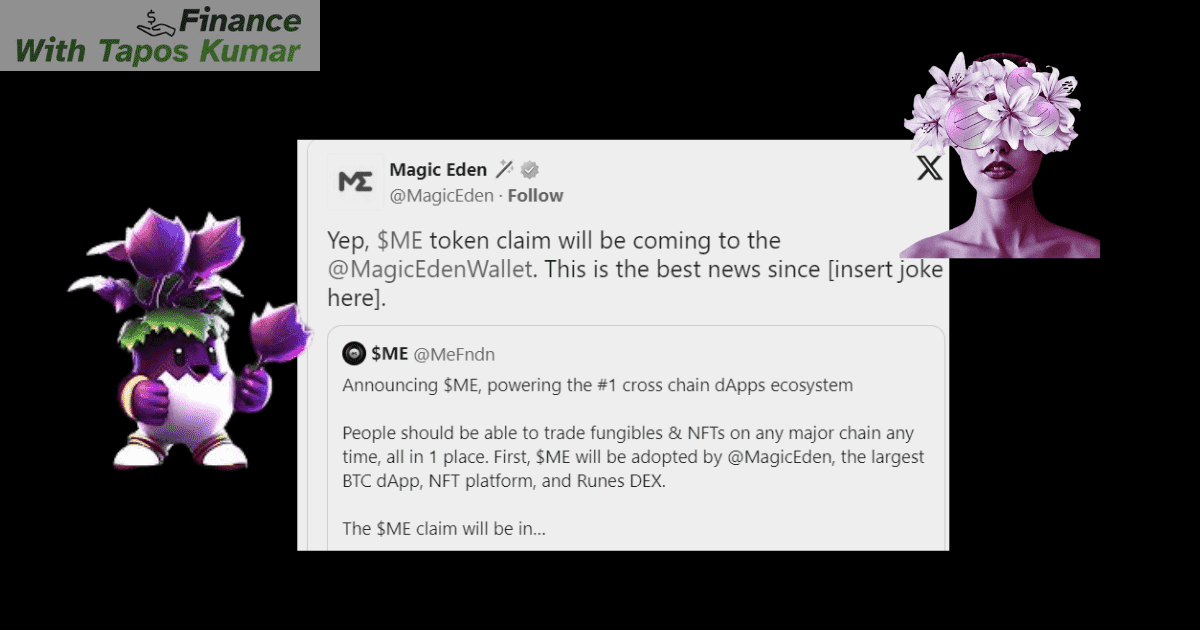
The Magic Eden token launch gives its communities new hope. The prime objective is to break single-chain barriers and provide multichain facilities to NFT communities.
So, questions arise: Can $ME foster a vibrant DAO ecosystem where token holders actively participate in governance and decision-making?
Questions led us to reality, and the purpose of this article is simple: to give you a detailed analysis of the Magic Eden token in this declining NFT market.
Are you ready? Let’s start with the following.
Finance Ideas quick summary | Tapos Kumar
The Magic Eden ($ME) token isn’t a marketplace reward; it is a strategic layer inside Web3’s largest NFT ecosystem.
Its real power is not short-term hype; instead, it lies in multi-chain utility, staking rewards, and governance influence.
Post-airdrop volatility is expected, but long-term holders who engage in staking, launchpad participation, and cross-chain governance could capture compounding value. ME doesn’t try to copy BNB or UNI; it is testing whether a token can connect fragmented NFT economies into one fluid network.
In short, ME’s worth isn’t in speculation; instead, it is in integration.
Wise investors should track staking ratios, cross-chain bridge adoption, and governance proposal activity. Because, those metrics reveal if ME evolves or evaporates.
Finance Ideas AI Snippet Box | Tapos Kumar
Is Magic Eden’s ME token only hype or real utility?
The $ME token is not only a reward token: it is designed to power governance, staking, fee discounts, and multi-chain minting incentives within the Magic Eden ecosystem. But the true test is whether it can maintain sustained demand beyond the airdrop flood.
What is a $ME token?
$ME is a native token of Magic Eden, which is one of the leading NFTs and runes in the marketplace. $ME wants to improve cross-chain functionality among different blockchain networks such as Solana, Ethereum, Base, and Polygon.
We can classify it as a Web3 token that has decentralized application features (DApps).
Will $ME empower its community with DAO?
$ME token could be a game-changer feature for Magic Eden. Multi-purpose use definitely can increase the token’s utility. However, a detailed analysis will help us understand whether $ME would be a community-driven token. Let’s analyze this in detail.
- Multi chain of $ME
Magic Eden wants to shift from a single chain to a multichain through the $ME token. This could bring positive aspects to Magic Eden, such as Scalability, which can reduce NFT transaction fees and improve efficiency to handle more transactions.
Magic Eden started as a Solana-based NFT platform. It aims to widen its user base and become a consumer of Dapps for retail crypto investors.
Additionally, multiple blockchain integration could lower risk also.

For example, if one chain encounters any network issues, then the other chain can smooth accessibility.
In a word, the Magic Eden token introduces an end to a single-chain system. The approach seems to suggest that $ME can foster a vibrant community-driven NFT ecosystem. So, yes, it could be a DAO-based NFT platform.
- $ME for traders
$ME can be used in various blockchains, which could give a good earning opportunity. Now you could ask me how? Well, under multichain, communities will see different prices for NFT in individual chains. So, the pricing gap could be a quick profit-earning opportunity.
- $ME for a diversified portfolio
The $ME token of Magic Eden would be an opportunity to diversify your NFT portfolio. $ME will increase trading volume, which helps to smooth the NFT exchange. So, higher trading naturally creates stable prices and increased profitability.
- DApps adoption of $ME
Third-party dApps adoption can boost $ME utility. It will not only increase transaction volumes but also make NFT more accessible to a broader audience. We can expect positivity, but it would be difficult to achieve in light of recent negative NFT market sentiment.
However, fluctuating market performance is typical for digital assets. NFTs are now in a declining trend. According to a research report by Statista, the NFT market will reach $683.9 million at the end of 2024. The study forecast a negative growth of 11.01% for 2025.
The study doesn’t forecast a positive trend within 2 or 3 years but suggests that per-user NFT revenue will increase to 0.15% by 2025.
Though the NFT market is still falling, we can expect an increased adoption of Dapp.
You may also like
Investor’s Corner= Lessons from the Magic Eden Token
I found that most traders chase token charts. Serious investors chase token behavior.
Magic Eden’s story is still unfolding, but its design hides practical lessons for anyone serious about long-term crypto investing.
Let’s see how:
Utility beats hype: Every successful token that outlived its launch frenzy delivered real-world or protocol-level use. ME’s multi-chain design follows that pattern.
Staking is a signal, not yield: Watch how many holders restake instead of selling; it shows conviction.
Governance ≠ democracy: Power flows to active participants. Voting engagement tells you if the token community truly matters.
Multi-chain expansion is a risk and an opportunity: Bridges bring exposure and exploits. Diversify storage and stay updated on bridge audits.
Patience pays in ecosystems, not spikes: The biggest gains often come from time in the system, not timing the market.
So, not speculative investors but ecosystem builders win NFT token economics. ME offers that blueprint if you read between the chains.
“Magic Eden’s token model hints at a new era where marketplace users become network stakeholders. When a platform turns its community into shareholders, loyalty stops being emotional; it becomes economic.”
— Tapos Kumar | US Finance & Crypto Expert | localhost/bloghub/
Finance Ideas Key takeaways | Tapos Kumar
- Magic Eden token aims to empower the NFT community
- Magic Eden tries to be a blockchain platform for NFT & digital assets.
- $ME could enhance Cross-Chain Trading.
- Communities can use third-party DApps with $ME.
- Magic Eden will first allow $ME as a mobile-first experience.
Concluding Thought
The Magic Eden token is introduced to enhance Cross-chain trading. The purpose of introducing $ME is simple: be the biggest chain and allow your communities to trade NFTs at any time.
Magic Eden is a rising NFT marketplace with a $4.19 billion NFT trading volume (as of the writing of this article).
Yeah, we are seeing dramatic fluctuations in the NFT market, but implementing a uniform $ME token will definitely benefit Magic Eden and its communities.
Frequently Asked Questions (FAQ)
Magic Eden wallet?
Magic Eden doesn’t have its own wallet; instead, it supports multiple wallets, such as MetaMask, Phantom, Wallet Connect, etc. You must connect one of these wallets to use Magic Eden.
Magic Eden ordinals?
There are no Magic Eden ordinals because Ordinals are built on Bitcoin. However, you can use them indirectly, such as through a third-party marketplace or cross-chain system.
Should I invest in the Magic Eden NFT marketplace?
The purpose is to introduce the $ME token to give more financial incentives to its NFT communities. Additionally, Magic Eden is one of the top NFT marketplaces with a proven growth rate. Therefore, investing in Magic Eden’s NFT seems reasonable.
Will ME token’s value collapse after the airdrop rush ends?
Yes, it is possible. After the initial hype, many token economies see a post-airdrop decline as claimers exit. The real durability depends on whether ME’s staking rewards, governance utility, and native demand can outpace sell pressure. Watching net staking vs sell volumes in months 2–6 is important.
How will ME tokens handle cross-chain bridging risks and interoperability?
To be genuinely useful, ME must traverse chains (Ethereum, Solana, ERC-20). Bridges come with slippage, bridging fees, and security vulnerabilities. If the bridging mechanism is poorly secured or gas-inefficient, ME could face liquidity fragmentation, which means tokens are stuck on one chain with weaker value elsewhere.
What hidden inflation or release schedules could dilute ME’s value long term?
Many tokens hide aggressive exposure schedules (for team, ecosystem, or reserve). ME’s vesting cliffs (12–24 months) could release large volumes into circulation. If community demand doesn’t grow proportionally, those exposures could depress the price. Map out all token allocations and lockup periods to anticipate those dilution events.
How many ME tokens will be burned or retired? Is there a deflationary element?
Some tokenomics include burn mechanics (fee burns, buybacks). If ME never burns or retires tokens, scarcity is weaker. Therefore, check whether transaction fees or marketplace activity feed a burn pool. Absence of even modest burns is a silent risk that many investors don’t understand.
If Magic Eden upgrades its smart contracts or governance model, could ME holders lose privileges?
Projects often adopt proxy or upgradeable smart contracts. But upgrades might change voting weights, staking conditions, or fee discount rules. If your ME holding depends on certain privileges, a future contract change could alter them. Therefore, always check governance protections or upgrade limits.
What happens if ME’s governance fails? Can token holders actually influence outcomes?
ME’s governance is an attractor, but governance systems often become symbolic. If real decisions stay centralized (core team or foundation), token holders have a limited voice. Evaluate how many proposals have passed, how many token holders vote, and whether votes actually change policy.
Could early whales or insiders have dominated ME allocations, and what exit risks do they bring?
A common trap: large allocations to insiders or early whales who can dump when listing occurs. If insiders control, say, 20–30% of ME supply with early exposes, they could trigger sell waves. Therefore, check the block explorer or allocations charts to see concentration in the top 10 or top 50 wallets.
How resilient is the ME token to regulatory action or marketplace delisting risk?
Because ME is a token tied to NFT marketplace activity, regulatory scrutiny is possible (securities classification, exchange listing delists). If major exchanges delist ME, liquidity could crater. A better analysis: which exchanges have already committed to listing ME, and what their delisting criteria are.
Could Magic Eden Token become the first “multi-chain governance currency” for NFTs?
Yes, in theory. ME already operates across Solana, Ethereum, and Bitcoin Ordinal markets. If Magic Eden integrates unified voting across chains, ME could pioneer the first cross-chain governance token model. That would set a precedent for multi-chain DAOs, something few tokens have achieved successfully.
How does ME’s fee-sharing logic compare to exchange-tokens like BNB or UNI?
ME currently recycles fees back into ecosystem growth pools and liquidity partnerships, unlike BNB (burn model) or UNI (fee revenue split proposal). This creates “soft yield” instead of cash payouts, a smoother but less transparent reward mechanism. It aligns holders with ecosystem expansion over short-term profit.
Is there a risk that ME becomes a ‘meta-token’ without native demand?
Yes. If NFT markets migrate to new chains or protocols while ME stays tied to Magic Eden’s core stack, it could lose use velocity. Tokens with utility confined to a single brand risk “ecosystem isolation.” Cross-protocol integration is the antidote, and Magic Eden’s real test for longevity.
Can ME tokenomics survive NFT market down-cycles without volume fees?
During bear phases, marketplace volume shrinks 70 % or more. If revenue sources dry up, ME’s buyback or reward programs weaken. A resilient token must attach utility outside of trading, for example, launchpad priority, DAO voting, or real-world brand drops. That is how ME could become not only a volume mirror but also a “store of access”.
What behavioral bias does Magic Eden exploit to sustain holder loyalty?
Magic Eden gamifies participation through “earned status loops”, holders collect badges, staking tiers, and early-access rights. These activate the endowment and commitment bias (people value what they have earned). It is psychology as tokenomics, and it is one reason ME’s community remains sticky even through volatility.
References & Sources
Below is the lists of sources that I have used to write this article:
Disclaimer
This is not a Sponsored post & the purpose of this article is only education. By reading this, you agree that the information of this blog article is not crypto investing advice. Do your own research before making any financial decision. Therefore, if you lost any money, localhost/bloghub/ will not be liable for this.