Morning readers. Can I ask you this question = Psychology of cash advance apps? Oh, sorry! Let me ask you the full question: Why do Americans use cash advance apps? Yeah, you need some time; that is okay. If you know the answer, let me know in the comments.
Say you are going to the office, and suddenly you need a car repair. Unfortunately, you forget your purse, so you are forced to take out a payday loan for a car repair.
Yeah, you paid it back. Then you took another for a utility bill. Then another & continue.
Imagine that you are in the same situation. If I asked you to describe your experience in three words, what would they be? I have no idea what your 3 words are, but if I were in your situation, I would say: embarrassment, anxiety, and unhappiness.
This incident doesn’t mean that you or I are irresponsible. We were in an urgent situation, and necessity knows no laws. How do humans feel when their phone glows at 3 a.m., offering a $40 bridge to morning? Isn’t it a sexy loan offering?
So, these cash advance apps simply monetize what our brains do under scarcity. In politics, there is no permanent friend. Similarly, human psychology never influences our brains to make permanent decisions. The fact is: Our psychology makes the worst monetary decisions under stress or scarcity. And today’s article is all about it.
I hope my independent, neutral analysis will not waste your time. After reading, you will clearly understand the psychology of cash advance apps. Don’t worry, I will also give solutions. Let’s continue:
Finance Ideas AI snippet box | Tapos Kumar
I found that Florida’s psychology is different for cash advance apps?
Yes, as per my data analysis. The fact is: Florida is not just a high-volume payday state. It is a state where a specific regulatory environment shapes loan psychology.
The Center for Responsible Lending found that Florida’s payday lending law, let me think: passed in 2001 and sold as a debt-trap prevention measure; failed to stop the wealth-stripping effects of loans with APRs averaging 278%. Over 83% of Florida payday loans went to borrowers unable to refinance in seven or more loans.
I think this is psychologically important because repeat borrowing normalizes the behavior. When seven or more loans is the rule, the brain stops warning you that the decision is unusual. It becomes routine. And routine decisions bypass deliberation completely.
Florida’s FIU (Florida International University) describes this exact behavior. For example, a maintenance worker in Central Florida described it as: Borrow. Pay back with interest. Bills short. Borrow more. Pay back with interest. Bills short. Repeat as necessary.
I don’t think that is a financial description. To me, it describes a borrowing cycle.
Related Articles
-
Dave App vs Brigit: How Cash Advance Apps Are Reshaping American Finances
-
Alternatives to cash advance apps: Try These 7 Instead
-
Cash advance app debt trap guide: 74% of Cash Advance Users Can’t Stop. Here’s Why
-
Gen Z minimum payment trap: I discussed why your balance went up
As the title says, this article is about the psychology of cash advance apps. So, I analyzed & found 5 major psychological patterns that are positively associated with the human mind. Read them patiently & try to relate them to your situation. Let’s read them:
Psychology -1: Present bias?
In my view, present bias is a human tendency to choose smaller financial benefits over a significant one later. Humans do it instead of knowing that later one will give more monetary benefits. Iam saying this from my 10 years of academic and corporate experience.
I have noticed that people borrow money today at a higher cost. They think like this: Okay, I need $100 for something. Who will give me? Friends, parents or relatives. I don’t want to show them my needy situation. I don’t want to bow down in front of them or compromise my ego. They influence to do it for showy culture or egoism.
Then, I also noticed that some people only focus on present needs & don’t care what will happen next.
Say they borrowed $100 from a cash advance app with a higher interest rate & deadline (14 days). They don’t care what happens after 14 days; they focus only on the present emergency.
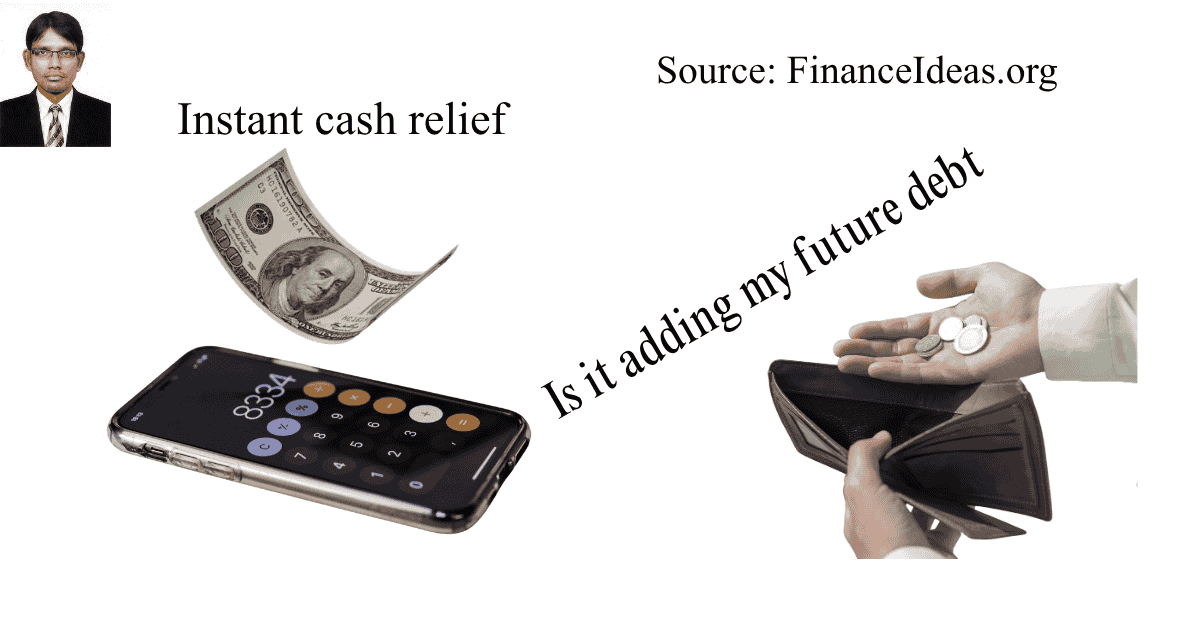
The moral is: Your cost is delayed, and you get instant financial relief. The apps provide that instant relief and elasticize the cost across a pay period. And, during an emergency, your brain can’t differentiate these two.
Psychology -2: Your future self is not a different person?
We often make money decisions today because we believe our future self will handle the cost, effort, or consequences. But when the future arrives, we are the ones paying the bill.
For example, you need $200 immediately before payday, so you use a cash advance app.
On Monday, you think: Next Friday’s paycheck will cover it. I will be fine.
Then, next Friday arrives. Your paycheck comes in, but the $200 advance is taken back. Now you have less money than expected and struggle to cover other bills.
Here, the person paying back the money later is not a different person. It is you.
I found that cash advance apps target this gap by making your future self uncertain. How? You don’t know what amount will be your next week’s paycheck. And, Americans unintentionally fall in this financial gap. This is not my personal view instead CRL suggest similar findings. CRL found that the average Florida user borrowed money 33 times a year and spent about $218 a year on app fees and tips.
N: B = These figures come from CRL’s analysis of payday loan/cash advance app users & don’t represent every borrower of Florida.
My tips: Before borrowing from your next paycheck, ask yourself: Can I make it if next week’s paycheck is smaller?
Say you are borrowing from your next paycheck.
Paycheck next Friday = $1,000
Advance today = $200
Next Friday’s usable paycheck = $800 (before any fees)
Now, carefully calculate your necessities before taking $200. Can you meet your needs with $800? If yes, or you have a backup, you can take it. Otherwise, I will not recommend.
Note= Based on my study, major US cash advance apps (EarnIn, Dave, Brigit, MoneyLion Instacash, Chime MyPay/SpotMe, and Albert) offer advances before payday, hmm, often without traditional credit checks. Yeah, some charge subscription fees, instant-transfer fees, etc. Keeping these in mind, I wrote before any fees.
Psychology -3: Not having enough money makes your mind focus only on the problem?
In my 10 years of professional life, I noticed that the human mind & money have a positive association. Say you have enough money, you will utilize resources efficiently by taking correct planning & decisions.
Conversely, imagine youare short on money; you will make bad decisions. Here, I refer to resources as money, mental capacity for reasoning, planning, and self‑control.
Now let’s see whether my traditional 10 years’ view associate with present US economy. What are the news headlines in American mainstream media like CNBC, CNN, and The New York Times? Layoffs, no fresher recruitment, no jobs, AI is coming for Sr jobs, huge investment in AI data centers, I lost jobs to AI, I took a voluntary exit, college degree lost credibility, etc. So, overall, it is a hype centric scarcity environment.
Scarcity pushes Americans toward short-term, urgent financial choices, like paying bills late or relying on high-interest loans, because the mind focuses on immediate needs and loses logical thinking for long-term planning.
My view is also supported by the CFPB. I just read their own financial well-being research & their findings show consistent with my analysis.
The CFPB’s financial well-being research found that 54% of respondents experience a great or extreme amount of stress when interacting with financial services providers, and 74% avoided seeking out financial services because of that stress.
However, I also saw that people make bad monetary decisions instead of having resources. Say, you layoff from a tech company from a management position. A scarcity environment pushes you to prioritize present needs. You have savings or enough money to survive, but your mind works like this: first survive January, then I will think about February. So, you are just adding financial struggle for the future.
Now you could ask me: I hate business school, & you gave a long behavior finance lecture. Yeah, I know I talk more, explain more.
Okay, let’s connect your question. This lecture associated with borrowing habit. How? When you decided to open cash apps, your mind is already in scarcity mode. Yeah, it is 3 a.m. & you are only focusing on present financial needs. So, cash advance apps just monetize your scarcity mind.
Oh god! I reveal many secrete. Will I get any sponsorship? Perhaps no.
Psychology -4: Dark patterns turn human urgency into a product?
Psychological thinking always benefits fintech products. How? The FTC’s action against the cash advance app Cleo AI is the public record of how psychological design works in this category.
The FTC alleged that Cleo promised access to hundreds of dollars in advances, but almost no one received anything close to the advertised amounts. It promised same-day or instant advances, but subscribers had to pay an extra fee, and then could wait until the next day. And, when consumers tried to cancel, the app made it difficult; some were told they could not cancel until they paid off outstanding advances.
I just read the consumer complaint section &, and it was horrible. Let me mention some here:
One consumer complaint this = I need my money right now to pay my rent. I have no other option. I can’t wait 3 days. I can’t wait 1 day. I need it now. Another said: I just subscribed and paid $35 for immediate access. Now I go on here, and it says up to 24 hrs. I have my son today, and he needs food. Oh! Long live psychology.
In my opinion, that is not a neutral product interface. It is a psychological funnel built around urgency, scarcity, and the suppression of deliberation. And the FTC made correct decisions. The FTC settlement required Cleo to pay $17 million, clearly disclose terms, and provide a simple cancellation path.
The moral is: When an app is designed to make you decide in seconds, the decision is not yours. It belongs to the interface.
Psychology -5: The demand for a commitment device?
Besides my publishing work, I also work as a research paper reviewer. So, I have to visit my author page frequently. Last night, I was about to close Google Chrome when Google sent me a notification via Google Scholar.
I found the title relevant because I am now researching articles on cash advance apps. The title was: “Are High-Interest Loans Predatory? Theory and Evidence from Payday Lending” by Hunt Allcott, Joshua Kim, Dmitry Taubinsky, and Jonathan Zinman. They presented it at an NBER conference. I read it & it really impressed me.
Here, researchers studying payday borrowers asked this question: Would you like extra motivation to avoid future payday loan debt? 54% said, “very much.” Another 36% said “somewhat.” Only 10% said “not at all.
Read that again. The people inside the circle are not defending the circle. They are asking for a way out.
But the same research found a tension: many borrowers also believed that restrictions on repeat borrowing would be bad for them, because they wanted the option to handle an unpredictable expense. They wanted both, i.e., a commitment device and a safety regulator.
The moral is: that tension is the real design problem. It is also the opening for a practical solution.
Quick Q/A: Reader’s Most Asked?
Can I get addicted to cash advance apps?
Look, fintech products are not drugs. Apps target our behavior, like cash relief, repayment, etc. Say you used a 1-time app for emergency $100 cash. Your finger & mind naturally push you to repeat it.
Or think like this. You often visit Starbucks for a cup of coffee after work or at the evening. Your mind naturally influences you to visit again. Here, cash apps just stimulate that human behavior. So this is about behavior, and you can’t say you are addicted.
Why do I keep saying this is the last time?
This happens because your future self feels less emotionally connected. This is because the person who will repay on Friday does not feel like the same person making the decision today. In behavioral finance, it is called future-self discontinuity.
Why do I want to stop but keep the app installed?
Hmm, because the app represents a safety regulator. Removing it feels risky. A better first step is to add delay. You can do it this way: turn off notifications, hide the icon, set a 10-minute delay. So don’t try to delete it totally before you have an extra cash.
Finance Ideas TL; DR | Tapos Kumar
My thought is: Cash advance apps do not create a new kind of borrower. They target the human brain through present bias, a tendency that emphasizes immediate monetary relief far more than next week’s cost.
But prior research surprised here. Research on payday borrowers shows that 54% say they very much want extra motivation to avoid future debt, and another 36% want it somewhat.
Therefore, the problem is not that people lack self-control. As per my analysis, it is that the app is designed to interrupt you when self-control is weakest.
Frequently asked questions (FAQs) about the psychology of cash advance apps?
Why do I feel relief when I tap borrow even though I know it will cost me later?
Based on my analysis, this happens because the monetary relief is instant and the cost is delayed. Your brain doesn’t think about future costs, and this is called present bias.
Can a cash advance app change my personality or decision-making over time?
No, but it can change your habits. When you keep borrowing over and over, your brain starts treating it as normal, and that automatic habit drives the behavior.
What is the single most important thing to understand about the psychology of cash advance apps?
In my view, it is this: The app knows you are human, and it works against that.
Is there a psychological difference between storefront payday loans and apps?
Yes. The app is always present. There is no walk to the storefront, no face-to-face interaction, and no social delay. The decision can happen in bed. Removing that delay changes the decision psychology.
Tapos’s last thought
Okay, I learned a lot about behavioral finance. Can you give me some guidance to get rid of it? Look, I am not an angel; I can’t control your thinking or behavior. Yeah, as a human finance pro who worked in both academia & industry, I can give you some steps that help you control your thinking.
I have to confess this: I can’t give you superior guidance like AI, and I can’t give you hype-based instructions that social media or video platforms gave you. If you want instant mental peace, then watch videos on TikTok/Instagram/YouTube/FB. Influencers on these platforms work day & night to fool you.
Anyway, below in the table, I have given 4-step pre-decision for thinking space. My steps help you to delay 60 seconds before you open the app. So, read with extra time:
| Step serials | Do these | How does it work? |
| 1. Name the mechanism | Say out loud & accept this: This is present bias. The relief is now; the cost is Friday. | Naming the bias involves deliberative thinking and decreases automaticity. |
| 2. Future-self check | Ask yourself: What will Friday-me wish I had done right now? | Research on future-self continuity shows that making the future self-more transparency diminishes present bias. |
| 3. The 10-minute delay | Set a timer for 10 minutes. I suggest you do one physical task like wash a dish, walk to the mailbox, drink water, talk to your friends, neighbour, relatives, colleagues but avoid toxic one. | In fintech, urgency is the product. A 10-minute delay breaks the urgency funnel. |
| 4. Test this question | Ask yourself: Is this an expense I can negotiate, delay, or reduce? | Most emergencies can be reduced by a payment plan or a bill negotiation call. That means, the app is not the only option. |
Hey! Do you think my article help you to understand psychology of cash advance apps? If you have personal experience, please share it in the comments. I love to learn from others because it will help me to write more helpful article for my readers. Bye!
References & Sources
Below is the lists of sources that I have used to write this article [You can also visit these site for self- study. By doing this, you can verify my information also]:
- Are High-Interest Loans Predatory? Theory and Evidence from Payday Lending (Research paper)
- FTC: Cleo AI Settlement
- Florida Senate: Fla. Stat. § 687.071
Disclaimer
This is not a Sponsored post & the purpose of this article is only education. By reading this, you agree that the information of this blog article is not investing advice. Do your own research before making any financial decision. Therefore, if you lost any money, Finance Ideas will not be liable for this.