
Imagine waking up one morning in mid-April 2028. You check your crypto portfolio, expecting the usual numbers. Instead, you see Bitcoin is surging. I know you will check a random tweet on X or a celebrity endorsement. But those are not the reasons for the BTC price hike. This happened for the BTC halving cycle.
Meanwhile, half the mining industry is collapsing, and most Bitcoin holders have no idea it is happening.
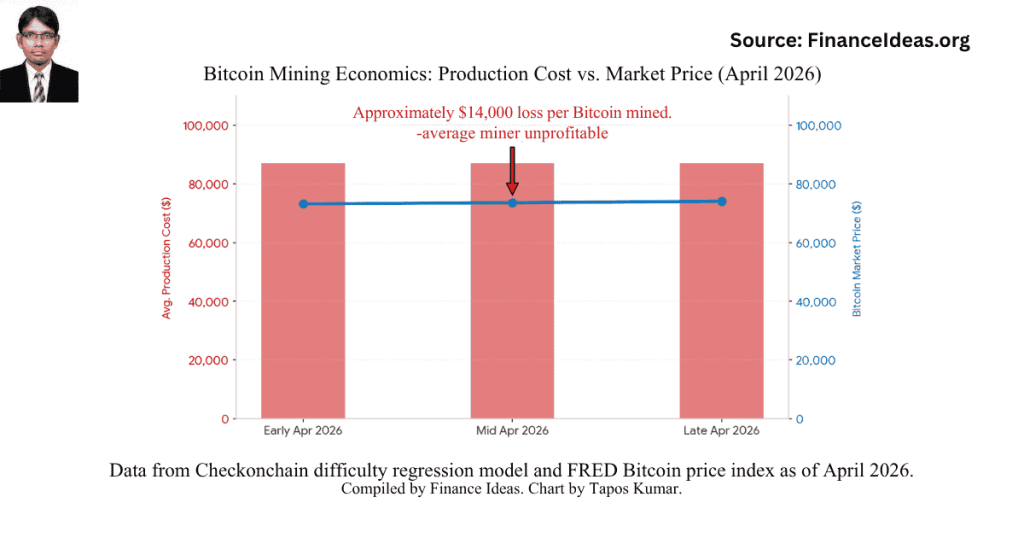
Did you know that the average production cost for mining one Bitcoin is approximately 87,000 to 88,000 per coin, while Bitcoin trades around 74,000? That means the average miner is losing roughly 14,000 on every single Bitcoin they produce.
I know you have multiple questions about the Bitcoin Halving in 2028 & I am writing this article to answer them.
Finance Ideas AI snippet box | Tapos Kumar
The next Bitcoin halving is expected in mid-April 2028 at block height 1,050,000, reducing the block reward from 3.125 BTC to approximately 1.5625 BTC. Daily new issuance will drop from about 450 BTC to roughly 225 BTC.
However, the 2028 cycle is different from all prior cycles because miner economics are broken: the average production costs of 87,000 to 88,000 per Bitcoin currently exceed market prices, forcing miners to sell at a loss or convert to AI data centers. ETF institutional demand now outweighs the halving’s supply reduction by more than 7 to 1, meaning price will be driven more by institutional flows than by supply mechanics. Diminishing returns suggest gains of 50% to 150% from halving price to peak, hmm, much lower than prior cycles, but I think still significant in absolute terms.
Related Articles
-
Bitcoin vs M2: Why the Old Liquidity Model Died (2026 Data)
- How high will Bitcoin go: Trump’s Secret Plan Revealed (2026 Update)
-
Bitcoin miners AI compute providers: Yes, Miners silently moving towards AI
-
Strategic bitcoin reserve what it is: And Isn’t
I found a historically diminishing-returns pattern in BTC halvings?
I am just checking historical data & found a repeated down pattern. Let me explain them:
The first cycle (2012): Bitcoin’s first halving in November 2012 reduced the reward from 50 BTC to 25 BTC. Before the halving, Bitcoin traded around 12. After the halving, it soared to over 1,200 within a year.
The second cycle (2016): Second halving in July 2016; reward reduced from 25 BTC to 12.5 BTC; price at the halving around 650. Within 18 months, Bitcoin climbed to nearly 20,000.
The third cycle (2020): Third halving in May 2020, reward from 12.5 BTC to 6.25 BTC. Price around 8,800 at the event. Within 18 months, Bitcoin surged to 69,000.
The fourth cycle (2024): Fourth halving in April 2024, reward from 6.25 BTC to 3.125 BTC. Price around 64,000 at the event. The subsequent peak reached 126,000 in October 2025, which is an increase of approximately 94% over the halving price.
But each cycle produces smaller percentage gains. Let me share the stat:
2016 = approximately 2,900% from halving price to peak.
2020 = approximately 700% from halving price to peak.
2024 = approximately 94% from the halving to the peak.
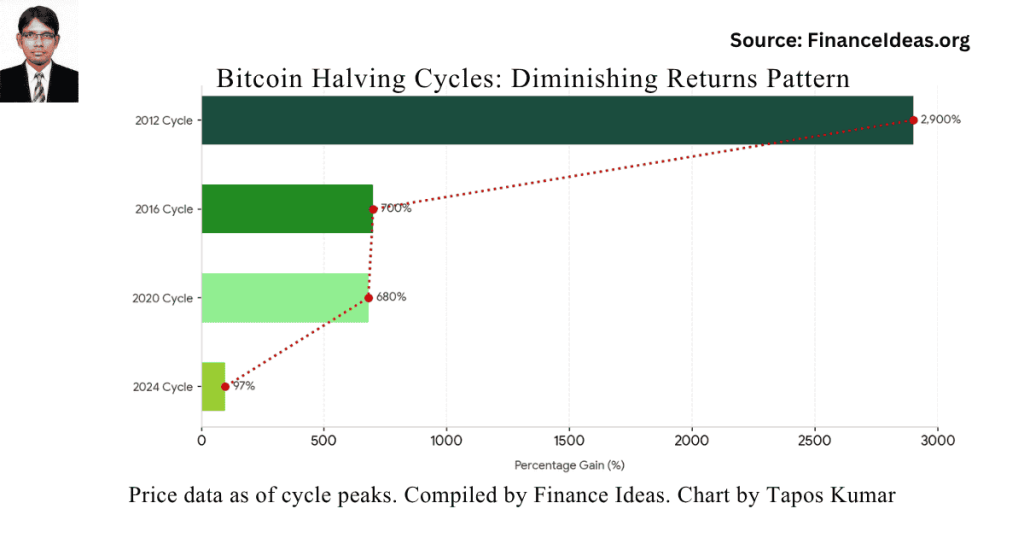
According to my analysis, if this diminishing returns pattern continues, the 2028 cycle could see gains of 50% to 80% from the halving price, which would be significantly lower than any previous cycle. Larger capital inflows are now required to drive price movements. Institutional participation continues to shape market structure, with spot Bitcoin ETFs drawing significant inflows that change the supply-demand equation entirely.
In my view, diminishing returns are not a failure, but a signature of a maturing asset. The fact is, Bitcoin is no longer a fringe experiment.
Bitcoin is a $1.5 trillion asset with institutional rails. Percentage gains naturally compress as market capitalization grows. A 50% gain on a 150,000 Bitcoin is 75,000 in absolute dollars, i.e., more real wealth creation than a 1,000% gain on a $1,000 Bitcoin.
My analysis found a miner profitability crisis?
The Bitcoin mining industry is experiencing its most stressful period since the network’s founding. Public mining companies face a wall of red ink that threatens their survival. Checkonchain’s difficulty regression model, which estimates average production costs based on network difficulty and energy inputs, pegged the figure at 88,000 per Bitcoin as of mid−March 2026. Bitcoin traded at approximately 69,200 at the time of that estimate, creating a gap of roughly $19,000 per coin and indicating the average miner was operating at a 21% loss per block mined.
Even in early May 2026, when Bitcoin traded between 80,000 and 81,000, the price was approximately 20% below the average production cost of $87,000 per BTC.
Now the question is, where is this cost pressure coming from? Oil trading above $100 per barrel following the Iran conflict feeds directly into electricity costs for mining operations, particularly the estimated 8% to 10% of global hash rate operating in energy markets sensitive to Middle Eastern supply disruptions. The effective closure of the Strait of Hormuz, which handles roughly 20% of the world’s oil and gas flows, has widened the damage to miners in regions dependent on those supply conditions.
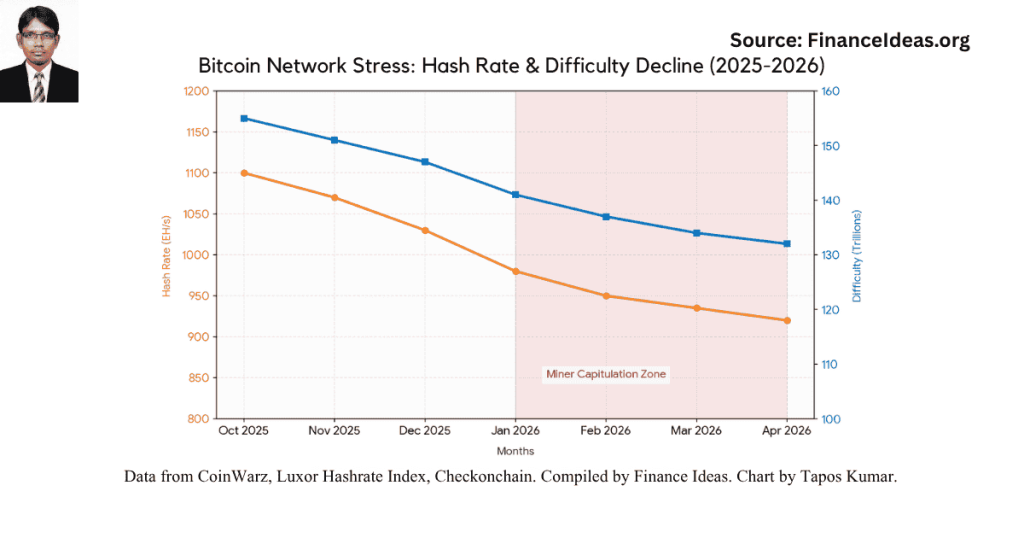
The Bitcoin network responded automatically to the slowdown in mining activity. Difficulty fell 7.76% on March 20, 2026, to 133.79 trillion at block 941,472; the second-largest negative adjustment of 2026; and is now roughly 10% below where it began the year. The hash rate has pulled back to about 920 EH/s, a notable decline from the record 1 zetahash the network reached in 2025. Hashprice, which measures expected daily revenue per unit of computing power, hovered near 33.30 per PH/s per day in late March, not far from the all-time low of 28 recorded on February 23.
Q1 2026 has now produced two of the top ten largest difficulty drops in the modern mining era, according to Luxor’s March 2026 Hashrate Lookback report. Whether this reflects a structural change in global hash rate geography, the early effects of the Iran conflict on energy-related miners, or something else entirely is an open question with real money at stake.
The financial pressure has been building since October 2025, when Bitcoin crashed from 126,000 to below 70,000. When production costs exceed the market price, miners sell Bitcoin to cover operating expenses. This creates additional selling pressure in a market where 43% of the total supply is already held at a loss relative to the October 2025 peak. Several publicly listed miners, including Marathon Digital, Cipher Mining, Core Scientific, MARA Holdings, and Hut 8, have begun directing capacity toward AI and high-performance computing to generate more stable revenue.
Why BTC miners are becoming data center operators?
In my view, if miners cannot make money mining Bitcoin, they will not shut down; instead, they will repurpose their operations.
Following the 2024 halving, block rewards were cut in half while energy, cooling, and hardware costs remained elevated, compressing margins across the industry. In response, miners are repurposing their existing infrastructure (power-heavy data centers, cooling systems, and land) into high-performance computing hubs for AI workloads. This alteration allows them to tap into more stable, long-term revenue streams tied to the surging demand for AI training and inference.
The capital market has noticed. Publicly traded miners with AI-altered descriptions trade at roughly 12.3x 12-month sales, while pure-play Bitcoin miners trade at 5.9x, which is less than half. Investors are paying double for AI risk, creating a self-reinforcing cycle: higher valuations make it easier to raise capital, which funds more AI infrastructure, which attracts more AI contracts.
This changes the fundamental economic model underlying the Bitcoin network. For 15 years, miners had one revenue stream: Bitcoin. If the Bitcoin price fell, miners shut down. Now, large portions of hashpower are becoming economically decoupled from Bitcoin’s price, because those miners have other revenue streams to lean on. A miner with a 15-year AI contract worth $7 billion doesn’t need to sell Bitcoin at the bottom to cover electricity bills. That miner can simply hold coins and wait for better prices. This could fundamentally reduce sell pressure after the 2028 halving, making the post-halving rally look very different from prior cycles.
Let me tell you why old price models are breaking for BTC?
So, you have seen the charts. Stock-to-flow, rainbow charts, power law, i.e., all the models that promised 1million Bitcoin by 2025 or 222,000 by 2026. They broke. Yes, bitter but true & let me tell you why?
The stock-to-flow model projects that Bitcoin could climb to 222,000 by 2026. Over the longer term, the model projects a 10-year valuation of 10.9 million per BTC. But Bitcoin has consistently underperformed the S2F-implied price, with residuals showing a Bearish bias and non‑stationary patterns suggesting omitted variables and statistical flaws.
Let me tell you what happened. The stock-to-flow ratio assumes that supply reduction alone drives price appreciation. But today, institutional demand via Bitcoin ETFs and treasury holdings far outweighs the annualized supply reduction from any single halving by more than 7 times.
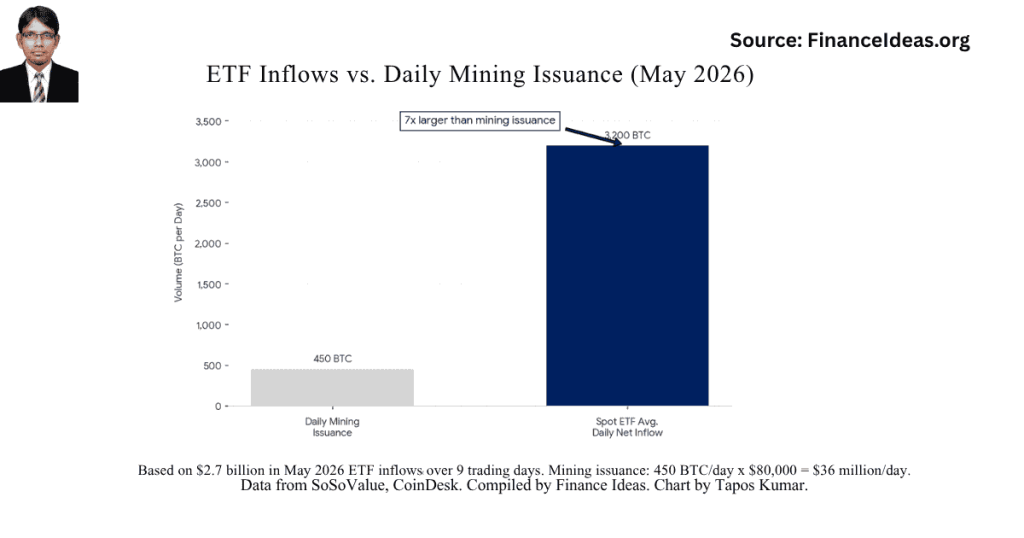
Bitcoin’s macro environment has fundamentally evolved since 2019. Institutional participation now shapes market structure. Spot Bitcoin ETFs absorbed roughly 2.44 billion in net inflows in April 2026 alone, nearly double March′s total. Total spot Bitcoin ETF assets under management now stand at approximately $102 billion, with cumulative net inflows since launch reaching $58.72 billion.
When ETF inflows alone can exceed total daily mining issuance multiple times over, the halving’s supply-side impact becomes dramatically less important than it once was. BlackRock’s IBIT alone captured over 70% of the month’s total inflows. That single ETF (one product) has more market-moving power than the entire global Bitcoin mining industry’s annual reduction in issuance from the 2028 halving.
Does this mean the halving isn’t important? No. But it means the halving is no longer the only story, or even the primary story. Price will be driven more by institutional adoption rates, regulatory clarity through the CLARITY Act, ETF flow patterns, and the macro liquidity environment. The halving is not the lead role; instead, it becomes a supporting actor.
Price Scenarios for 2028–2029 BTC halving? (my neutral logical analysis)
Here are my three plausible paths for Bitcoin leading into and following the 2028 halving.
Bear Scenario = 75,000 to 150,000: Miner capitulation continues. AI transformation fails for some operators. ETF inflows stagnate. Regulatory uncertainty persists. Bitcoin trades sideways through 2027 and enters the halving without the usual pre-halving run-up.
Base Scenario = 150,000 to 250,000: A moderate pre-halving rally begins in late 2027. ETF inflows return to 2025 levels. Institutional adoption slowly increases. The CLARITY Act passes, providing regulatory clarity. The halving acts as a positive catalyst, and Bitcoin reaches new highs by mid-2029.
Bull Scenario =250,000 to 500,000: The AI transformation successfully diversifies miner revenue, reducing sell pressure. Bitcoin’s scarcity description combines with accelerating institutional adoption. ETF assets under management double from current levels. Macro conditions favor risk assets. Bitcoin enters a multi-year upswing.
Yes, long-term models vary widely. The BAERM model currently estimates Bitcoin’s fair value at 159,000, projecting 7.59 million over ten years, with around 88% predictive fit since the second halving. The stock-to-flow model forecasts approximately $10.9 million per Bitcoin over the next decade. Neither model fully accounts for the AI transition, institutional ETF dynamics, or the CLARITY Act’s regulatory impact, meaning the actual path could differ meaningfully from both projections.
My personal base-case view is a price range of 200,000 to 250,000 by late 2029, representing significantly lower percentage gains than any prior cycle but substantial absolute dollar appreciation from today’s levels of around $74,000. That is a roughly 150% increase over three years, i.e., not the 1,000% gains of 2016, but enough to generate significant wealth for patient holders.
Finance Ideas TL; DR | Tapos Kumar
The 2028 halving arrives at a moment when Bitcoin’s market structure has fundamentally changed. How? ETF-driven demand now outweighs supply reduction by more than 7 to 1. Miner economics are broken, with production costs far exceeding market prices. Yeah, historical halving patterns are important, but they need recalibration. The companies you call miners are becoming AI data center operators.
Download Free PDFs Without E-mail
- Bitcoin halving 2028 quick reference Tapos Kumar
- Bitcoin halving 2028 price scenarios Tapos Kumar
- Bitcoin miner capitulation guide Tapos Kumar
- Bitcoin halving 2028 data pack Tapos Kumar
Frequently Asked Questions (FAQ) about Bitcoin Halving Cycle?
Exactly when is the next Bitcoin halving?
Hmm, Mid-April 2028 is the current projection, but the exact timing depends on network hashing speed. The halving occurs automatically at block height 1,050,000, so it is not on a fixed calendar date. Different live trackers give slightly different projected dates, ranging from mid to late April 2028.
How much will the block reward be after the 2028 halving?
According to my analysis, the reward will drop from 3.125 BTC per block to approximately 1.5625 BTC per block. Daily new issuance will decline from about 450 BTC to roughly 225 BTC.
What happens if BTC miners keep losing money?
Hmm, weak miners will shut down. The network difficulty will drop, making it easier for remaining miners. Hashrate will consolidate among the most efficient operators; those with electricity below $0.04/kWh and next-generation S21-class ASICs. This is called miner capitulation, and it historically precedes major price bottoms.
How do ETF inflows affect the halving?
ETF inflows now outweigh daily mining issuance by a significant margin. A single ETF (BlackRock’s IBIT) accounted for over 70% of the $2.44 billion in inflows in April 2026. Supply mechanics matter less when institutional demand completely overwhelms new issuance.
What is the most efficient miner hardware in 2026?
S21 XP class ASIC miners, operating at 15–20 joules per terahash, are the only machines viable in the current 68,000–81,000 price range. Their shutdown price is estimated at 55,000–62,000, assuming a competitive power cost of 0.05/kWh. S19XP machines have a shutdown price of approximately 75,000 and have largely been powered down.
Will the 2028 halving cause a price crash or a rally?
Historically, halvings have preceded major price rallies, but with a lag of 12–18 months. The rally has never been immediate. Expect sideways trading or moderate declines immediately following the halving, followed by a sustained uptrend beginning 6–12 months later. Diminishing returns mean the magnitude will likely be smaller than in prior cycles.
How much Bitcoin will be mined between now and the 2028 halving?
Approximately 450 BTC per day, or roughly 164,250 BTC per year, until the halving. That is roughly 328,500 BTC between now and April 2028; less than two weeks of ETF inflow volume at current rates. The supply is small relative to institutional demand.
Will the CLARITY Act affect the 2028 halving?
Yes. The CLARITY Act would define the regulatory roles of the SEC and CFTC on digital assets, providing long-term regulatory clarity that institutions require for full-scale adoption. If passed, it could dramatically accelerate ETF inflows before the 2028 halving, changing the supply-demand equation entirely.
Should I buy Bitcoin now or wait for the halving?
Dollar‑cost averaging during the current mining capitulation period has historically been effective. Trying to time the exact bottom is difficult. The hash ribbons capitulation signal may indicate that the worst of miner selling is already underway. Accumulating gradually through 2026 and 2027, rather than waiting for a specific halving date, is the more prudent approach.
What is the single most important metric to watch before the 2028 halving?
ETF flow data, specifically the seven-day moving average of net inflows into U.S. spot Bitcoin ETFs. When institutional buying consistently exceeds mining issuance, it creates supply pressure that historically precedes upward price moves. And, hash rate and difficulty trends are secondary.
Could the 2028 halving be the last one to have a significant price impact?
Hmm, possibly. As Bitcoin matures and institutional ETFs dominate, supply-based scarcity arguments will continue to diminish. The 2032 halving may have a minimal price impact because ETF demand will have already absorbed most of the available supply. The 2028 halving may be the last cycle where the event itself meaningfully moves markets.
Tapos’s last thought
Before closing my article, I want to share my last advice with you:
First, adjust your expectations. Do not expect the 1,000% gains of prior cycles. Bitcoin is too large and too mature for that. A 100% to 200% gain over the next three years is expected and historically consistent with diminishing returns. That is an excellent return.
Second, watch the miners. Miner capitulation is one of the most reliable bottom signals in Bitcoin markets. The hash ribbon indicator is currently flashing a capitulation signal; historically, a feature of major bottoms in 2019 and 2022. When the capitulation ends, it marks excellent entry points. When miners collectively stop selling and start accumulating, it is a strong signal that the worst is over.
Third, differentiate between miners. Publicly traded miners with AI contracts and low debt are fundamentally different from pure-play miners burning cash every quarter. The AI miners will survive the halving even if the Bitcoin price stays flat. The pure-play miners may not. If you invest in mining stocks, you must understand which is which.
Fourth, understand the new price drivers. ETF inflows are more important than supply issuance. You should track weekly ETF flow data the same way you track Bitcoin price. When ETFs are absorbing 5 to 10 times daily mining issuance, the halving’s supply-side impact becomes marginal.
Fifth, be patient. The halving cycle still works; just more slowly and with lower amplitude. The best strategy for most investors remains dollar-cost averaging and long-term holding. Trying to time the precise bottom of the mining capitulation cycle is difficult. Just accumulating through the pain is simpler and historically effective.
Sixth, watch for the AI-margin pull. Miners successfully transitioning to AI will have diversified, stable revenue streams. Those stocks may re-rate higher as AI infrastructure plays before the halving arrives & that trade is starting now.
Seventh, respect the diminishing returns. If each halving cycle produces smaller percentage gains, do not leverage yourself expecting 10x returns. Remember that position size matters. Bitcoin is a solid addition to a diversified portfolio, so do not think of it as a lottery ticket.
References & Sources
Below is the lists of sources that I have used to write this article:
- CLARITY Act (H.R. 3633) – The Digital Asset Market Clarity Act
- SEC Clarifies Application of Federal Securities Laws to Crypto Assets
- Executive Order 14330 – Democratizing Access to Alternative Assets for 401(k) Investors
Disclaimer
This is not a Sponsored post & the purpose of this article is only education. By reading this, you agree that the information of this blog article is not crypto investing advice. Do your own research before making any financial decision. Therefore, if you lost any money, Finance Ideas will not be liable for this.