Look, I am not political & going to say something that might surprise you.
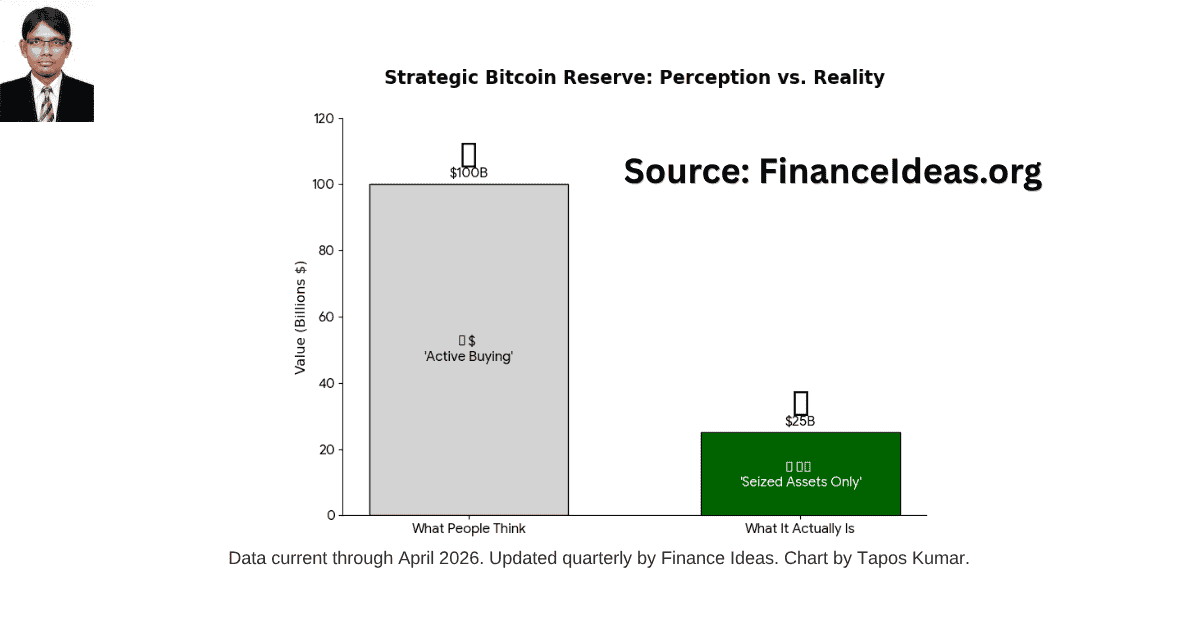
When President Trump signed Executive Order 14233 back in March 2025, headlines screamed: “U.S. Creates Strategic Bitcoin Reserve!” Social media lit up. Every expert assumed Uncle Sam was about to start scooping up Bitcoin like there was no tomorrow.
Unfortunately, that never happened.
Almost a year later, the “Strategic Bitcoin Reserve” sounds like a monumental endorsement of crypto. But the reality is way more complicated, and for some, a little disappointing. The US government is holding onto a massive pile of Bitcoin. But it is not buying it, not managing it for profit, and not even using it to stabilize markets.
And while you weren’t looking, the value of that so‑called strategic stash gradually lost 26%.
Please pardon me if my lines hurt you. Today, I will write about what this reserve is, what it is not, and why it is important for you as an investor.
I will also write about the growing gap between this passive federal holding and the active, aggressive plans being proposed by lawmakers on Capitol Hill and even at the state level.
I hope, after reading my article, you will know more about America’s crypto stockpile than others do.
Finance Ideas AI snippet box | Tapos Kumar
What is the strategic bitcoin reserve?
On March 6, 2025, President Trump signed Executive Order 14233. It ordered the Treasury Department to create two distinct pools of digital assets:
1 = Strategic Bitcoin Reserve: Holds only Bitcoin.
2 = US Digital Asset Stockpile: Holds all other seized cryptocurrencies (Ethereum, stablecoins, etc.).
But the reserve is capitalized fully with bitcoin owned by the Department of the Treasury, which was finally forfeited as part of criminal or civil asset forfeiture proceedings. In simple terms, the government swept up all the crypto it already had lying around from busts and forfeitures, put it in one place, and called it a reserve. It never went to the market to buy a single extra Bitcoin.
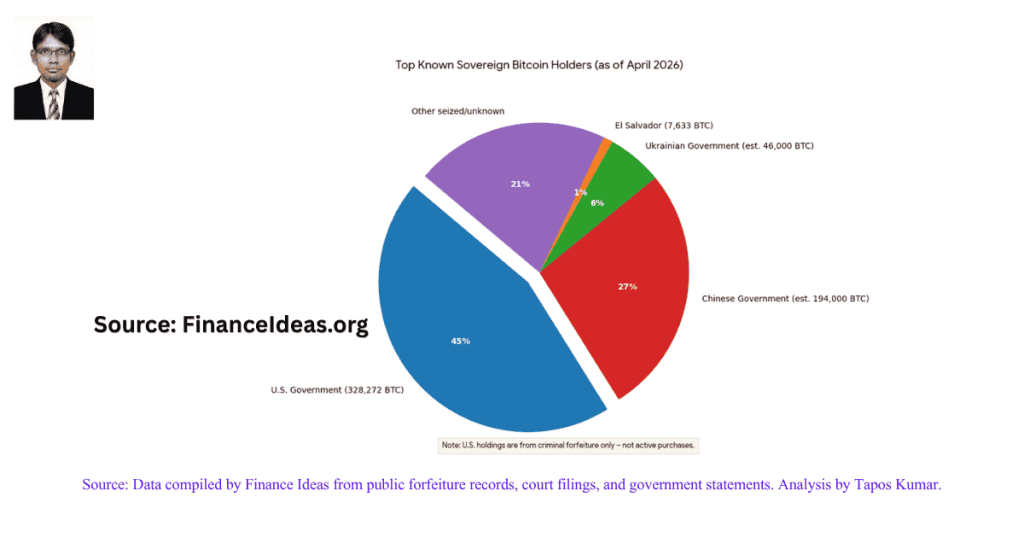
On the very same day the executive order was signed, the Treasury and Commerce Secretaries were authorized to develop budget‑neutral strategies for acquiring additional bitcoin, provided they impose no incremental costs on United States taxpayers. That is right; the order leaves the door cracked open for future purchases, but only if they are free; no spending taxpayer money & no dipping into the general fund.
The government is explicitly prohibited from acquiring additional assets for the stockpile (the non‑Bitcoin part) unless they come through forfeiture. That prohibition does not apply to Bitcoin, but the budget‑neutral requirement means any future acquisition would have to be quite creative; i.e., think donations, barter, or tapping into a separate sovereign wealth fund.
Related Articles
-
Bitcoin vs M2: Why the Old Liquidity Model Died (2026 Data)
- How high will Bitcoin go: Trump’s Secret Plan Revealed (2026 Update)
-
Bitcoin miners AI compute providers: Yes, Miners silently moving towards AI
What is not a strategic Bitcoin reserve?
First, you need to know that a strategic Bitcoin reserve is not:
- A sovereign wealth fund investing in crypto for profit
- A market‑stabilization fund, like the exchange stabilization fund, for currencies.
- A government endorsement of Bitcoin as a legal tender or official reserve asset
- An actively managed fund that buys, sells, or trades Bitcoin
- A mechanism where taxpayers foot the bill for crypto accumulation
I think the most common misperception is the name itself. How? When people hear Bitcoin Reserve, they think of something akin to the Strategic Petroleum Reserve: a vast government stockpile actively managed, drawn upon in emergencies, and refilled as needed.
That is not the case here. Bitcoin is not bought; it is just held. It cannot be sold. It produces no yield, earns no interest, and provides no liquidity in a crisis. It is an inert pile of digital gold collecting digital dust.
Pause for a second and think about the implications. The model for this reserve came from two very different sources. One is the Strategic Petroleum Reserve, hmm, a purchased stockpile. But the administration merged that idea with the U.S. Bullion Depository at Fort Knox, a repository for assets the government already owns, mostly from old Treasury gold holdings. The resulting hybrid creates endless confusion. As of today, Congress has not codified it into law, & leaving its long‑term structure open to political winds.
How did the Bitcoin reserve decline by 26%?
At the time of the executive order, the US government’s cryptocurrency holdings were valued at over 30 billion. As of early March 2026, that value had dropped to approximately 22.39 billion, a decline of 26%.
Can we expect recovery? Or the more decline in loading. I don’t know. If you know, then share it in the comments so that I can learn from you.
Now you could ask me why the reserve loses value? Because the government did nothing. It did not buy the dip, did not sell to lock in gains, and certainly did not hedge. The entire portfolio has been sitting idle as Bitcoin’s price corrected from its late‑2025 highs. Let me share the facts:
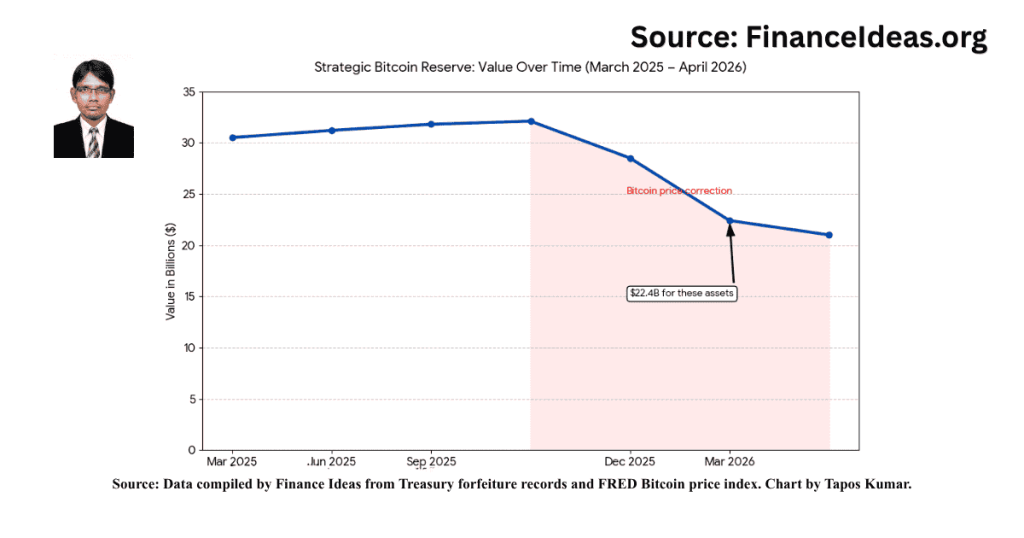
Metric Value at Launch (March 2025) Current Value (April 2026) Change
Government Crypto Holdings > $30 billion $22.39 billion -26%
But this is unrealized paper loss. It is not money spent and lost. It is crypto that was seized for free, transferred to the Treasury at zero cost.
Yeah, the US government has not spent taxpayer dollars to acquire any Bitcoin in its Strategic Bitcoin Reserve.
However, the lack of transparency and a clear framework could distort markets and erode public trust. Moreover, the 26% decline occurred even as Bitcoin’s price was historically high, meaning the drop did not require a catastrophic crypto winter, just normal post‑ATH cooling.
I found competing visions for a real BTC reserve on Capitol Hill?
If the executive order represents the passive approach, Capitol Hill is buzzing with proposals for something far more aggressive. Let me explain it:
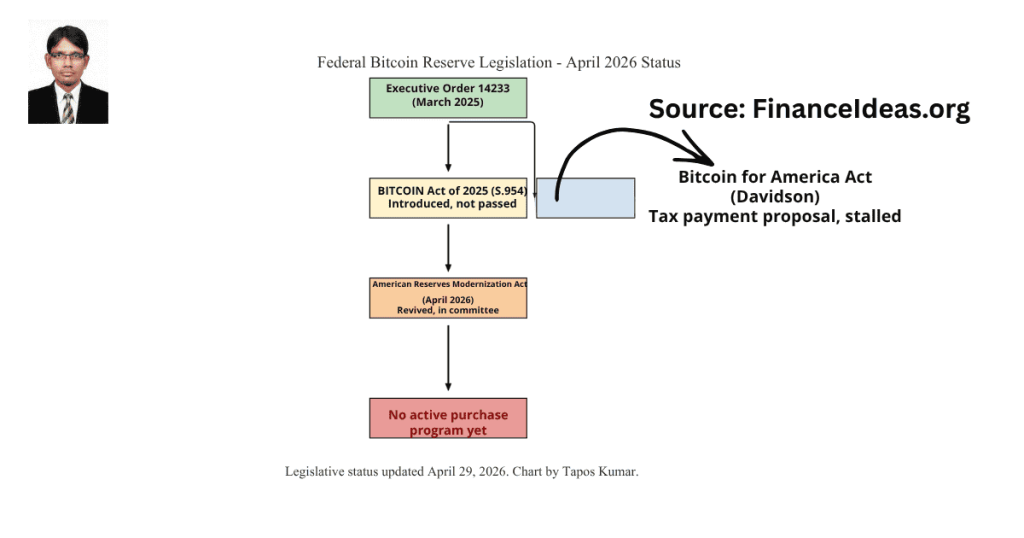
The Bitcoin Act of 2025 (S.954)
Shortly after the executive order, Senator Cynthia Lummis (R‑WY) and Congressman Nick Begich (R‑AK) introduced the Bitcoin Act of 2025. This bill would establish a strategic Bitcoin reserve by having the government purchase BTC over time.
Key provisions include:
- A mandated purchase of up to 200,000 bitcoins per year over five years
- A 20‑year holding requirement on all acquired bitcoin
- A decentralized network of secure, geographically distributed storage facilities across the United States
In an interview announcing the legislation, Begich described it as a natural extension of the executive order: “The administration’s EO was a first step. Our bill gives it the force of law and adds the missing piece: active acquisition.”
The American Reserves Modernization Act (2026)
On April 25, 2026, Begich announced plans to revive the legislation under a new name: the American Reserves Modernization Act. The move follows President Trump’s executive order establishing the strategic Bitcoin reserve and US digital asset stockpile, a bill that would seek to codify it into law.
This signals that the fight over what a strategic Bitcoin reserve” means is far from over.
The Bitcoin for America Act (Rep. Warren Davidson)
Meanwhile, Rep. Warren Davidson (R‑OH) has taken a different approach entirely. His Bitcoin for America Act would allow taxpayers to pay their federal taxes in Bitcoin, with the proceeds funneled directly into the strategic Bitcoin reserve.
“By allowing taxpayers to pay federal taxes in Bitcoin and having the proceeds placed into the strategic Bitcoin reserve,” Davidson said, “the nation will benefit by having a tangible asset that appreciates in value over time; unlike the U.S. dollar, which is guaranteed to lose value.”
The proposal is genius on multiple levels. It gives crypto advocates a real‑world way to use Bitcoin for a major financial obligation; it creates a steady, demand‑driven inflow into the reserve without tapping the general fund; and if Bitcoin appreciates over time, it could become a net revenue source for the government.
I found that states are moving faster than Washington?
Amid the federal debate, individual states are already implementing their own plans. Let me tell you how:
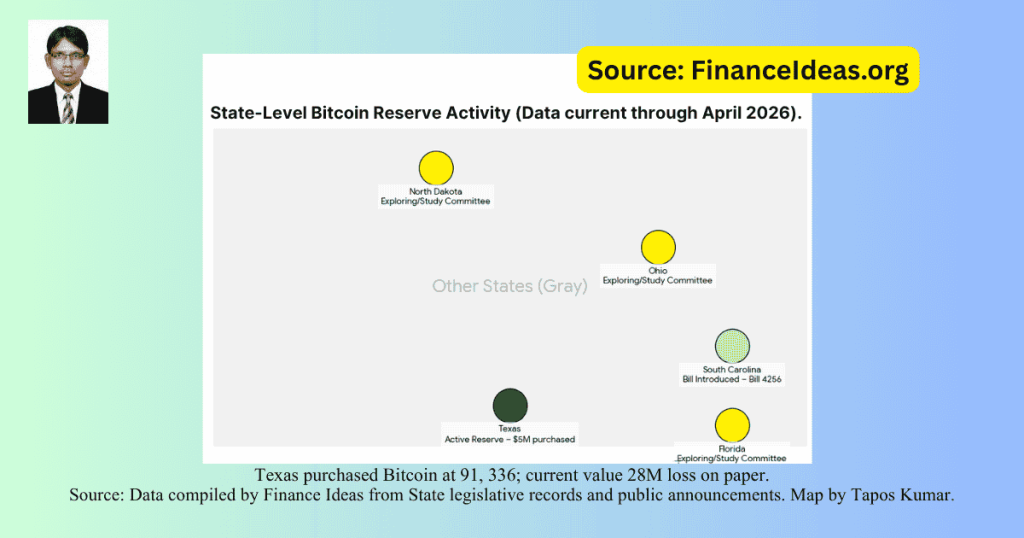
- Texas seeded a state‑level Bitcoin reserve fund with 5 million in late 2025, buying Bitcoin at a market price of 5 million, and then buying Bitcoin at a market price of 91,336. Less than two months later, that initial purchase had lost more than 28% of its value.
- South Carolina introduced the Strategic Digital Assets Reserve Act (Bill 4256), which would allow the State to own digital assets, including Bitcoin, “as a financial asset,” and for South Carolinians to voluntarily donate digital assets to promote a shared ownership.
This patchwork of state experiments raises an obvious question in my mind: if the federal reserve is not actively buying, could state reserves spark a new source of institutional demand in 2026‑27? If you know, share in the comments.
Download PDFs Resources Without E-mail
- Strategic Bitcoin Reserve Fact Sheet-Tapos Kumar
- Bitcoin Reserve Myths vs Reality Tapos-Kumar
- Bitcoin Reserve Legislative Tracker-Tapos Kumar
Finance Ideas TL; DR | Tapos Kumar
The strategic Bitcoin reserve is not the US buying Bitcoin. It is a passive vault of roughly $22 billion in crypto assets that the government already owns through criminal forfeitures, like putting seized gold into Fort Knox, rather than going to the market to buy more. Under Executive Order 14233, the Treasury cannot purchase Bitcoin for the reserve or sell what it already holds. The only way the reserve grows is through future forfeitures or an act of Congress. Meanwhile, the paper value of the reserve has dropped 26% since launch; an unrealized loss on assets that cost taxpayers nothing.
Frequently Asked Questions (FAQ) about the strategic bitcoin reserve: what is it?
Can the US government sell the Bitcoin in the reserve?
Under current rules, no. The executive order explicitly prohibits the sale of any Bitcoin deposited into the Strategic Bitcoin Reserve. It is meant to be a long‑term store of value, and not a trading desk. However, Congress could change that with new legislation.
Does the strategic Bitcoin reserve mean the US is adopting Bitcoin as a reserve currency?
No. It is not a reserve currency like the dollar or gold. It is a passive holding of assets that the government already owns. It does not back the dollar, does not stabilize markets, and cannot be used for international settlements.
Can I donate my Bitcoin to the strategic Bitcoin reserve?
Not directly. There is no public donation mechanism. However, the Bitcoin for America Act (proposed by Rep. Warren Davidson) would allow taxpayers to pay federal taxes in Bitcoin, with the proceeds funneled into the reserve. That bill is still in committee.
What happens if the government seizes more Bitcoin from criminals?
That Bitcoin is automatically added to the reserve. For example, if the DOJ seizes 5,000 BTC from a darknet market operator tomorrow, those coins will be added to the strategic Bitcoin reserve without any congressional approval.
Does the reserve affect Bitcoin’s price?
Hmm, minimal. Because the government is not buying or selling, the reserve does not create supply or demand pressure. However, the psychological impact is real, i.e., it signals that the US government sees Bitcoin as a legitimate asset worth holding long‑term.
Could a future US president empty the reserve?
A subsequent president can revoke the executive order. If that happens, the Treasury could sell the Bitcoin. However, selling would require a new policy and likely congressional involvement. The reserve is not yet permanent law; that is why the Bitcoin Act is important.
How does the reserve‘s 26% loss compare to the Strategic Petroleum Reserve?
The Strategic Petroleum Reserve has also lost value at times (when oil prices drop). But I found the key difference is that the SPR was actively purchased with taxpayer money. The Bitcoin reserve cost taxpayers $0. So, a paper loss on free assets is not a fiscal problem.
What should I watch to know if the reserve will expand?
I recommend three things:
- Progress of the American Reserves Modernization Act (revived April 27, 2026)
- Statements from Treasury Secretary Bessent about a budget‑neutral acquisition.
- State‑level reserve performance; if Texas or South Carolina succeeds, it builds momentum for federal purchase programs.
Is there any chance the US will sell Bitcoin to fund the national debt?
Hmm, politically unlikely, since the executive order prohibits sales. Any sale would require a new law passed by Congress. Given the crypto lobby’s strength, a sale is unlikely unless there is a major scandal or Bitcoin collapses to near zero.
Tapos’s last thought
The strategic Bitcoin reserve is not a market catalyst today. But it is a clear signal that the US government is officially in the Bitcoin custody business.
So, what should you do in this situation? Below, I have given some advice for you.
- Adjust your expectations. Yes, do not expect the US government to start buying Bitcoin in 2026. The current budget‑neutral language makes active accumulation extremely unlikely. If you see headlines about “more bills introduced” or “lawmakers push for active purchases,” that is a down‑the‑road story.
- Watch Texas and South Carolina. If those state‑level reserves perform well or poorly with their active purchase strategies, they will serve as real‑world pilots for the federal debate.
- Follow Begich’s American Reserves Modernization Act. It was revived on April 27, 2026. If that bill picks up co‑sponsors or moves to a committee hearing, the probability of active US Bitcoin purchases increases substantially.
- Use the confusion as your edge. The fact that most people misunderstand this reserve means you have a valuable informational edge. When everyone else expects a government buying spree, you know the reality is far more muted.
- Do not panic over the 26% loss. The government paid nothing for those coins. Unrealized paper losses on seized assets are not a budget problem, i.e., they are a headline problem.
Do you think the US should turn this passive hoard into an active buying program? Or is the current “hold what we have” approach the right one? Share your opinion in the comment below.
References & Sources
Below is the lists of sources that I have used to write this article:
- Executive Order 14233, Congress.gov, and Federal Register
- Fact Sheet: President Donald J. Trump Establishes the Strategic Bitcoin Reserve and U.S. Digital Asset Stockpile
- Texas Legislation Status (Strategic Bitcoin Reserve Bill)
Disclaimer
This is not a Sponsored post & the purpose of this article is only education. By reading this, you agree that the information of this blog article is not crypto investing advice. Do your own research before making any financial decision. Therefore, if you lost any money, Finance Ideas will not be liable for this.