Last night, one of my readers shared a personal experience via a LinkedIn message. At first, I thought it was spam or fake, but after 2 hours, I visited official sites to verify it. I also checked Reddit for evidence, i.e., whether anyone had said something similar to this. I do this because I am now writing articles on Black Friday deals.
Let me share that message with you (yeah, I have permission): I called the customer service lines for Walmart, Target, and Best Buy and asked: “I bought a TV on Black Friday. It has one dead pixel. Can I return it?”
| Retailer | Response | My interpretations |
| Walmart | Yes, as long as it is within the return deadline. One dead pixel qualifies as defective. | Walmart makes returns simple for defective products. |
| Target | It depends on the number of dead pixels. Our policy requires 3+ dead pixels for a return. | Target doesn’t see one dead pixel as a defect. You would need more than that for a return. |
| Best Buy | You can return it, but there is a 15% restocking fee if the box is opened. | Best Buy charges a fee even on defective items if the box is opened. |
Now you might be thinking: why am I sharing this without a traditional article intro? Hmm, a reasoning question. If you are a regular reader, you know I write about financial solutions. I am a finance pro; I collect facts from trusted sites and then interpret them in simple language so you can make financial decisions.
Okay, come to the point. Did you notice that the same product, the same defect, three completely different outcomes. That means, the return policy is not a policy; it is a negotiation. And the only way to win the negotiation is to know the rules before you buy. Don’t worry. I will teach you those ways. One small request: Don’t open multiple pages side‑by‑side; it will shorten your reading time. My article needs active reading for maximum financial benefits. Just sip coffee & start reading:
Finance Ideas AI snippet box | Tapos Kumar
Are Black Friday return policies different from regular policies?
Yes. Many retailers extend their return periods for holiday purchases. However, some also add restrictions, like final sale labels or shorter deadlines for electronics. Best Buy’s restocking fees on drones, cameras, and phones apply year-round, but they are especially relevant during Black Friday when shoppers buy more electronics.
Related Articles
-
Black Friday Shopping [How to Survive the Crowds and Save Money in 2026]
-
Spot fake Black Friday deals verification guide: I Tracked 25 Retailers’ Black Friday Prices. Most Were Fake
-
Black Friday scams avoid safety guide: The Complete Safety Guide
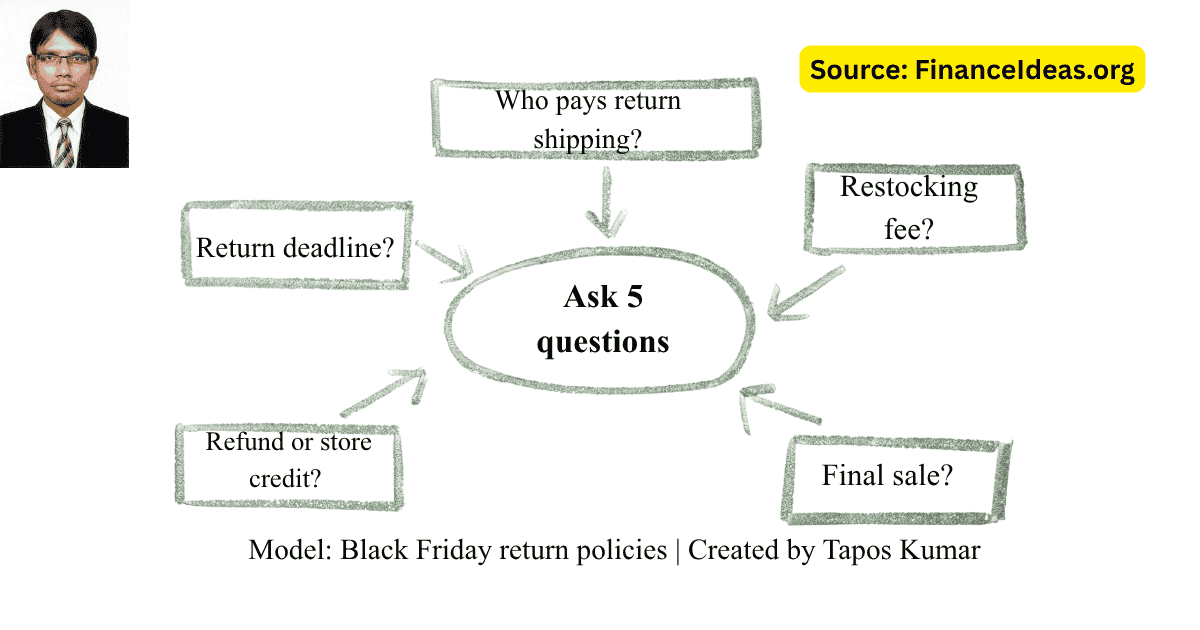
I have created a 5-question model for you. Ask these questions before Black Friday purchase. I hope it saves you time & money.
Question 1 = What is the return deadline?
Did you know holiday return periods differ from regular policies? Most retailers extend their standard 30-day deadline to 60–90 days for purchases made between October and December.
I know you are thinking of asking AI, but wait a second. I have collected data from major retailer sites. I have explained it simply so you can understand quickly. It will save you time & money.
Let’s read the table:
| Retailer | Holiday return deadline | Exceptions |
| Walmart | Purchases Oct 1 – Dec 31 returnable until Jan 31 | Electronics/jewelry shorter (14–30 days) |
| Amazon | Most items purchased Nov 1 – Dec 31 returnable until Jan 31 | Marketplace sellers can differ |
| Target | Extended through late January | Apple products: 14 days; other electronics: 30 days |
| Best Buy | Standard 15 days; 60 days for Plus/Total members | Phones/drones/cameras: restocking fee (10–15%) |
| Costco | 90 days for electronics; unlimited for most items | No restocking fees |
Did you find the table helpful? Please, let me know in the comments. If you understand it, then you need to do following 2 tasks:
Ask yourself: What is the last day I can return this?
Write the date: _______________
Question 2 = Is there a restocking fee?
Restocking fees can be 10–15% of the purchase price. On a $500 drone or camera, that is $75 to return it.
Let me share official data from top US retailers with my interpretations:
- Best Buy charges a flat $45 on activatable devices (cell phones, cellular tablets, cellular wearables) and 15% of the item purchase price on drones, DSLR cameras, mirrorless cameras, camcorders, projectors, and special-order products.
- Walmart usually doesn’t charge restocking fees.
- Target generally does not charge restocking fees.
- Costco does not charge restocking fees.
Read my note: Best Buy does not charge a restocking fee if the product is unopened, or if the purchase occurs in Alabama, Colorado, Hawaii, Iowa, Mississippi, Ohio, Oklahoma, South Carolina, or where prohibited by law.
Ask yourself: Is there a restocking fee if I return this?
Write the fee: _______%
Question 3 = Is this item final sale?
Some Black Friday items, especially doorbusters and deeply discounted products, are marked final sale. This means no returns, no exchanges & no exceptions.
After visiting official sites, I found this= Best Buy explicitly lists “Items marked as Final Sale” as nonreturnable. Then, some stores don’t allow returns on clearance items and can offer store credit instead of a refund.
Ask yourself: Is this item final sale, or can I return it?
Check: ☐ Returnable ☐ Final sale
Question 4: Do I get a refund or store credit?
Some retailers offer store credit only for returns without a receipt. Without a receipt, you may receive store credit instead of a refund.
After visiting official sites, I found this = Most major American retailers offer full refunds to the original payment method with a receipt. Without a receipt, policies vary. Best Buy states that “reimbursements on returns lacking proof of purchase may be subject to fees”.
Ask yourself: Will I get a full refund to my original payment method?
Write: ☐ Full refund ☐ Store credit ☐ Exchange only
Question 5 = Who pays for return shipping?
Some retailers charge $9.99 or more for return shipping if you are not a rewards member. This adds to your cost if you need to return.
My data analysis found the following:
- Amazon offers free returns on most items.
- Target offers free returns for Circle members.
- Best Buy offers free returns via prepaid UPS shipping label.
- Walmart offers free returns in-store
Ask yourself: Do I have to pay for return shipping?
Write: ☐ Free ☐ $_______ fee
Holiday Return Deadlines?
Below, I have provided a comparative analysis of return policies. I hope it saves you time & give you enough guidance to understand major retailers.
| Retailer | Standard return period | Holiday extension | Restocking fees | Final sale items | Return shipping |
| Walmart | 90 days | Oct 1 – Dec 31 to Jan 31 | Rare (electronics/jewelry) | Select items | Free in‑store |
| Amazon | 30 days | Nov 1 – Dec 31 to Jan 31 | Rare (marketplace sellers can differ) | Amazon Haul & Renewed items | Free on most items |
| Target | 90 days | Extended through late January | No (Apple products only 14 days) | Select items | Free for circle members |
| Best Buy | 15 days | 60 days for Plus/Total members (Jan 14–31) | $45 on activatable devices; 15% on drones/cameras/projectors | Yes, marked final sale | Free via prepaid UPS label |
| Costco | 90 days for electronics; unlimited for most items | No extension needed | No | No | Free |
| Macy’s | 90 days | Extended through January | No | Last Act items excluded | $9.99 for non‑members |
| Kohl’s | 180 days | Extended during holidays | No | Select items | Free in‑store |
We conducted case studies to understand Black Friday return policies?
We collected the top 3 cases from consumer forums and review sites, including Quora & Reddit. These are real customer complaints, so you can trust us.
One confession: we reviewed about 100 similar cases, then modified them with professional judgment to make them helpful. So these cases are not exact copies, but they help you understand Black Friday return policies easily. Read closely; it could be similar to yours.
Case study 1= The $120 drone return
A shopper bought a drone from Best Buy. When he tried to return it, he was charged a 15% restocking fee, hmm, $120 on an $800 drone. He described himself as a “loyal” customer and said he didn’t know about the fee because it was listed on the product page & didn’t find it at checkout.
In my analysis, this return has failed because =Best Buy’s return policy explicitly states that drones have a 15% restocking fee if returned by any customer, including Elite and Elite Plus members.
My lesson from this case: Best Buy’s restocking fees apply to drones, DSLR cameras, mirrorless cameras, camcorders, projectors, and electric micro mobility devices. So, always check the product page for the restocking fee before buying.
Case Study 2 = The $70 Phone restocking fee
A customer returned two phones to Best Buy. He was told he owed $34 per phone, hmm, $70 total, for restocking fees. He had paid $2 for the phones under a promotional offer. The store manager told him there was no possible way to override the restocking fee. He spent three hours in the store and left in despair.
In my view, this return failed because Best Buy charges a flat $45 restocking fee on activatable devices, including cell phones. The fee applies even if the customer believes the return is acceptable.
My lesson for you: The restocking fee on phones and tablets is flat; it doesn’t matter what you paid for the device. A $2 phone can cost you $45 to return. If you are buying a phone or tablet as a gift, know the return fee before you buy.
Case Study 3 = The hidden 15% fee
A shopper ordered an item online, and a representative told them there would be no restocking fee. When the return was processed, they deducted a 15% restocking fee.
Hmm, this return has failed because the customer relied on a verbal assurance from a representative. In my opinion, the customer should ask for or request the written policy as a document. This is because Best Buy’s written policy clearly states that certain items carry a 15% restocking fee.
My lesson for you after analyzing 3 cases: Never rely on what a customer service representative tells you. The written policy is the only thing that can save you. Take a screenshot of the product page showing the return policy before you buy.
Did you know? Restocking fees are legal in all 50 states?
Yes, you read it correctly, but the rules can vary. Restocking fees are legal in every US state, and no federal law bans them. However, several states impose specific disclosure requirements that go beyond simply mentioning it somewhere.
Let’s understand it:
| State | What the Law requires? |
| California | Retailers must conspicuously display their return policy, including restocking fees, before purchase. The policy must be posted in a location visible to the consumer at the time of purchase. |
| Connecticut | Restocking fees are allowed, but only if clearly stated in the store’s return and refund policy. Connecticut law requires that restocking fees be disclosed in bold or underlined print on the posted policy. |
| Nine States | Connecticut, Maryland, New Jersey, Utah, Arizona, California, Hawaii, New York, and Virginia require retailers to conspicuously display their return (exchange) policy at the time of purchase. |
Read my note: You can’t charge a restocking fee for a defective item. If the item is defective, damaged in transit, or not what you ordered, the return is the seller’s responsibility, and charging a restocking fee in that situation runs against consumer protection expectations in most states.
What does this mean for you?
Say you live in California or Connecticut, and the retailer did not clearly disclose the restocking fee before you bought. In that case, you have a legal basis to dispute the fee. If you live in a state without specific disclosure requirements, the retailer’s written policy controls, so screenshot it before you buy.
Just walk away if you see these signs in Black Friday returns?
Listen: I know you are hyped, or your surroundings may be pushing you to shop. Wait a moment & check these alarming signs. If you see any of these, think twice before buying. Let’s understand them:
| Alarming signs | Dangerous? |
| Final sale; No returns | The sale is final. You can’t return, exchange, or refund the item. |
| 7-Day return period | Almost impossible to test and return in time. |
| Store credit only | You have to spend the money at that store, whether you like it or not. |
| Original packaging required | Keep the original box. Some stores can refuse returns without it. |
| Restocking fee: 15%+ | On a $500 item, that is $75 to return it. |
| Return shipping: $15+ | Adds to your cost if you need to return. |
| Electronics: 14 Days | Way shorter than the standard 30–90 days. |
Quick Q/A: Reader’s Most Asked?
What is the biggest mistake shoppers make with returns?
Based on my analysis, the biggest mistake is this = US shoppers assume all items can be returned. But at present, Black Friday deals, doorbusters, and deeply discounted products are marked final sale. Therefore, I recommend you always check the return policy. This is because certain items may not be eligible for returns or exchanges.
Can I return an item I bought online to a physical store?
It depends on the retailer. My analysis found that Walmart, Target, and Best Buy generally accept online returns in-store. Best Buy allows returns to any Best Buy store for in-store or online purchases. And Amazon accepts returns at Whole Foods and UPS locations.
Can I return a Black Friday item without a receipt?
Hmm, it depends on the retailer. Most retailers offer store credit only for returns without a receipt. Some can refuse the return entirely. Best Buy states that reimbursements on returns lacking proof of purchase can be subject to fees. As I previously said: Always keep your receipt or take a screenshot of your order confirmation. It will protect you from legal or bargaining disputes.
Finance Ideas TLDR | Tapos Kumar
- Ask these 5 questions before buying: Return deadline? Restocking fee? Final sale? Refund or store credit? Who pays return shipping?
- Electronics have shorter deadlines, hmm, often 14–30 days. Best Buy’s standard deadline is 15 days.
- Final sale means no returns, and it is not always clear until checkout.
- Restocking fees can be 10–15% on electronics and large appliances. Best Buy charges 15% on drones, cameras, and projectors.
- Restocking fees are legal in all 50 states, but California and Connecticut require clear disclosure before purchase.
- We found that credit cards offer stronger protection than debit cards for disputes.
- Screenshot your purchase page; proof if you need to dispute or price-match.
Frequently Asked Questions (FAQs) about Black Friday return policies?
What does final sale mean?
Hmm, final sale means the item cannot be returned or exchanged. In simple line =No refunds, no store credit, no exceptions. After visiting the official site, I found that Best Buy explicitly lists “Items marked as Final Sale” as nonreturnable. So, always look for this label before buying.
What is a restocking fee?
I have said this in my previous article. You may have limited time to read, so I will explain it briefly.
Based on my analysis, a restocking fee is a percentage of the purchase price charged when you return an item. Best Buy charges a flat $45 on activatable devices and 15% on drones, cameras, and projectors. Yeah, not all retailers charge restocking fees.
Can a retailer charge a restocking fee on a defective item?
No. If the item is defective, damaged in transit, or not what you ordered, the return is the seller’s responsibility. Charging a restocking fee in that situation runs against consumer protection expectations in most states.
How long do I have to return a Black Friday purchase?
If you have time, read this table = Holiday Return Deadlines from the body article (above case study section). You will find more detail about it.
Anyway, let me answer it shortly so that you can save time:
It varies by retailer. My study found that Walmart and Amazon typically extend returns to January 31. Target extends through late January. Best Buy has a shorter deadline (15 days standard; 60 days for members). And Costco offers 90 days for electronics.
Tapos’s last thought
Alright, now tell me what to do if retailers refuse my return? I found this as a repeated question in consumer forums and review sites. So, I decided to explain it so that you can understand Black Friday return policies clearly.
You could have different situations, so I answer it part-wise. Read & tell me in the comments which one is related to you.
Ask for the written policy = Request a copy of the return policy that applies to your purchase. If the policy wasn’t disclosed before purchase, you have valid reasons to dispute. I repeatedly said this in the body of the article because it is important.
Request a manager’s help = If the representative refuses, ask for a store manager. If the manager refuses, ask for the corporate customer service number.
File a dispute with your credit card company= The Fair Credit Billing Act gives you the right to dispute charges for goods that are defective or not as described. Call the number on the back of your card. I also discussed it in my body article. So, read my article serially.
Report the issue to the FTC = File a complaint at the FTC’s fraud section. These complaints help the FTC identify companies that repeatedly cause problems for consumers. I have talked about this in my Black Friday scam articles. You can read them if you have time.
File a complaint with your state Attorney General= Your state’s consumer protection office can intervene in disputes involving unfair or deceptive practices.
But you must keep this document = Your credit card statement. The Fair Credit Billing Act requires your card issuer to investigate disputes within 30 days. If the item was defective or not as described, you have valid reasons for a chargeback.
References & Sources
Below is the lists of sources that I have used to write this article [You can also visit these site for self- study. By doing this, you can verify my information also]:
Disclaimer
The information provided in this article is just the author’s view & only for educational purposes. This guide is not for promotion or affiliate purpose. By reading this, you agree that the information is not personal finance advice. Do your research before making your black Friday plan. Therefore, Finance Ideas will not be liable for your financial loss if occur.