I imagine this story =Three years ago, you bought a 50-inch TV on Black Friday. Hmm, the sale price was $400, down from $550. You felt good about it. You used a credit card and checked out.
A week later, one of your friends told you she bought the same TV for $287. You surprised & asked her = Do you have secret discount? Do you know the store manager? She replied no. She said that I used stacking.
Below the table, describe what she did for stacking:
| Steps | What she did? | Savings |
| Sale price | Black Friday deal | $400 |
| Promo code | Found a $25-off code on RetailMeNot | –$25 |
| Cashback portal | Activated Rakuten (8% back) | –$30 |
| Credit card | Used Chase Freedom Flex (5% rotating category) | –$20 |
| Store loyalty | Redeemed Target Circle rewards | –$12 |
| Final price | $313 |
Ah, now I get it. But wait, that is $313; why did you say $287? Your friend replied that I received my cashback separately every three months, while my credit card rewards were applied directly to my card balance. After deducting cashback & card rewards, my final price came to $287.
You’re probably too busy to post deals on Slickdeals. Or openly discuss in the r/Frugal subreddit. Perhaps you don’t trust them so much now & start reading Consumer Reports.
Alas! I can measure your frustration in this AI era. And, trust me, my article will help you save this Black Friday. After studying consumer forums and review sites, including federal ones, I have created a 5-step stacking model. It will save you time & also give you some secret techniques. I hope you find my article effective. Let’s start with the following:
Finance Ideas AI snippet box| Tapos Kumar
How much can the average shopper save by stacking on Black Friday?
A well-executed stack, like the one our article guided, saves 15–25% more than the sale price alone. Let me give you a mathematical estimate: On a $500 TV, that is $75–$125. Over a full Black Friday shopping trip, stacking can save hundreds of dollars for five minutes of setup.
Related Articles
-
Black Friday Shopping [How to Survive the Crowds and Save Money in 2026]
-
Spot fake Black Friday deals verification guide: I Tracked 25 Retailers’ Black Friday Prices. Most Were Fake
-
Black Friday scams avoid safety guide: The Complete Safety Guide
-
Black Friday return policies: My 1 reader lost $400 on a ‘Final Sale’ TV. Learn why?
My 5-step stacking model?
Black Friday shopping is becoming complex day by day. I have studied historical patterns and then created a 5-step stacking model. Don’t worry, this model will work for every Black Friday purchase. If you wish, you can take a screenshot, bookmark or print the steps, or make it a PDF. During shopping, just review it. Okay, let’s read them serially:
Step 1 = The sale price?
This is the advertised Black Friday discount, i.e., the price on the tag.
I suggest you consider it as a foundation. Look, if the sale price isn’t good, no amount of stacking will make it a great deal. So, always verify the sale price against the product’s 30-day price history first.
My tips: Never start stacking until you have confirmed the base price is a discount.
Step 2 = The promo code?
Hmm, a coupon code applied at checkout. These come from retailer newsletters, cashback portals, or browser extensions.
How to find them?
You can find them in the following ways:
Browser extensions: Capital One Shopping automatically tests codes at checkout.
Retailer newsletters: Sign up before Black Friday. Many retailers send exclusive codes to subscribers.
Cashback portals: Rakuten and TopCashback usually list promo codes alongside their cashback rates.
My tips: Always try a promo code. The worst that happens is it doesn’t work. So, be mentally prepared as well.
Step 3 = The cashback portal?
Let me think: This is a website or app that pays you a percentage of your purchase back. You click through their link to the retailer, and they share a portion of their commission with you.
Let’s learn about the major players:
| Portal | Best for | Typical rate | Payout |
| Rakuten | Online shopping | 1–40% (typical 2–10%) | Quarterly, $5.01 minimum |
| Ibotta | Grocery + drugstore | $0.25–$5 per offer + 5% bonuses | PayPal in 1–2 days, $20 minimum |
| Fetch | Any receipt | Points (1,000 pts ≈ $1) | Gift cards from $3 |
| TopCashback | Rate hunters | Varies | PayPal or bank |
Did you understand the table? Let me know in the comments. Meanwhile, I am going to explain these portals. Don’t worry, I will not used jargon shopping terms or words, instead use simple words so that you don’t need to ask shopping advisors or invest time to ask AI. Let’s read them serially.
Rakuten is the most widely used cashback portal in the U.S., with 3,500+ partner retailers including Macy’s, Walmart, Target, Best Buy, and Nike. It offers a $50 sign-up bonus via referral after $50 in qualifying spend within 90 days. During Black Friday and Cyber Monday, Rakuten usually boosts rates to 10–20x points at select retailers.
As per my analysis, Ibotta is the gold standard for grocery and drugstore receipts. It pays in dollars rather than points, with per-offer payouts of $0.25–$5. We found that Ibotta users report an average of about $250 per year in cashback.
In my view, Fetch is the lazy money option because it accepts any receipt, requires no offer selection, and pays in gift cards starting at $3. Roughly 1,000 Fetch Points equal about $1 in gift card value.
My advice: Activate your cashback portal before you click through to the retailer. Hmm, if you open a new tab and go directly to the store, you lose the cashback. The browser extension makes this automatic for Rakuten.
Step 4 = The credit card rewards?
This is the cashback or points you earn from your credit card. I think card rewards are the direct savings step because they don’t depend on a retailer coupon field. They post automatically based on your spending category.
My analysis found these are the best cards for Black Friday stacking:
| Card | Best for | Rate | Cap |
| Chase Freedom Flex | Rotating 5% categories | 5% on up to $1,500/quarter | Must activate |
| Discover it Cash Back | Rotating 5% categories | 5% on up to $1,500/quarter | Must activate |
| Citi Custom Cash | Automatic 5% on top category | 5% on up to $500/month | No activation |
| Amex Blue Cash Preferred | Groceries | 6% on first $6,000/year | $95 annual fee |
| Target RedCard | Target | 5% off every purchase | No cap |
Chase Freedom Flex recent categories: Grocery stores and dining (October 1 – December 31). Walmart and Target are excluded from the grocery category. Therefore, Cardmembers must activate by December 14.
My tips: You should know your card’s bonus categories before you shop. Say your card offers 5% on grocery stores. In this case, use it for grocery purchases. If it offers 3% on online shopping, use it for everything online.
Step 5 = Store loyalty
This is the retailer’s own rewards program.
The major programs, as per my analysis:
| Program | Cost | Main benefit |
| Target Circle | Free | 1% back on every purchase, personalized offers |
| Walmart+ | $98/year | Member pricing, free shipping, fuel discounts |
| Best Buy My Best Buy | Free | Points on purchases; 60-day returns for Plus members |
| Amazon Prime | $139/year | Free shipping, Prime-exclusive deals |
In my view, Target Circle is one of the best free retail loyalty programs. Members automatically get 1% back on every Target purchase, with no spend limit, plus personalized percentage-off offers on frequently purchased categories.
My tips: Always enter your loyalty number or link your account before checkout. The 1% adds up, and during Black Friday, Target Circle usually sends members exclusive 20–40% off coupons.
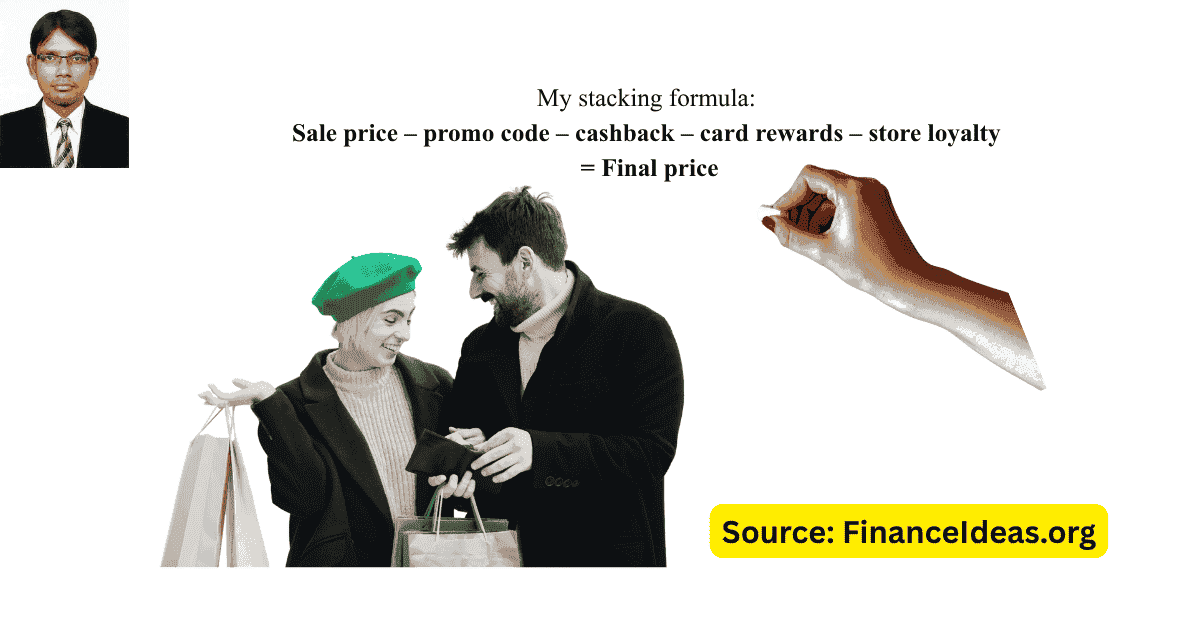
Memorize my stacking formula: Sale price – promo code – cashback – card rewards – store loyalty = Final price.
Which cashback portal should you use for Black Friday?
I want to save you time. I try to write a medium article, but in finance, everything is regulated. That is why I talk more to make it simple.
Anyway, below in the table, I have given a quick tool comparison table. Yeah, I analyzed them using the 5-step model above, but this table gives you the most reading benefit in the shortest time. Let’s understand the table:
| Tool | Best for | Rate | Payout | Browser extension? |
| Rakuten | Online shopping at major retailers | 1–40% (typical 2–10%) | Quarterly, $5.01 min | Yes |
| Ibotta | Grocery + drugstore receipts | $0.25–$5 per offer | PayPal, $20 min | No |
| Fetch | Any receipt (passive) | Points (closer to $0.001/pt) | Gift cards, $3 min | No |
| TopCashback | Rate hunters | Varies | PayPal/bank | Yes |
| Capital One Shopping | Price comparison + coupons | Varies | Gift cards | Yes |
My opinion = I will be neutral here. Look, this is not financial advice. I just share my opinion. Before making any financial decisions, do your own study or simply consult with your advisors.
Anyway, let’s come to the point. I suggest you use Rakuten for online purchases, Ibotta for grocery receipts, and Fetch for the same receipts (you can upload the same receipt to both Ibotta and Fetch for double earnings). This three-app stack gives you three streams from one purchase.
Note on Honey: Honey’s ongoing legal trouble over how it treats creators makes it challenging to recommend over the alternatives right now. Hmm, Capital One Shopping is the better alternative for automated coupon testing and price comparison.
Important note on rates: Cashback rates and credit card bonus categories change quarterly and annually. I have written this article based on recent updates. You can visit official sites if you wish to check the accuracy of this article.
These are the 5 most common stacking mistakes on Black Friday?
We have collected the most commonly repeated stacking mistakes that shoppers historically make on Black Friday.
| Mistake | It costs you? | Solution |
| Activating cashback after clicking through | You lose the step permanently | Activate Rakuten or Ibotta before you open the retailer |
| Using a promo code that disables cashback | Some codes void cashback tracking | Test with a small purchase first, or read the fine print |
| Not activating rotating card categories | You earn 1% instead of 5% | Activate Chase Freedom Flex and Discover categories on day 1 of the quarter |
| Forgetting store loyalty | You leave 1–5% on the table | Always enter your loyalty number before checkout |
| Stacking on a weak base price | You save 20% on a product that was inflated 30% | Verify the sale price against 30-day history first |
Quick Q/A: Reader’s Most Asked?
Is stacking worth the effort for Black Friday?
As per my analysis, yes, but you need to do it consistently. Hmm, the setup takes five minutes in October. But the payoff is hundreds of dollars in November. The mistake I found American shoppers make is thinking stacking is complicated. Actually, it is not. It is just a checklist: activate the portal, use the right card, enter your loyalty number, apply the code. That is it.
What is the best time to activate cashback for Black Friday?
Hmm, before you start shopping. So, activate your portal accounts in October, install the browser extensions, and set up your loyalty programs. It will help you on Black Friday to click and buy.
Can I stack coupons with cashback?
Yes, but not always. Some promo codes disable cashback tracking. I recommend activating the cashback portal first, then testing the promo code. If the code turns off cashback, you will see a warning in the portal’s extension.
Can you stack gift cards with other savings?
Yes, and it is a pro move, as per me. Buying discounted gift cards (from sites like Raise or Costco) and using them to pay for Black Friday purchases is an additional savings step. However, some retailers exclude gift card purchases from earning rewards.
Finance ideas TLDR | Tapos Kumar
- Step 1= Sale price: The advertised Black Friday discount. This is your starting point.
- Step 2 = Promo code: A working coupon code applied at checkout.
- Step 3 = Cashback portal: Activate Rakuten, Ibotta, or TopCashback before you click through to the retailer. Hmm, you can earn 1–40% back.
- Step 4 = Credit card rewards: Use a card with a bonus category that matches your purchase (5% rotating categories, 3% online shopping, etc.).
- Step 5 = Store loyalty: Stack Target Circle (1% back), Walmart+ (member pricing), or Best Buy rewards.
Frequently Asked Questions (FAQs) about Black Friday stacking savings?
Does Rakuten work with credit card rewards?
Yes. Rakuten cashback stacks with credit card rewards because they are separate systems. You can earn Rakuten cashback and your card’s rewards on the same purchase.
Can you use multiple cashback portals on one purchase?
No. You can only earn cashback from one portal per purchase. If you click through Rakuten and then TopCashback, only the last click usually counts. So, choose one portal per transaction.
How long does Rakuten take to pay?
Rakuten pays quarterly; let me think: in February, May, August, and November. The minimum payout is $5.01 via PayPal or check.
Does cashback work on Black Friday deals?
Usually, yes. But some retailers exclude Black Friday doorbusters from cashback eligibility. So, check the portal’s terms before you buy.
Tapos’s last thought
The fact is: most shoppers focus on sale price. They usually compare the was price to the now price and decide whether it is a good deal. Listen, this is the 1st step.
For this reason, two shoppers can buy the same product at the same store on the same day and pay very different prices. And this happens for stacking i.e., you don’t know how to stack but your friend knows (as I said at the start of my article). You don’t think about 5 steps of stacking (as I recommended); therefore, you don’t understand that some promo codes disable cashback tracking. And some member prices exclude additional coupons.
That is the reason I call stacking a skill. So, if any influencers or social media videos guide you on stacking hacks, don’t trust them. The moral is: You need to know which steps work together, and which ones cancel each other out.
Hope my article guides you enough. Bye!
References & Sources
Below is the lists of sources that I have used to write this article [You can also visit these site for self- study. By doing this, you can verify my information also]:
Disclaimer
The information provided in this article is just the author’s view & only for educational purposes. This guide is not for promotion or affiliate purpose. By reading this, you agree that the information is not personal finance advice. Do your research before making your black Friday plan. Therefore, Finance Ideas will not be liable for your financial loss if occur.