So, you can’t control excitement, but believe you can be careful when shopping or buying any necessary items. You spent about $ 1.2 K on a kitchen gadget (you used it twice), a jacket in a color that you don’t wear. And a subscription to a streaming service you already had.
If I portrayed your story as per budgeting principles, you do this to manage urgency, scarcity, and limited-time pressure. Am I correct? Let me know in the comments.
I just read UK research from Tesco Mobile and Standard Life. According to this research, 44% of Black Friday shoppers get caught up in the excitement and regret their purchases. Nearly a third (31%) say they regretted at least one purchase, and 17% never used or wore what they bought.
So, you are not alone in paying the price for ignoring budget planning. You regret overpaying; that is why you are searching for a Black Friday budget planner on Google or asking AI questions. I don’t know where you asked; you are reading my article, so I can assume that you don’t get proper guidelines.
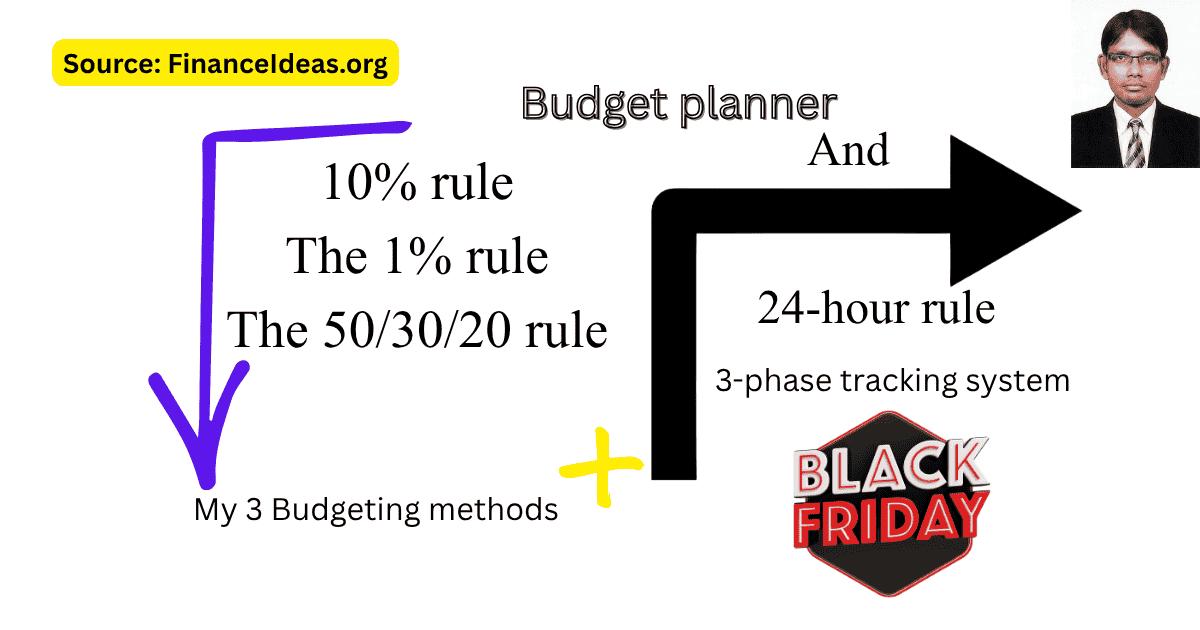
Hold on. I will teach you 3 effective budgeting techniques with a tracking system. My hype-free guidance will help you understand how to budget for Black Friday. Let’s start:
Finance Ideas AI snippet box | Tapos Kumar
Why does Black Friday confuse our brain?
This is because Black Friday gives us too many choices. And, according to behavioral marketing, we make bad shopping decisions when we get unexpected choices.
The moral is: Black Friday is designed to bypass your rational brain, so it influences you to spend.
Below, I have summarized the reasons and solutions in a table so you can control your spending behavior.
| Emotional fallout | What it does? | How to counter it? |
| Urgency (Deal ends in 2 hours!) | Creates panic, you buy without thinking | The 24-Hour rule: wait a day for purchases over $100 |
| Scarcity (Only 3 left!) | Creates fear of missing out | Ask: Would I buy this at full price? |
| Social proof (10,000 people bought this today!) | Makes you feel like you are missing out | Remember: retailers manufacture this number |
| Anchoring (Was $500, now $250!) | Makes $250 feel like a steal | Check the 30-day price history, was it ever $500? |
| Decision fatigue | By hour 3, you will buy anything to end the stress | Shop with a list. Stick to it. |
Related Articles
-
Black Friday Shopping [How to Survive the Crowds and Save Money in 2026]
-
Spot fake Black Friday deals verification guide: I Tracked 25 Retailers’ Black Friday Prices. Most Were Fake
-
Black Friday scams avoid safety guide: The Complete Safety Guide
-
Black Friday return policies: My 1 reader lost $400 on a ‘Final Sale’ TV. Learn why?
-
Black Friday stacking savings: I compare Rakuten vs Ibotta vs Fetch to find out which cashback app pays more?
I developed 3 budgeting methods for Black Friday?
Did you know that CFPB’s five-step spending plan for avoiding holiday debt starts with setting a budget? I hope you know, but many Americans don’t do it. As per my analysis, American shoppers set a number and abandon it by the second store. I think this is a psychological disorder that arises from ignoring a budget number.
The fact is: you don’t need to master Charles T. Horngren’s Management and Cost Accounting book. Yeah, this accounting budgeting is more complex than Black Friday budgeting. The good news is: I am not your accounting professor, so cool down.
After analysing similar cases & federal data, I have developed 3 easy budgeting methods. You need to pick one that fits your financial situation. So, take your coffee & snacks; then start reading:
Method 1 = The 10% rule (I found the easiest)
Under this method, you need to allocate 5–10% of your monthly take-home income for all holiday shopping.
Say your monthly take-home pay is $6,338. In this case, your Black Friday budget is $316.9–$633.8.
This budgeting method will be best for you if you are a salaried employee with steady monthly income.
The good thing is: You can implement it easily because you don’t need spreadsheets or hardcore accounting knowledge. You just need to know your monthly income.
Note: I found the latest U.S. median household income (U.S. Census Bureau) as of now is $87,460 & after-tax income is $76,060. Based on these stats, I use $6,338/month for this study. US household income can change over time due to wage growth, inflation, tax policy, and healthcare costs.
Method 2 = The 1% rule (For savers)
Take 1% of your annual income as your total holiday season budget.
For example, your annual income ranges between $210,000 and $335,000. In this situation, your total holiday budget will be $2,100 or $3,350. That covers gifts, decorations, travel, and Black Friday.
This budgeting method suits high-income earners who want to keep holiday spending in check. So, if you fall under the top 10% or 5% household income group, you can consider it.
This budgeting method is effective because it (the 1% rule) forces you to think about the entire season, including Black Friday.
Note: I used recent income stats from the Internal Revenue Service (IRS) Statistics of Income (SOI) Division. As I previously said, stats can change over time. I will update my article when recent federal data is published, but you can use these incomes as a baseline. You can expect a maximum 3% fluctuation.
Method 3: The 50/30/20 Rule (For detailed planners)
I think your finance planner or advisor taught you about this traditional budgeting method. It is simple; you just allocate your net monthly income rationally. Like the following way:
- 50% for needs (rent, utilities, groceries)
- 30% for wants (shopping, dining, entertainment)
- 20% for savings & debt
As per this method, your Black Friday budget comes from the 30% wants category.
Say your monthly take-home pay is $6,338. Based on this income, if I calculate your Wants budget, that would be$1,901.4. If I divide it by 3 (I assume your wants consist of 3 categories. If you have more, just divide by that number), then you should allocate $633.8 of that to Black Friday.
I created this budgeting guide for anyone who already uses the 50/30/20 model for monthly budgeting. If you belong to this class, you can use it for Black Friday shopping.
My Black Friday budgeting advice for you?
I will stay neutral here because a money crisis creates equal stress for everyone. Money budgeting doesn’t work if you have a financial crisis or mental stress from recent AI layoff waves. I don’t know your exact stress, but I assume you have something that comes from a money crisis.
Do you have a money emergency in the next 60 days? Budgeting works better when you have money, but you are bad at managing it. You could be surprised & ask yourself: why am I asking this question?
Hmm, logical thinking. I will not impose my thoughts here; instead, explain your question with federal data.
It is midnight, and I am studying the personal saving rate on BEA (Bureau of Economic Analysis). The U.S. personal savings rate is 3.0% (July 2026 reported), which is down from 5.2% a year earlier.
What does this stat suggest? Americans are saving less. So if you are in the majority with little cushion, keep your Black Friday budget conservative.
Follow this rule: Never use credit cards to fund a Black Friday purchase you can’t pay off in 30 days. I suggest this because the average American carries $7,756 in credit card debt, and total U.S. credit debt exceeds $10 trillion (per G.19 & FRED data).
Read my 3-phase tracking system?
Yeah, budgeting is good, but in the current economy, setting a budget is step 1 & tracking it is step 2. I know you feel a little confused here, but don’t worry; I will explain it simply so you can apply it to your situation. Let’s read them:
Phase 1 = Pre-Shopping (October–Early November)
Under Phase 1, I recommend you do the following:
Prepare your list = Write down what you need. Be specific: “55-inch TV for living room instead of a TV.
Record current prices = Check Amazon, Walmart, Target, and Best Buy. Then, write down the price for each item.
Set your budget = Evaluate your financial situation & then use one of my 3 methods above.
Share it with someone =Hmm, this is not a traditional budgeting or shopping principle, but from my professional point of view, telling a friend or family member your budget can increase accountability.
For your convenience, I have shared a hypothetical shopping list. It will speed up your work.
| Item | Store | Current Price | Target Price | Budget |
| TV | Best Buy | $549 | $400 | $400 |
| Laptop | Amazon | $899 | $750 | $750 |
| Total | $1,150 |
Note: Prices in the table can change due to retailers’ policies. For accuracy, visit their official sites. I use these prices for study purposes.
Phase 2 = During shopping (Black Friday)
In this phase, you have to do the following:
- Track every purchase in real time. You can do this by using a notes app or a printed tracker.
- Apply the 24-Hour rule. For any purchase over $100 not on your list, wait 24 hours.
- Check your remaining budget before checkout. If you have spent $800 of a $1,000 budget, you have $200 left. So, don’t exceed it.
Read this hypothetical tracker:
| Item | Store | Price | Remaining budget |
| TV | Best Buy | $399 | $601 |
| Laptop | Amazon | $749 | –$148 = stop here because the number goes negative. A negative number means you just add extra cash debt, so don’t be emotional in this inflation era. |
Phase 3 = Post-shopping (After Black Friday)
Do the following things patiently:
- Review your purchases. Did you stay within budget? What did you buy that wasn’t on the list?
- Return what you don’t need. Most retailers have extended holiday return periods. So, use them.
- You can make minor mistakes, and that is okay. Write down the lesson that you learned from that mistake.
If you have time, you can answer these 4 questions. I created this questionnaire set to make your tracking system easier. Answer these questions with extra time; take pen, pencil & paper if needed.
- Did I stay within my budget? ☐ Yes ☐ No
- What did I buy that wasn’t on my list? _______________
- What was my main impulse purchase? _______________
- What will I do differently next year? _______________
Read my 24-hour rule?
You perhaps know about it because I discussed it indirectly in other Black Friday articles. Hmm, I want to repeat this with detailed application against impulse shopping. Below, in the table, I have summarized this into time intervals with consequences. Let’s read them:
| Time | What happens |
| 0 minutes | The deal feels urgent. You want it now. Retailers apply urgency hype. |
| 1 hour | The urgency fades. You start to think rationally that stop you buying unnecessary items. |
| 24 hours | Most impulse purchases are forgotten. You realize you didn’t need it. |
The exception: It is possible that the item is on your list, and the price is right. In this case, you should buy it. Doorbusters sell out. And the 24-Hour rule is for unplanned purchases only.
Quick Q/A: Reader’s Most Asked?
Is Black Friday worth it for budget-conscious shoppers?
In my view, Black Friday is worth it if you have a plan. Without a budget, you will overspend. With a budget and a list, you can save hundreds of dollars on items you need.
Therefore, the problem isn’t Black Friday. According to me, the problem is shopping without a system. And the current inflationary economy suggests Americans can’t afford to overspend. So, budgeting isn’t optional; it is mandatory now.
Finance ideas TLDR | Tapos Kumar
- Choose my one budgeting method. The 10% rule (easiest), the 1% rule (for savers), or the 50/30/20 rule (for detailed planners).
- Wait 24 hours before any purchase over $100. I found that most impulse buys are forgotten by then.
- Track in three phases: Pre-shopping (plan), during-shopping (track), post-shopping (reflect).
- Share your budget with a friend. Based on my analysis, if you do this, you are 42% more likely to stick to it.
- Follow this one rule: If it is not on the list, don’t buy it.
Frequently Asked Questions (FAQ) about Black Friday budget planner?
Should I use credit cards on Black Friday?
Yes, with one condition. Use a credit card for the rewards and fraud protection. But only if you can pay off the balance in full within 30 days. Remember this = Never carry a balance.
Should I use cash or credit cards for Black Friday?
Credit cards offer better fraud protection and rewards. But only if you pay off the balance immediately. Cash (or a debit card) forces you to stay within your limit because when it is gone, it is gone.
What if I can’t afford Black Friday this year?
Don’t be sad because you are not alone. The U.S. personal savings rate was 3.0% in July 2026, near historic lows. So, if your budget is tight, consider skipping Black Friday. This is because your financial security is more important than a deal or holiday shopping.
Tapos’s last thought
Black Friday is designed to make you overspend. Yeah, I repeated this line & brands perhaps hate me. I don’t care about sponsorships; I wrote neutrally so my readers can make the right financial decisions.
I studied accounting, so I know the financial difference between willpower and accountability. You can’t rely on willpower, but accountability can help you get rid of budgeting mistakes.
I hope my approach helps you do that. If you have more questions, ask me in the comments. I will answer them as soon as possible. Thanks for reading.
References & Sources
Below is the lists of sources that I have used to write this article [You can also visit these site for self- study. By doing this, you can verify my information also]:
- Bureau of Economic Analysis (BEA)
- Consumer Financial Protection Bureau (CFPB)
- Federal Reserve
- Mirror (UK)
- Express (UK)
Disclaimer
The information provided in this article is just the author’s view & only for educational purposes. This guide is not for promotion or affiliate purpose. By reading this, you agree that the information is not personal finance advice. Do your research before making your black Friday plan. Therefore, Finance Ideas will not be liable for your financial loss if occur.