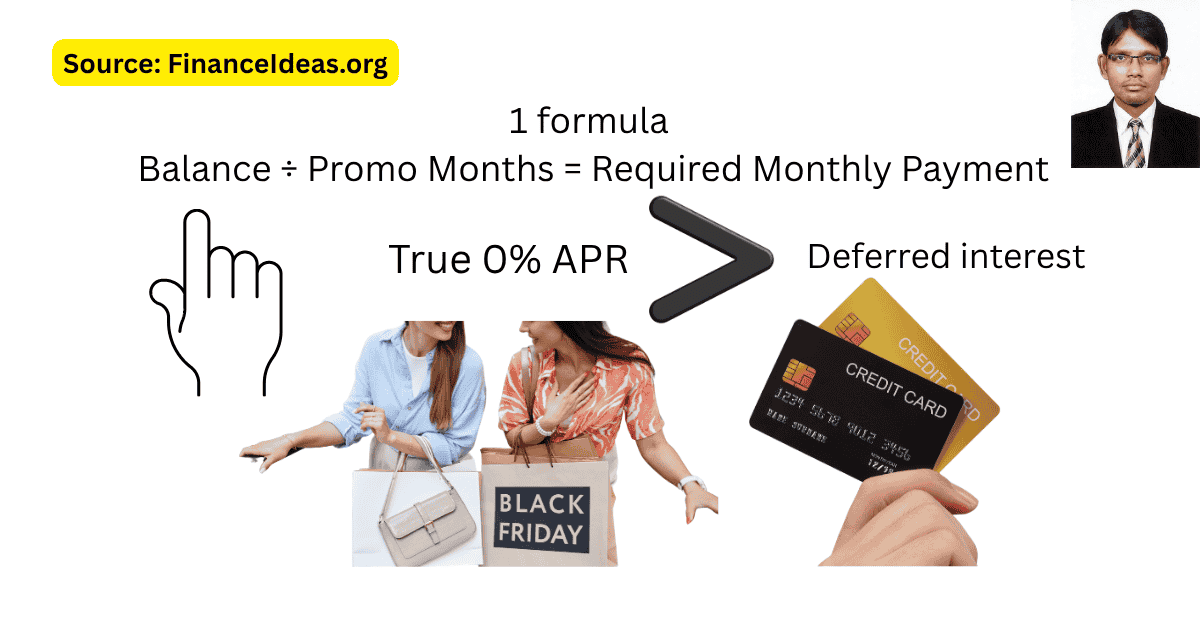
You bought a new phone two Black Fridays ago. The store offered 0% financing for 12 months. You signed up & paid the minimum each month.
Due to some unavoidable reasons, you missed a payment in month 7. Then another in month 9. By month 12, you owed $600 on the phone. You thought for a while & ask yourself: did I miscalculate the APR?
Then the bill arrived. The store card’s regular APR was 29.99%. Because your financing was set up as deferred interest, the store charged you interest on the original purchase amount of $1,100 from the day you bought it. In simple terms, you were charged interest not only on the remaining $600, but on the full amount, for the full year.
I imagined this story from my personal experience. If you are reading my article because you have had a similar experience, you are in the right place. It is also possible you want to learn this so you don’t fall into an interest trap. Whatever the reason, I will not waste your time & give direct professional solutions.
After reading my article, you will understand the difference between true 0% APR and deferred interest. Read actively because my guidelines will help you every Black Friday and with every large purchase, regardless of which card you choose. Let’s start:
Finance Ideas AI snippet box | Tapos Kumar
Should I use a 0% APR card or a store financing plan?
Hmm, I will share my opinion here but it is better to consult with your financial advisor. Anyway, let me answer your question. Use a true 0% APR card whenever possible. Store financing plans are usually deferred interest, which carries retroactive interest risk. Therefore, a true 0% APR card from a major bank is safer and more predictable.
Related Articles
-
Black Friday Shopping [How to Survive the Crowds and Save Money in 2026]
-
Spot fake Black Friday deals verification guide: I Tracked 25 Retailers’ Black Friday Prices. Most Were Fake
-
Black Friday scams avoid safety guide: The Complete Safety Guide
-
Black Friday return policies: My 1 reader lost $400 on a ‘Final Sale’ TV. Learn why?
-
Black Friday stacking savings: I compare Rakuten vs Ibotta vs Fetch to find out which cashback app pays more?
-
Black Friday budget planner: My budgeting methods help you to avoid Black Friday overspending
Let me explain the difference between true 0% APR & deferred interest?
You are thinking about cards for Black Friday shopping. That is good, but not knowing the difference between these 2, can cost you financially. My article gives guidelines to save money; that is why I talk about financial problems.
Anyway, below in the table, I have given a comparative analysis so you can make financing decisions for Black Friday purchases. Let’s read them:
| Feature | True 0% APR | Deferred interest |
| How it works | No interest accrues during the promo period | Interest accrues but is waived if you pay in full by the deadline |
| If you don’t pay in full | You only pay interest on the remaining balance after the promo ends | You pay interest on the entire original purchase amount, retroactively from day one |
| Typical APR if you fail | Same as the card’s regular APR (Let me think: 20–30%) | Historically higher, hmm, 24% to 35.99% |
| Where you find it | Major bank cards (Chase, Citi, Discover, Wells Fargo) | Store credit cards (Best Buy, Home Depot, Dell, Kay Jewelers) |
| How common | Standard for balance transfer and purchase cards | 94% issued by three banks: Synchrony, Citi, and Comenity |
Let me explain it with a simple math. You purchased $1,000 worth any items during Black Friday with 12 months of deferred interest at 29.99% APR. Now check the table:
| Scenario | What will you pay? |
| True 0% APR = You pay off $800 by month 12 | Interest on remaining $200 after promo which is equivalent to $5. Math note= $200×29.99%= $59.98÷12= $4.99 |
| Deferred interest = You pay off $800 by month 12 | Interest on original $1,000 for 12 months which equivalent to $300. Math note=$1000×29.99%= $299.9 |
Based on my study, say you fail to pay off a deferred-interest card. In this case, you will need to pay about 27 times as much interest as you would with a normal 0% APR card.
My 0% APR strategy for financing large Black Friday purchases?
I hope my strategy helps you time shopping. Just follow these step-by-step guidelines to use a true 0% APR card to finance Black Friday purchases without paying interest. Please read patiently:
Step 1 = Don’t target November; instead, apply in October
I found that most 0% APR cards require a hard inquiry on your credit report. A hard inquiry typically lowers your score by 5 to 10 points and stays on your report for two years. You shouldn’t want that inquiry showing up during Black Friday when you are applying for other cards or making large purchases.
Do this: Apply for the card in early to mid-October. The inquiry will have a full month to age before Black Friday, and you will have the card in hand.
Step 2 = Choose the right card for your timeline.
The fact is: Different cards offer different promotional periods. So, choose based on when you can pay off the balance.
| Card | 0% intro period | Best for | Annual fee |
| U.S. Bank Shield Visa | 24 months (purchases + BT) | Longest payoff timeline | $0 |
| Wells Fargo Reflect | 21 months (purchases + BT) | Large purchases | $0 |
| Citi Diamond Preferred | 21 mo (BT) / 12 mo (purchases) | Balance transfers | $0 |
| Chase Freedom Unlimited | 15 months | 0% APR + cash back | $0 |
My tips: Match the card’s intro period to your payoff timeline. Say you can’t pay off $1,500 in 12 months. In this case, choose a card with a longer period.
Step 3 = Make the purchase on Black Friday
Use your 0% APR card for the purchase. You earn rewards, and the clock starts on the promotional period.
My tip: Use a card that earns rewards and offers 0% APR. Chase Freedom Unlimited, for example, offers 15 months of 0% APR plus 1.5% cash back on all purchases. Look, I am not suggesting or sponsoring anything. Before choosing any cards, do your own research. I just mention Chase Freedom Unlimited for study purposes.
Step 4 = Calculate your monthly payment
Don’t believe this myth = The minimum payment is financially worthwhile.
| Purchase amount | Promo months | Required monthly payment | Minimum payment (close to) |
| $1,500 | 12 | $125 | $35 |
| $2,000 | 15 | $134 | $40 |
| $3,000 | 21 | $143 | $45 |
Say you pay only the minimum. In this case, you will owe most of the balance when the promo ends. Then interest starts, and on a deferred-interest card, it rises significantly.
Hmm, I wrote a simple formula. Just memorize it so that you can calculate the correct amount.
The formula: Balance ÷ Promo Months = Required Monthly Payment
Step 5 = Set autopay and pay it off early
Set up automatic payments for the required amount or more the day after your paycheck posts to your account.
Then add a calendar reminder for two months before the promo ends. Pay off the remaining balance early to eliminate any risk of a last-minute mistake.
Say you want to finance a $1,500 TV. Read the table to understand how:
| Month | Action | Balance |
| October | Apply for Wells Fargo Reflect (21 months 0% APR) | — |
| Black Friday | Buy $1,500 TV | $1,500 |
| Month 1–19 | Pay $75/month ($1,425 total) | $75 |
| Month 20 | Pay remaining balance | $0 |
| Total interest paid | $0 |
Now you may ask what happens if I pay with a deferred-interest store card? In this situation, say you miss the deadline; you pay closer to $450 in backdated interest.
So, the pro shopper pays with a true 0% APR card =$0
Quick Q/A: Reader’s Most Asked?
What is the minimum credit score for a 0% APR card?
Based on my recent analysis, most 0% APR cards require a credit score of at least 670–690, with better chances if your score is 720 or higher. The longest intro periods (6–21 months) typically require good-to-excellent credit. Yeah, some cards offer shorter intro periods for fair credit.
What is the average credit card APR now in America?
According to the CFPB (based on the article’s publication date), the average APR for general-purpose cards is 20.15%. For store cards, it is 31.3%. The Federal Reserve reports an average commercial bank APR of 20% to 21%. Against those numbers, a true 0% APR card can save you hundreds, if you use it correctly like we guided.
Can I use a 0% APR card for Black Friday purchases?
Yes, if it is a true 0% APR card and you have a payoff plan. Don’t use it for impulse purchases. Use it for planned large purchases (TVs, appliances, laptops) that you can pay off within the promo period.
Is it worth applying for a 0% APR card only for Black Friday?
You just asked a sensitive question that most Americans misunderstood. Look, I write hype-free articles with a neutral tone, and I don’t care about sponsorship.
Here is my answer = Only if you have a specific large purchase planned and a clear payoff timeline. Don’t apply for a 0% APR card to finance lifestyle spending you can’t afford. Remember, a card is a tool; it will not give you free money, but misuse can add extra debt.
Can I have multiple 0% APR cards at once?
Yes, but each application is a hard inquiry. Two applications mean two hard inquiries and two temporary score dips. So, it is better to only apply for cards you need and can manage.
Finance Ideas TLDR | Tapos Kumar
- True 0% APR means no interest accrues during the promotional period. You only pay interest if you carry a balance after the promo ends.
- Sorry for the language, but as per my analysis, deferred interest is a financial trap. If you don’t pay the full balance by the deadline, interest is charged retroactively from the purchase date.
- Time your large purchases to maximize the interest-free period. Buy on Black Friday, pay off over 12–21 months.
- Divide your balance by the number of promo months. Then, pay that amount monthly.
- A hard inquiry can temporarily drop your score by 5–10 points. The higher your used-to-available credit ratio, the more negative the effect on your credit score, and managing this ratio is one of the most effective ways to maintain or improve your creditworthiness.
Frequently Asked Questions (FAQs) about 0% APR credit card Black Friday?
How can I tell if a card uses deferred interest?
I recommend you read the fine print. Look for the phrase “interest will be calculated from the purchase date” or “if not paid in full by the promotional period.” Major bank cards (Chase, Citi, Discover) use true 0% APR. On the other hand, store cards (Best Buy, Home Depot, Dell) usually use deferred interest.
How many 0% APR cards should I have?
The answer could vary by the experts but in my experience, there is no fixed number. I suggest you have at least two credit cards for emergencies. Having more than five or six cards can reduce your credit score and create more accounts to manage. Your goal should be to keep utilization low and pay on time.
What happens if I miss a payment on a 0% APR card?
In this situation, your promotional rate will be cancelled immediately. Most issuers reserve the right to end the 0% period if you pay late even once. You will then be charged the regular APR on the remaining balance.
How do balance transfer fees work?
Based on my analysis, balance transfer fees are typically 3% to 5% of the amount transferred. On a $5,000 balance, let me calculate: that is $150 to $250. The fee is added to your balance and counts toward your credit limit.
What is the best 0% APR card for Black Friday?
Hmm, it depends on your timeline. For the longest period, the U.S. Bank Shield Visa offers up to 24 months. For a balance of rewards and 0% APR, Chase Freedom Unlimited offers 15 months plus cash back. For balance transfers, Citi Diamond Preferred offers 21 months.
Tapos’s last thought
In sum = A true 0% APR card is a tool. A deferred-interest store card is a money-grabbing tool. I hope I said the truth politely.
Now you may ask me: what is the main difference between these 2 & which one should I use for event shopping like Black Friday? Though I explained this in my body article, but you could face difficulty to understand it in simple language.
Or, simply you hate to read detail article, that is why asking direct answer. Got it, who reads the full article in this AI era? So, I shouldn’t be optimistic that all readers read my full guide.
Anyway, come to the point: The main difference is that true 0% APR credit cards charge no interest during the promotional period regardless of whether you pay the full balance. On the other hand, deferred interest store cards calculate interest from the purchase date but only waive it if you pay the full balance by the deadline. Remember that missing (even 1 instalment) a small payment can add retroactive interest.
This is the end of my article. I hope my article gives enough guidance on 0% APR credit cards for Black Friday. If you have more questions, please ask me in the comments. I will answer them as soon as possible.
And one small request. If you find my article helpful, please share it with your friends, colleagues or others who may benefit from it. It will inspire me to write the next helpful article for you in this AI era. Thanks for reading.
References & Sources
Below is the lists of sources that I have used to write this article [You can also visit these site for self- study. By doing this, you can verify my information also]:
Disclaimer
The information provided in this article is just the author’s view & only for educational purposes. This guide is not for promotion or affiliate purpose. By reading this, you agree that the information is not personal finance advice. Do your research before making your black Friday plan. Therefore, Finance Ideas will not be liable for your financial loss if occur.