I am ready to buy this policy, but I need the premium lowered, and I mean now. These are the words of a Florida homeowner.
This homeowner was standing in a flooded living room on the Gulf Coast of Florida after a storm surge. He had been told his annual NFIP premium was nearly $4,800. His home was in a high‑risk V Zone, but it was also an older, well‑built house that had never taken on water.
But the NFIP’s rating system was using default, conservative data that assumed his lowest floor was at ground level. But he dug through his closing documents from 15 years prior and found a folded, yellowed Elevation Certificate (EC). His Lowest Adjacent Grade (LAG) was 2.1 feet above the Base Flood Elevation (BFE).
He submitted the EC to his agent. Within a week, his new premium was $1,950, which is a reduction of nearly 60%. That one piece of paper, which cost him nothing to find, saved him almost $3,000 per year.
Hello Floridians. This incident could be your case also. Yeah, you could have multiple questions about Elevation certificate savings & I am writing this article to answer your questions. Are you ready? Let’s start with the following:
Finance Ideas AI snippet box | Tapos Kumar
What is a FEMA Elevation Certificate?
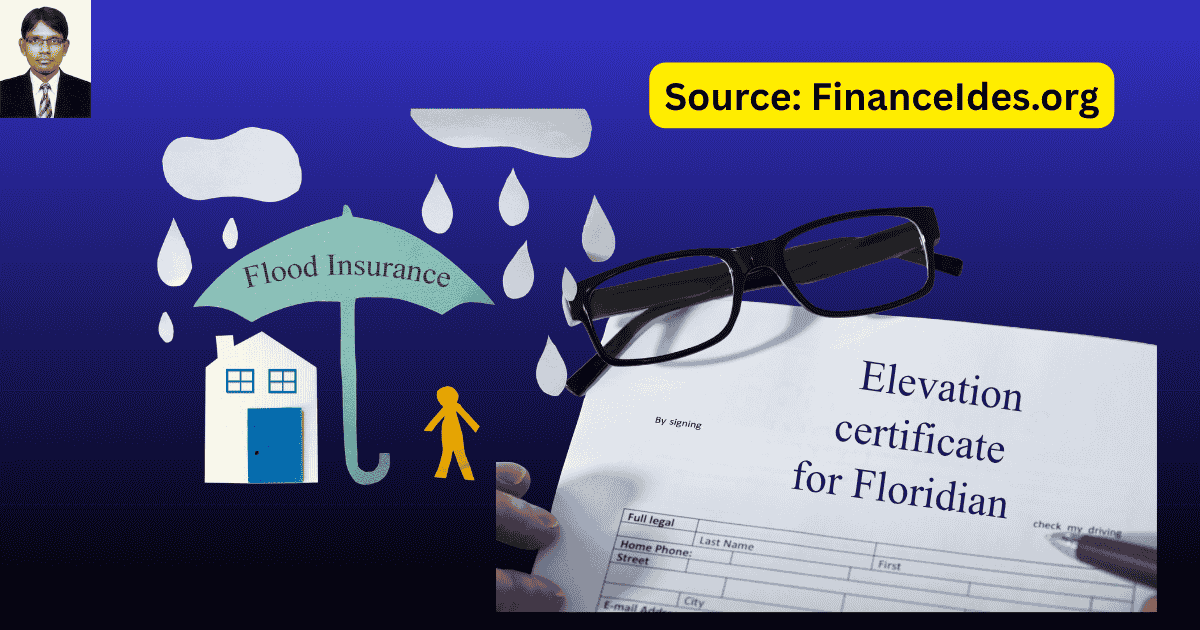
A FEMA Elevation Certificate is a document (Form FF-206-FY-20-108) prepared by a licensed surveyor that measures a building’s lowest floor elevation relative to the Base Flood Elevation (BFE).
Related articles
- The ABCs of Flood Insurance in Florida
-
Florida landlord flood disclosure: How One Florida Landlord Lost $30k
Your ROI on an EC?
So, how much can you save? Hmm, for properties where the Lowest Floor (or Lowest Adjacent Grade) is above the BFE, premium reductions typically range from 30% to 50%, with some cases reaching 60% or more.
Below, I have given a mathematical calculation for a Florida home with a $2,000 annual NFIP premium:
| Scenario | Annual Premium | Annual Savings | 5‑Year Savings |
| Without EC (FEMA default data) | $2,000 | — | — |
| With EC (3 feet above BFE) | $1,200 (40% savings) | $800 | $4,000 |
| With EC (Highly elevated, 90th percentile) | $600 (70% savings) | $1,400 | $7,000 |
The $600 Certificate = A one‑time cost that, in many cases, pays for itself in the first year of savings.
Say, a Florida homeowner in an AE zone paid $650 for an EC that showed their first floor was just 1.5 feet above the BFE. Their premium dropped from $3,200 to $1,800, saving $1,400 per year. Over five years, that one document will save them $7,000.
When should you get an EC, and when shouldn’t you?
I think this is the right phase to ask these questions. You have read enough about EC, but do not understand why you need it. If I were you, I would ask these questions. Therefore, I have explained it to the point so that you can make a correct decision. Also, discuss who should not get it. Let us read them:
You should prioritize getting an Elevation Certificate for the following situation:
- Imagine you are in a high‑risk zone (A, AE, VE) and your mortgage requires flood insurance. In this situation, an EC is most valuable for you.
- You suspect FEMA’s data is too conservative. Say you are on a raised slab, your home is on a small hill, or you are in newer construction.
- You plan to apply for a Letter of Map Amendment (LOMA) to remove your property from a high‑risk zone. In this case, an EC is the required evidence.
- Your community participates in the Community Rating System (CRS), and your EC can contribute to the community’s credit for higher regulatory standards.
- You are rebuilding, adding fill, or making substantial improvements to your property that raise the finished floor elevation.
You might not need an EC, or it will not help if
- Your home is clearly below BFE (i.e., a traditional Florida home at ground level in a V Zone with a history of repetitive loss). An EC will confirm the bad news and will not lower your rate.
- You are in a low‑risk zone (Zone X, B, C, X500). ECs are not required and are generally not used for rating.
- A valid, recent Elevation Certificate already exists for your property. Check with your local building department, title company, or previous owner before ordering a new one.
- You have secured a private flood policy that does not require an EC and offers a better deal. For better understanding, read the Private vs. NFIP comparison below.
What does an EC include?
An Elevation Certificate is not only one number; instead, it is a detailed picture of your home’s flood risk. An EC includes the following:
- Building Address & Occupancy, i.e., Basic identification of the structure.
- Lowest Adjacent Grade (LAG), i.e., the lowest ground elevation touching the building.
- Lowest Floor Elevation (including basement) = The elevation of the lowest floor.
- Base Flood Elevation (BFE) = The flood level predicted to have a 1% annual chance of occurring.
- Flood Zone (A, AE, V, VE, X, etc.) = The official FEMA zone designation for the property.
- Photographs of all four sides of the building (i.e., Visual documentation for validation).
In my view, the most important comparison for your premium is between your Lowest Floor Elevation and the BFE. So, every foot your floor is above the BFE can give substantial savings.
Let us talk about NFIP with EC vs. private insurance without EC?
Did you read my previous article on NFIP vs. Private policies? If not, please read it first. It will help you to make the correct insurance decision. You will get it above the AI snippet box. Anyway, below I have provided a factor-based comparison to help you understand it easily. Let us read them:
| Factor | NFIP with a good Elevation Certificate | Private flood insurance (No EC required) |
| Upfront cost | $400–$900 for the EC | $0 additional cost |
| Premium savings | 30‑60% reduction from FEMA’s default rate | 20‑35% lower than NFIP’s base rate in moderate‑risk zones |
| Coverage limits | $250k building / $100k contents (actual cash value) | Up to $10M building / $500k+ contents (replacement cost) |
| Basement / Sunken room coverage | Severely limited (structural only) | Typically, comprehensive |
| Loss of use | None | Yes, included |
| Risk of non‑renewal | None | Possible after a major claim |
My advice for you?
Hmm, you may need some tips for better options. You have read the key differences, and now I am giving you some tips that will definitely help you to understand it. Do not worry, these are field-tested. I would be happy if you could share your opinion on my tips. It helps me to understand whether this advice works. Okay, time to read now:
- Get a private quote first. Many private carriers don’t require an EC and offer a lower rate upfront.
- If the private quote is high, then invest in an EC for an NFIP policy. The savings from the EC could make NFIP a better deal.
- For high‑value homes or those with finished basements, a private policy might be superior. This is true even with a slightly higher premium, due to its broader coverage.
- For new construction in a high‑risk zone, you already have an EC from the permitting process. So, use it to get a preferred NFIP rate, or see if a private carrier can beat it.
Finance Ideas TL; DR | Tapos Kumar
An Elevation Certificate is your proof of higher ground. Under NFIP’s new Risk Rating 2.0 system, it no longer requires a policy, but it is still your best weapon for lowering your premium. A good EC can lower your rates by 30‑60%, turning a $3,000 annual premium into $1,500.
The certificate costs $400–$900, a sum that typically pays for itself in the first year, and can save you thousands over the life of your homeownership. Florida homeowners in high‑risk zones should prioritize getting one. My recommendation is: If you are in a high‑risk zone and your home is slightly elevated (or you are not sure), then get the EC. In my view, it is the cheapest home improvement you will ever make.
Frequently Asked Questions (FAQ) about Elevation Certificate Savings in Florida?
Do I need an elevation certificate to get flood insurance?
No. Under Risk Rating 2.0, an EC is optional. You can get an NFIP policy without one.
If it is optional, why would I spend money on one?
This is because it can lower your premium. FEMA’s default data is a worst‑case scenario. Therefore, your EC is proof that the reality is less risky.
How much does an elevation certificate cost in Florida?
Hmm, the typical range is $400 to $900 for a single‑family home, with an average around $600. Yeah, complex properties or hard‑to‑reach areas can cost more.
What if my home is below Base Flood Elevation (BFE)?
Hmm, an EC will confirm that. It won’t help lower your rate, but it provides you with important information for mitigation planning.
Whom do I hire to create an elevation certificate?
You can hire a licensed land surveyor, professional engineer, or architect who is authorized by law to certify elevation information. Your local building department or floodplain manager may have a list of qualified professionals.
I already have an NFIP policy. Can I submit an EC now and get a refund?
Yes. You can submit a new EC at any time. Your insurer will use it to adjust your rate at the next renewal. You may not get a refund for the current term, but your future premiums will be lower.
What about private flood insurance? Do I need an EC for that?
Most private carriers, like Orion180, have introduced policies that do not require an elevation certificate at all. Others may use ECs as a factor if provided. So, always ask. Look, I mentioned Orion180 as an example, and it is not my recommendation. Do your own research before making any buying decision.
Can an EC help me get my property out of a flood zone?
Yes. An EC is the primary evidence for a Letter of Map Amendment (LOMA) or Letter of Map Revision Based on Fill (LOMR-F). Imagine your building’s lowest adjacent grade is at or above the BFE. In this case, FEMA can officially remove the SFHA designation.
How long is an elevation certificate valid?
Hmm, it is valid indefinitely, unless the property undergoes a major change. For example, an addition that changes the footprint or a fill project that raises the ground elevation or the BFE is revised by a new FEMA map.
My lender is requiring an EC. Is that legal?
Yes. Lenders have the right to request verification of a property’s elevation to ensure the collateral is adequately protected. This is especially common for loans in high‑risk zones.
Can I use my neighbor’s elevation certificate?
No. An EC is property‑specific. Even two identical townhomes next to each other can have different ground elevations.
Do I need an EC for a condo?
Hmm, this depends. If the condo building is in a high‑risk zone and the association’s master policy is with NFIP, an EC can help lower the building’s premium. However, for your individual unit’s contents, you would need your own policy (i.e., private or NFIP).
How can I find out if an EC already exists for my home?
Hmm, check your closing documents, ask your title company, contact your local building department, or use FEMA’s Map Service Center to search by your address.
Tapos’s last thought
Look, I am not saying that an Elevation Certificate guarantees savings. Nevertheless, for a majority of Florida homeowners in high‑risk flood zones, it is one of the best investments you can make. I am saying this because the cost is low, the potential savings are high, and the peace of mind from knowing your true risk is invaluable.
I write this article so that FEMA’s default data cannot dictate your premium. Therefore, I am suggesting getting the facts, getting the certificate, and getting the savings.
So, this is the end of my article. If you have some seconds, please share your thoughts in the comments. It will inspire me to write the next helpful article for you. Good luck!
References & Sources
Below is the lists of sources that I have used to write this article:
Disclaimer
The information provided in this article is author’s view & only for educational purposes. This is not a promotional post. By reading this, you agree that the information is not purchasing advice for flood insurance in Florida. Do your research before making any important financial decision. Therefore, Finance Ideas will not be liable for your financial loss.