
For years, financial advisors have given the same advice: “When geopolitical anarchy erupts, buy gold. When central banks print money, buy Bitcoin.” The two were supposed to dance together, gold as the ancient fire, Bitcoin as the new electricity.
Hmm, long live traditional advice! But I witnessed how this traditional finance rule broke. Yeas, true & let me back my views.
While missiles flew and oil prices spiked, gold surged past $5,600 an ounce, posting its strongest quarter in a decade. And Bitcoin? It dropped. The correlation that investors had relied on for years collapsed to near zero, and in some weeks, even turned negative.
My question is: If gold and Bitcoin don’t move together, what is each asset for?
Today, I will write about this & also explain how we enter into a new era for hard assets. And, yes, you have many questions & I am happy to say that you will get the perfect answer. So, be patient & sit to read for some time. Let’s start with the following:
Finance Ideas AI snippet box | Tapos Kumar
Watch three signals to know whether gold or Bitcoin will lead. First, the Geopolitical Shock Index (oil price, Strait of Hormuz traffic, central bank gold buying); when this spikes, gold outperforms. Second, the Liquidity Pulse (Fed balance sheet changes, real yields, ETF flows); when this turns positive, Bitcoin catches up. Third, the Miner Stress Signal (hash price, difficulty drops, AI change announcements); capitulation often marks Bitcoin’s bottom. Now, gold wins on signal one, Bitcoin waits on signals two and three. So, you don’t need to pick one forever; just watch the signals and rebalance annually.
Related Articles
-
Bitcoin vs M2: Why the Old Liquidity Model Died (2026 Data)
- How high will Bitcoin go: Trump’s Secret Plan Revealed (2026 Update)
-
Bitcoin miners AI compute providers: Yes, Miners silently moving towards AI
-
Strategic bitcoin reserve what it is: And Isn’t
-
Bitcoin Halving Cycle: Yes The Cycle Is Broken
I found great decoupling between Bitcoin & Gold?
Let’s see what the data says. In the last year alone, gold prices surged by approximately 65%, driven by relentless central bank buying and escalating geopolitical tensions. By early May 2026, spot gold was trading around 5,900 per ounce. The Iran war and the Strait of Hormuz blockade pushed crude oil above 100 per barrel, and gold did what gold has always done; it soared.
Bitcoin, on the other hand, hit a peak of approximately 126,000 in October 2025. As of the current date, it trades around 86,000; a decline of roughly 47% from its all-time high.
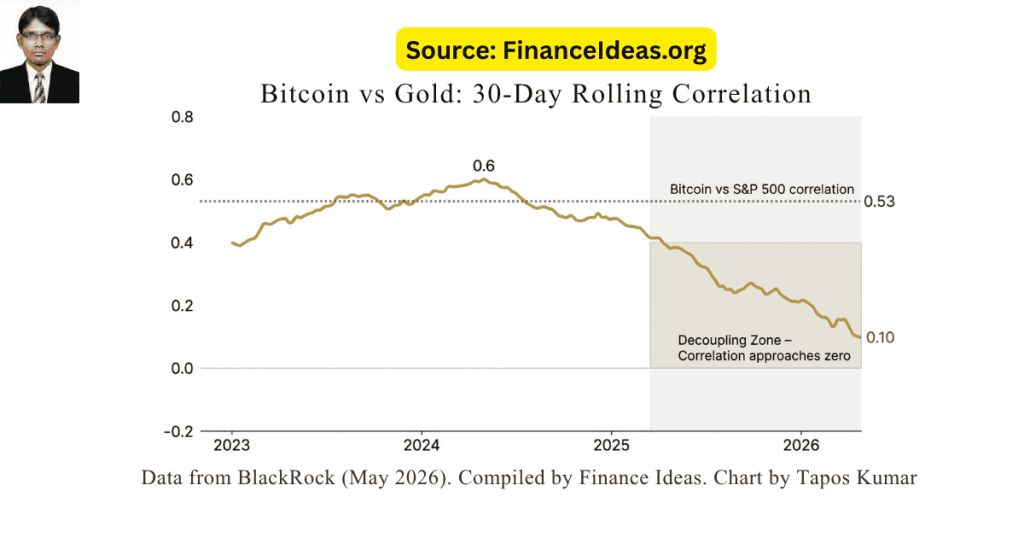
The fact is, the 30-day rolling correlation between Bitcoin and gold has collapsed to approximately 0.10 (according to the article writing date), according to BlackRock research. For comparison, in 2023-2024, that correlation ranged between 0.4 and 0.6. In certain weeks of the current year, it turned negative, meaning the two assets moved in opposite directions.
| Metric | Gold (2025-2026) | Bitcoin (2025-2026) | Correlation |
| Peak Price | $5,900/oz (May 2026) | $126,000 (Oct 2025) | N/A |
| % Change from start of 2025 | +65% | +32% (peak) / -47% (current) | N/A |
| 30‑Day Rolling Correlation (May 2026) | N/A | N/A | About 0.10 (near zero) |
| Key Driver | Geopolitical risk, central bank buying | AI deflation fears, miner capitulation, ETF flows | Decoupling |
This decoupling is not a problem. It is a structural alteration that suggests Bitcoin and Gold are not substitutes now; they are complements, each responding to different macroeconomic forces.
According to me, Gold is winning the geopolitical moment?
Gold’s resurgence in recent years is not an accident. In my view, it is the result of a perfect storm of demand-side pressures that Bitcoin simply does not capture.
Central banks have been buying Gold at a record pace. The World Gold Council reports that central bank demand remains a dominant force, with purchases significantly above the five-year average. China has led the charge, adding to its reserves for many consecutive months, while Poland has signaled a target of 400 tones.
Now the question is, why are central banks buying Gold? Because they cannot buy Bitcoin. The U.S. government holds Bitcoin through the Strategic Bitcoin Reserve, but most central banks are prohibited from holding crypto assets. So, they default to Gold; the only politically neutral, universally accepted hard asset.
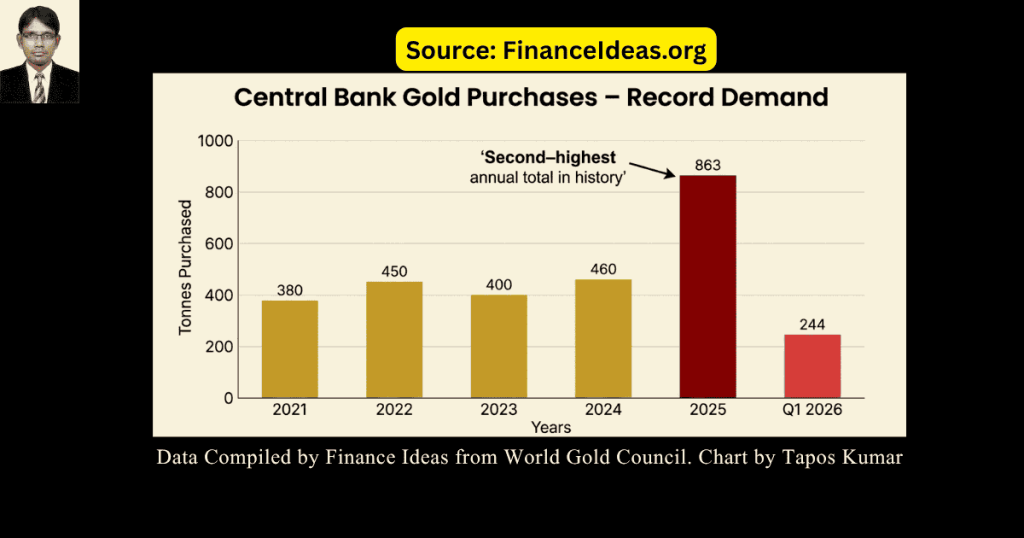
At the same time, retail investors have piled into Gold as a hedge against the very real geopolitical risks. The Iran-Israel war, the Strait of Hormuz blockade (which handles approximately 20% of global oil flows), and the resulting increase in energy prices have caused classic safe-haven behavior.
Gold is also benefiting from expectations of rate cuts. The European Central Bank cut rates by 25 basis points, and equally expectations for the Bank of England’s first cut have moved to August. Yeah, lower rates reduce the opportunity cost of holding non-yielding assets like Gold.
In simple words: when the world is on fire, people buy Gold. That has not changed for 5,000 years.
Why is Bitcoin behaving differently (I found an AI deflation effect)?
So why has Bitcoin not acted as a safe haven in recent years?
The answer lies in a factor that gold investors have never had to consider: AI deflation.
As I wrote in my earlier article, Arthur Hayes argues that AI is replacing knowledge workers at scale (engineers, accountants, lawyers), creating a consumer credit crisis that could rival the 2008 subprime crisis. Banks face potential loan losses of up to 527 billion. When AI displaces a 90,000‑a‑year worker, and their income drops to $28,000 in unemployment, they default on credit cards and car loans.
Remember my words: In a deflationary credit crisis, investors sell risk assets first. Bitcoin is perceived as a risk asset, while Gold is perceived as a final settlement asset. Until the Fed prints money to bail out the banks, Bitcoin will struggle to reclaim its safe-haven status. Gold, on the other hand, thrives on the fear itself.
This is the decoupling in a nutshell. Gold hedges the risk of war and inflation. Bitcoin hedges the risk of monetary debasement and policy failure. They are not the same thing.
Hmm, BTC scarcity showdown: supply mechanics important?
Bitcoin has a hard cap of 21 million coins. Its annual supply inflation will drop below 0.4% after the 2028 halving. Gold, by contrast, has an annual supply growth of approximately 1.8%, driven by mine production. In theory, Bitcoin is objectively scarcer.
But theory and practice diverged now. While Bitcoin’s supply issuance is fixed, its effective market supply is influenced by miner selling pressure. With production costs at 87,000‑88,000 per Bitcoin and prices around $86,000, miners are barely breaking even. They are selling coins to cover operational costs, adding to sell-side pressure.
Gold has no such dynamic. There is no gold miner capitulation cycle where miners are forced to sell inventory to stay afloat. Gold sits in vaults, central bank reserves, and jewelry boxes. Its effective supply is stable and predictable.
The White House itself acknowledged Bitcoin’s fixed supply as a strategic advantage in Executive Order 14178, stating, “Because there is a fixed supply of BTC, there is a strategic advantage to the United States being among the first to incorporate it into a strategic reserve. But strategic advantage for a government reserve is different from safe-haven behavior for a retail investor.
Central Banks vs. Institutions regarding BTC & Gold?
Perhaps the most important distinction between Gold and Bitcoin now is who is buying them.
Central banks are buying Gold. The People’s Bank of China, the National Bank of Poland, and the Central Bank of Türkiye have all been accumulating Gold at a rapid pace. These are not speculative buyers. They are long‑term sovereign reserve managers.
Institutions (pension funds, endowments, and asset managers) are buying Bitcoin. The spot Bitcoin ETFs have accumulated over 60 billion in net inflows. BlackRock′s IBIT alone holds more than 25 billion in Bitcoin & this is institutional money.
BlackRock’s Head of Digital Assets, Robert Mitchnick, described the firm’s approach: “Bitcoin is not a ‘risk-on’ asset. It is a global monetary alternative. For those who are concerned about fiscal and monetary policy, Bitcoin has a different risk profile than Gold. Yeah, that distinction is subtle but critical.
Gold is bought by governments as a geopolitical hedge. Bitcoin is bought by institutions as a monetary hedge. They serve different masters.
The portfolio allocator’s advice (how to position yourself)?
First, stop asking “Gold or Bitcoin?” and start asking “How do they fit together?”
A simple 2×2 matrix can help you think about allocation:
| Environment | Gold’s Role | Bitcoin’s Role |
| Geopolitical crisis (Iran war, oil shock) | Strong positive (safe haven) | Neutral to negative (risk‑off) |
| Monetary debasement (Fed printing, inflation) | Positive (real asset) | Strong positive (scarcity hedge) |
| Deflationary credit crisis (AI job losses) | Neutral (stable) | Negative (risk asset) |
| Tech‑led productivity boom (AI acceleration) | Neutral to negative | Positive (adoption driver) |
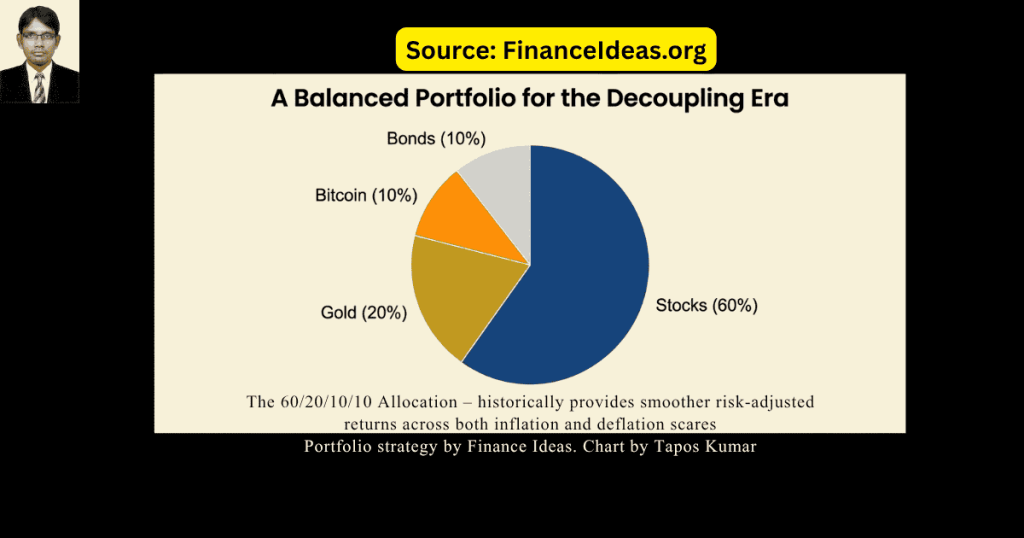
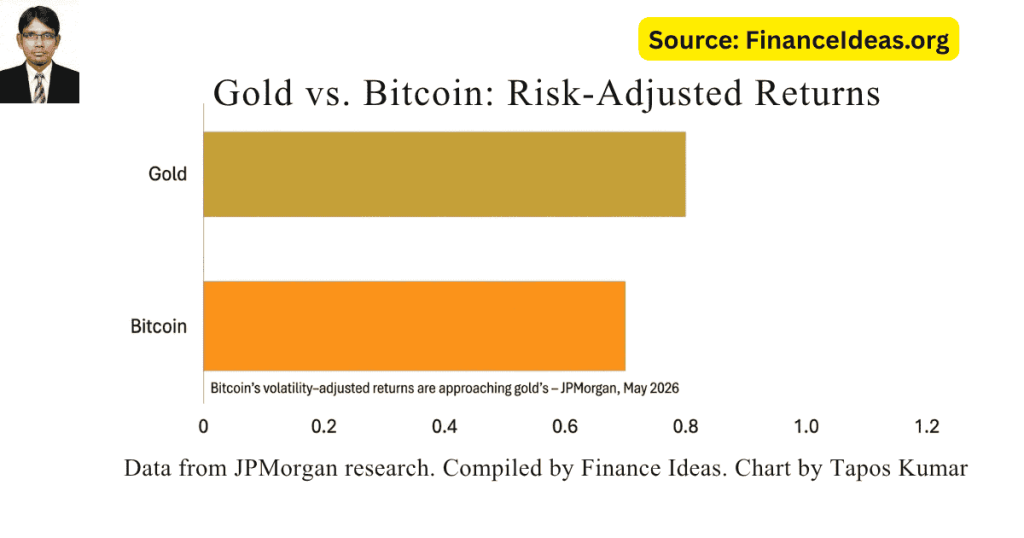
Second, consider a balanced allocation. JPMorgan analysts have noted that Bitcoin is becoming more attractive on a volatility-adjusted basis, but that does not mean abandoning gold. A 60/20/10/10 portfolio, i.e., 60% stocks, 20% gold, 10% Bitcoin, 10% bonds, may offer the best risk-adjusted returns for now to the 2030 period.
Third, use the right vehicles. For gold, consider physical gold ETFs like GLD or IAU. For Bitcoin, use spot ETFs like IBIT or GBTC. Avoid futures-based products due to contango costs.
Fourth, rebalance annually. If Bitcoin surges 100% in a year, take profits and reallocate to gold or bonds. If gold rallies during a geopolitical crisis, rebalance into Bitcoin at lower prices. The decoupling creates opportunities, but only if you are disciplined.
Finance Ideas TL; DR | Tapos Kumar
The Bitcoin-gold correlation collapsed to near zero and turned negative. Gold surged 65% in 2025-2026 as a traditional safe haven, while Bitcoin dropped 47% from its peak, weighed down by AI deflation fears and miner capitulation. Central banks are buying record amounts of gold, while institutional money is rotating back into Bitcoin ETFs. The two are not competitors; they hedge different risks. A 60/20/10/10 portfolio (stocks/gold/Bitcoin/bonds) may offer the best risk-adjusted returns for 2026-2030.
Frequently Asked Questions (FAQ) About Bitcoin vs. Gold?
Is Bitcoin or gold a better hedge against inflation?
Hmm, both, but for different inflation types. Gold hedges goods inflation (oil, food) driven by supply shocks. Bitcoin hedges monetary inflation (money supply expansion) driven by central bank policy. In recent years, goods inflation from the Iran war has favored gold.
Why did gold outperform Bitcoin?
Central banks bought record amounts of gold, but they cannot buy Bitcoin. The Iran war generated classic safe-haven demand. AI deflation fears weighed on Bitcoin as a risk asset. Therefore, two different drivers, two different outcomes.
What is the correlation between Bitcoin and gold right now?
Approximately 0.10 on a 30‑day rolling basis, according to BlackRock research. This is near zero, meaning the two assets move independently. In early weeks of recent years, the correlation turned negative also.
Can Bitcoin flip gold’s market cap by 2030?
Gold’s total market capitalization is approximately 19 trillion. Bitcoin is about 1.7 trillion. A 1,000% increase in Bitcoin would be needed to flip gold, hmm, possible but unlikely by 2030. A more realistic scenario is Bitcoin capturing 10‑20% of gold’s market cap by 2035.
What does the White House say about Bitcoin vs. gold?
Executive Order 14178 explicitly describes Bitcoin as digital gold and notes its fixed supply as a strategic advantage. The order established a Strategic Bitcoin Reserve, putting the U.S. government among the largest sovereign holders of Bitcoin.
How do central banks view Bitcoin vs. gold?
Most central banks are prohibited from holding Bitcoin. They buy gold instead, and they bought record amounts in recent years. This divergence is structural, not temporary, and will continue to favor gold for sovereign reserve managers.
Does the Bitcoin halving affect gold?
Hmm, no direct effect. The halving reduces Bitcoin’s supply issuance, which could support Bitcoin’s price over time. But gold’s market does not react to Bitcoin’s supply mechanics. The two markets are largely independent.
What happens to gold if the Fed cuts rates?
Lower rates reduce the opportunity cost of holding gold (no yield). That is bullish for gold. The European Central Bank already cut rates in May 2026, and markets expect the Fed to follow in September. This supports both gold and Bitcoin.
Is gold mining more environmentally friendly than Bitcoin mining?
No. Gold mining produces approximately 100‑150 million tons of waste annually, uses significant water resources, and leaves permanent landscape damage. Bitcoin mining’s environmental impact is concentrated in electricity consumption, which can be renewable. Both have environmental costs, but the comparison is not one-sided.
Can I hold both gold and Bitcoin in my IRA?
Yes. Gold IRAs have existed for decades. Bitcoin IRAs are newer but increasingly common through specialized custodians like iTrustCapital or via spot Bitcoin ETFs in mainstream IRA accounts. The DOL’s proposed 401(k) rule would expand crypto access to retirement plans.
What do Fidelity and BlackRock say about Bitcoin vs. gold?
Fidelity argues for getting off zero on Bitcoin as a portfolio diversifier. BlackRock describes Bitcoin as a global monetary alternative with a different risk profile than gold. Both see Bitcoin as complementary to gold.
Will the AI deflation trend affect gold?
Indirectly. If AI-driven job losses cause a credit crisis, the Fed will print money. Money printing is bullish for both gold and Bitcoin. The timing is important; Bitcoin may drop first as a risk asset, then rally hard on Fed action. Gold may be more stable throughout.
How often should I rebalance between gold and Bitcoin?
In my view, annually is sufficient for most long‑term investors. The decoupling creates opportunities, but attempting to time short‑term moves is risky. A simple annual rebalancing to target percentages (e.g., 10% Bitcoin, 20% gold) captures the benefits of diversification without excessive trading.
Tapos last thought
I don’t think BTC can replace gold, nor can gold replace Bitcoin. Gold is doing what gold has always done, i.e., protecting wealth during geopolitical anarchy, war, and oil shocks. Bitcoin is doing what Bitcoin was designed to do, i.e., providing a non-sovereign, fixed-supply monetary alternative to endless money printing.
Therefore, I recommend that you pick both. Gold for the world we cannot predict (wars, supply shocks, central bank buying), and Bitcoin for the world we can, i.e., monetary debasement, fiscal deficits, institutional adoption.
References & Sources
Below is the lists of sources that I have used to write this article:
- Executive Order 14178 – Strengthening American Leadership in Digital Financial Technology
- World Gold Council – Central Bank Gold Demand
- Executive Order 14233 – Establishment of the Strategic Bitcoin Reserve and United States Digital Asset Stockpile
Disclaimer
This is not a Sponsored post & the purpose of this article is only education. By reading this, you agree that the information of this blog article is not investing advice. Do your own research before making any financial decision. Therefore, if you lost any money, Finance Ideas will not be liable for this.