So, your first check arrived in late March. You felt it like a lifeline because you found a $30,000 check from the National Flood Insurance Program to rebuild your storm-damaged home.
Yeah, you had waited months. You had fought with paperwork. Finally, help had arrived. Bravo! Hard effort pays off finally.
Then, a day after you tried to deposit the check, the bank said, “The check wasn’t good.” The bank was investigating potential fraud. Sorrow! I can anticipate your frustration on your face. This money wasn’t real & the hope was fake. And you were left with nothing but a worthless piece of paper and the sinking realization that someone had stolen your recovery.
I imagine this story after analyzing federal data on why Florida is the fraud capital of the United States regarding flood insurance. Look, I am not degrading any states; I am just telling the facts. You could disagree with me & that is okay.
The purpose of this article is = To guide you about Flood insurance scams & fake agents in Florida. You may be a victim of this scam, or perhaps you are, and I am writing to help you avoid flood insurance scams.
Yeah, you have many questions. Perhaps feel tired of not getting a proper answer from prominent insurance or finance sites. It is also possible that the recommendations from your AI tools don’t work. Whatever the reasons, this article could be a blessing for you. Trust me! I will not waste your time. You will get solutions. Let’s start:
Finance Ideas AI snippet box | Tapos Kumar
What does the fraud crisis mean for Florida’s economy and housing market?
In my view, insurance fraud is a hidden tax on every Floridian. According to our study, insurance scams cost Floridians about $310 billion annually, & $10 billion is lost to post-disaster losses (our study is based on federal data). Our study is consistent with the findings of “The Coalition Against Insurance Fraud”. Their study estimates that insurance fraud costs at least $308.6 billion per year nationally, with upwards of $9.3 billion lost to post-disaster fraud alone.
Florida’s disproportionate share of litigation; 41% of national homeowners lawsuits, with under 5% of claims, drives up premiums for everyone. Finance Ideas found that average defense costs per claim dropped from $948 to $724 after litigation reform. However, litigated claims still cost an average of $15,261 to adjust, compared to just $2,046 for non-litigated claims. And, those costs are passed directly to policyholders.
Related articles
- The ABCs of Flood Insurance in Florida
-
Florida landlord flood disclosure: How One Florida Landlord Lost $30k
-
Increased cost compliance Florida: The $30,000 Hidden Benefit
-
Cobra zone flood insurance Florida: When Your Florida Home Can’t Get Federal Flood Insurance
-
Renters flood insurance Florida: Your Landlord’s Policy Won’t Save You
Finance Ideas conducted a survey to find out why Florida is the fraud capital for flood insurance?
As I previously said, Florida is the fraud capital of the United States, so I want to share federal data sources so that you can trust me. If you are a regular reader of my site, then you know I write based on federal data. I just added my professional experience with this data so that you can understand & make financial decisions.
Let’s read these data:
| Statistic | What it means for you? | Source |
| $866 million | Lost to fraud in Florida in 2024 alone; the highest in the nation | FTC |
| $710 million | Lost by Florida seniors (60+) to fraud in 2025 which is an 83% increase from 2024 | FBI/National Elder Fraud Report |
| $258 million+ | Stolen from Floridians aged 50 and over in 2025 | FTC/AARP |
| Over 50% | Of Florida disaster victims were targeted by scams within a month of the event | U.S. Census Data |
| 41% | Of all U.S. homeowners insurance lawsuits in 2025 came from Florida; down from 79% in 2020, but still disproportionate to the state’s under 5% share of national claims | Florida Office of Insurance Regulation |
| 41% | Of Hurricane Milton claims closed without payment were due to damage falling below deductibles | Florida Office of Insurance Regulation |
| 33.2% | Of Hurricane Helene claims closed without payment were due to sub-deductible damage | Florida Office of Insurance Regulation |
My personal opinion based on the above data: Florida files under 5% of the nation’s homeowners’ insurance claims but accounts for 41% of all related lawsuits nationwide. While litigation reform has cut Florida’s lawsuit share nearly in half since 2020, the state remains a disproportionate litigation hotspot. And when a storm hits, scammers follow; over half of Florida’s disaster victims are targeted within a month.
I detected the 7 most common flood insurance scams in Florida
Alright! You have learned enough about why Florida is the fraud capital. Now it is time to introduce some flood insurance scams. First, you have to accept that scammers can do any form of fraud. If you feel any doubts, just recheck.
Anyway. Below, we have described some flood insurance scams that frequently occur in Florida (we have collected these from similar cases & federal data so that you can trust us).
Take 1 Hugo Spritz, be cool & start reading them carefully:
1= Fake flood insurance policies and agents
Here, scammers create fake insurance websites, pose as agents, or sell bogus NFIP policies. Victims only discover the fraud when they try to file a claim and learn they have no coverage.
The warning signs:
You will experience the following:
- Unsolicited calls or emails offering amazing deals on flood insurance
- Agents who pressure you to buy immediately
- Payment requests via wire transfer, gift cards, or cryptocurrency
- Policies that seem too cheap to be true
Do this: Always verify agents (through the official site of My Florida license. I have shared the official link in the Reference section below) and call your insurance company directly to confirm any policy.
2 = Storm-chasing contractors
After a storm, unlicensed or dishonest contractors go door-to-door offering immediate repairs. They promise to handle the insurance claim or pressure homeowners to sign contracts on the spot. They take deposits and then disappear.
After Hurricane Ian in 2022, the Florida Attorney General’s office received hundreds of complaints about contractor fraud in Lee, Charlotte, and Sarasota counties alone. The same pattern followed Hurricane Helene and Hurricane Milton in 2024. And, as per our study, contractor fraud complaints in Florida now total thousands. So, beware of this fraud.
The warning signs:
You will notice the following activities:
- Demands for full payment up front
- Refusal to provide license or insurance information
- Creating urgency or fear-based pressure
- Offering to waive deductibles (which is illegal in Florida)
- Going door-to-door unsolicited
Do this: A legitimate contractor will provide a Florida license number. You can verify it on the official My Florida license site. Remember that Florida statute prohibits contractors from collecting more than 10% of a contract value as an initial deposit.
Mark my words: When a hurricane hits, the scammers are right behind the storm. They don’t wait for the debris to clear; they are knocking on doors before the water recedes.
3 = Fake FEMA inspectors and representatives
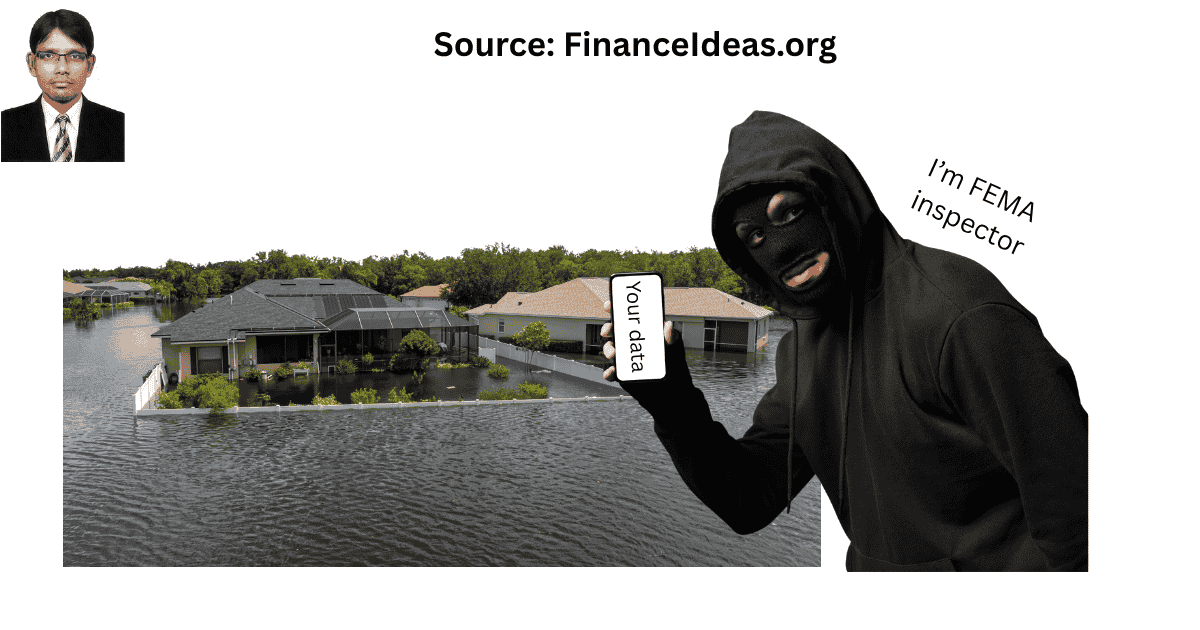
Here, scammers pose as FEMA inspectors or representatives to steal personal information, collect fees for assistance, or file fraudulent claims using stolen identities. They can claim to be there to help with your flood insurance claim.
The warning signs:
You will see:
- Unsolicited visits claiming to be from FEMA
- Requests for payment or personal information
- Pressure to sign documents immediately
- No official identification or credentials
Do this: FEMA never charges for disaster assistance. Real FEMA inspectors will have official identification and will not ask for money. So, I suggest you contact FEMA directly to verify any representative.
“The name of the game: move the money from the client’s pocket into your pocket.” – I just recall this from “The Wolf of Wall Street (2013)”. I love this quote because Mike Hanna perfectly explains the predatory nature of fraudulent business practices.
You might be astonished to see Hollywood; maybe thought I was reading a flood insurance scam. What does Hollywood do here? Like you, I am a human. I also feel bored because writing a finance article requires a high level of mental pressure. I just finished 7 cup coffee, & I don’t like to drink too much. Okay, come to the point.
You have learned the top 3 scams. Are you protected from predators? Let me know in the comments.
Meanwhile, I will explain other scams. Let’s read them:
4 = Assignment of benefits (AOB) abuse
Some scams involve asking homeowners to sign documents that transfer insurance rights to a third party. While AOB agreements can be legitimate, they are frequently abused. Once signed, the contractor or vendor can control the claim and billing, leading to inflated costs or disputes.
The warning signs:
Scammers will do the following:
- Contractors who want you to sign an AOB before the work starts
- Pressure to sign without reading the document
- Vague language about what you are giving up
Do this: Never sign an AOB without reading it carefully. If you don’t understand it, don’t sign it. Consult with your insurance company or an attorney first.
5 = Phishing emails and fake calls
Here, you will see emails, texts, or phone calls claiming to be from your insurer requesting personal or payment information. These messages often look official but contain subtle errors.
The warning signs:
You can mark the following signs as a warning:
- Unsolicited emails or calls asking for personal information
- Links to fake websites that look like your insurer’s site
- Urgent language demanding immediate action
- Requests for payment via unusual methods
Do this: Never click links or share information unless you have independently verified the source. Call your insurance company directly using the number on your policy, & do not use the number in the email or text.
6 = Overbilling and inflated repair claims
Even when work is completed, some bad actors inflate invoices or bill for unnecessary repairs. Yes, this can happen & this can lead to claim disputes, coverage cancellations, or policy non-renewals.
The warning signs:
You will notice:
- Estimates that seem unusually high
- Charges for work you didn’t authorize
- Invoices that don’t match the scope of work
Do this: Get multiple estimates. Document all work. Never authorize additional work without a written estimate.
7 = Fake crowdfunding and charity scams
Scammers create fake fundraising campaigns, steal photos from other disasters, and post emotional stories to solicit donations.
The warning signs:
You see the following:
- Campaigns that don’t identify the organizer
- Requests for cash or wire transfers
- Campaigns that seem too emotional or urgent
- No transparency about how funds will be used
Do this: Only donate to campaigns conducted by people you know. Research the charity before giving. Don’t assume that charities recommended on social media are legitimate.
So, I have explained 7 types of flood insurance scams. Now tell me, which type of fraud have you experienced? If you can manage a few seconds, then mention the name in the comments. It is also possible that you have encountered a completely different type of scam. If you don’t mind, can you share about it in the comments so I can learn from you too & be aware of my readers?
How to protect yourself from flood insurance scams in Florida?
“Truth is like poetry. And most people hate poetry.” – I really fell in love with this line from “The Big Short (2015)”. Let me tell you why.
In my opinion, scams succeed in insurance because people prefer comforting lies. Protection requires facing hard realities. So, I request you don’t ignore comfortable lies & prepare for hard realities.
If you read the above scams patiently, then this is the perfect time to learn about protection. We are human; so, fault is a natural quality that makes us mortal. So, this is uncontrollable, but we can limit it. Here, I will give you some protection steps that help you avoid scammers.
Mark my words: I can’t guarantee you 100%, & it is impossible. This is because fraud activity evolves, but my steps will help you detect that scam. Let’s read them:
Step-1 = Slow down: Scammers rely on urgency. So, I recommend you take time to review documents, get second opinions, and ask questions.
Step-2 = Verify before you trust: Confirm licenses, insurance credentials, and identities. Don’t rely solely on logos, uniforms, or business cards.
Step-3 = Never pay in full upfront: Reputable contractors typically require partial payments tied to completed work. Florida law caps deposits at 10%.
Step-4 = Don’t sign what you don’t understand: Read contracts carefully, especially anything involving claim rights or benefits.
Step-5 = Work through trusted channels: Contact your insurance company or agent directly to confirm next steps.
Step-6 = Check credentials: Verify contractor licenses (through the official My Florida License site; I have shared the official link in the Reference section below) and agent licenses through the Florida Department of Financial Services.
Step-7 = Document everything: Keep records of all communications, contracts, and payments.
My tips: If you don’t sign anything, then no one can take advantage of you. I just repeated “Florida CFO Jimmy Patronis’s quote & according to me, this is the best flood insurance scam protection.
Where to verify and report for flood insurance scam in Florida?
It is understandable that you have learned scam types, but how can you take immediate action? You are not a finance or insurance expert; you are a homeowner & I can understand your concern. By considering these issues, I have shared some Federal resources with brief summaries. It will help you take quick action. Let’s read them:
| Resource | Contact | What it does |
| Florida CFO’s Office | 1-877-MY-FL-CFO (1-877-693-5236) | Report scams, get help with claims, file complaints |
| Florida Office of Insurance Regulation | Floir site (I have shared official link in Reference section below) | File complaints about insurers, verify insurance companies |
| Florida Department of Financial Services | Verify agent licenses at My Florida license (I have shared official link in Reference section below) | Check if your agent or contractor is licensed |
| FEMA Direct | 1-800-621-3362 | Verify FEMA representatives, report fraud |
| Florida Attorney General’s Office | My Florida license (I have shared official link in Reference section below) | Report fraud, file consumer complaints |
| National Flood Insurance Program (NFIP) Direct | 1-800-638-6620 | Verify NFIP policies, report fraud |
Finance Ideas TL; DR | Tapos Kumar
Flood insurance scams in Florida are widespread, and they spike after every hurricane. Scammers pose as agents, adjusters, contractors, and FEMA inspectors to steal from homeowners at their most vulnerable moment.
The most common scams:
- Fake insurance agents sell bogus policies that don’t exist when you file a claim
- Storm-chasing contractors demanding full payment up front, then disappearing
- Fake FEMA inspectors are stealing personal information to file fraudulent claims
- Phishing scams pretending to be from your insurer
Your protection toolkit:
- Verify everything: Check agent licenses on the official My Florida License site. I have shared the official link in the Reference section below.
- Never pay upfront: Florida law caps deposits at 10% of contract value
- Don’t sign anything without reading it carefully
- Call your insurer directly to verify any communication
In short: Scammers thrive on urgency and fear. Slow down, verify, and never give money or personal information to someone who pressures you. If it feels wrong, it probably is.
Free downloadable resources without e-mail
- Florida flood insurance scam data report by Finance Ideas
- Florida disaster scam survivor checklist
- Florida Flood Insurance Scam Prevention Kit
Frequently Asked Questions (FAQ) about Flood insurance scams in Florida?
What should I do if a contractor asks for full payment up front?
Don’t pay. Florida law prohibits contractors from collecting more than 10% of a contract value as an initial deposit.
Are FEMA representatives fake?
Yes. Scammers pose as FEMA inspectors to steal personal information. Real FEMA inspectors have official identification and never ask for money.
What if I have already been scammed?
Contact the Florida CFO’s office at 1-877-MY-FL-CFO (1-877-693-5236). File a complaint with the Florida Office of Insurance Regulation and the Florida Attorney General’s Office.
What should I do if someone claiming to be from FEMA shows up at my door?
Ask for identification. FEMA never charges for disaster assistance. Call FEMA directly at 1-800-621-3362 to verify.
Why is Florida such a target for insurance scams?
In my view, Florida’s frequent hurricanes, large seasonal population, complex insurance policies, and high repair costs make it a prime target.
What is the single most important thing I can do to avoid flood insurance scams?
In my analysis, slow down. Scammers rely on urgency and fear. Take time to verify everything through official channels before signing anything or giving money.
Tapos’s last thought
Look, someone who has lost their home, their car, or their life savings shouldn’t also have to fight identity theft. But in Florida, that is what happens to thousands of storm victims every year.
I think Flood insurance scams are a cruel reality in Florida. They prey on people at their most vulnerable, after they have lost everything and are desperate for help.
Again, I am not disrespecting any states; I am just stating the facts.
My main purpose was to help you detect insurance fraud. I hope I help you. However, I am not an angel, so you naturally have more questions. Don’t worry, you can ask me in the comments & I would be glad to answer them. Good luck!
References & Sources
Below is the lists of sources that I have used to write this article:
- My Florida license
- Florida Office of Insurance Regulation (Floir)
- How to Spot and Avoid Imposter Scams
- FBI/National Elder Fraud Report
- U.S. Census Data
Disclaimer
The information provided in this article is author’s view & only for educational purposes. This is not a promotional post. By reading this, you agree that the information is not purchasing advice for flood insurance in Florida. Do your research before making any important financial decision. Therefore, Finance Ideas will not be liable for your financial loss.